

The Economic Balancing Act: India Resilience Against Global Volatility
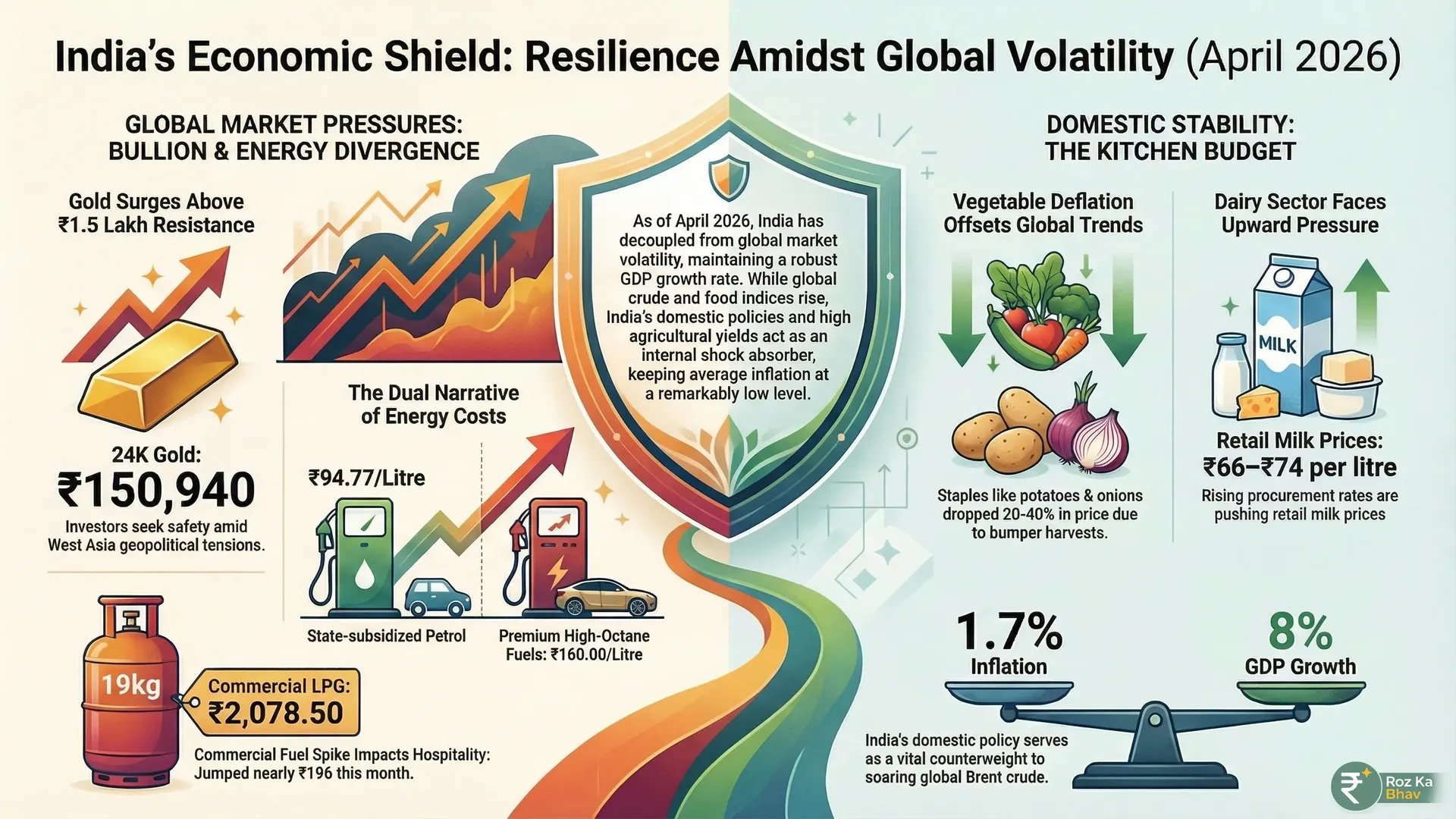
As the sun rose over New Delhi this Sunday, the atmosphere in the financial districts signaled a shift. We are witnessing a compelling trend where India is somewhat decoupling from the erratic swings of the global market. While Brent crude hovers near the $100 mark and international food prices climb, the domestic scene remains remarkably resilient it appears the Indian economy has developed its own internal shock absorbers over the last year.
The latest data from the
Economic Survey
indicates that India recently recorded a low inflation rate, averaging just 1.7% in the latter half of the previous fiscal year. This is a major milestone for the public, largely driven by a significant drop in Vegetable Price. Honestly: if someone predicted two years ago that we would achieve 8% GDP growth alongside such low inflation, it would have sounded like a pipe dream; yet here we are.
However, it is not all positive news. While your daily vegetables might be more affordable, gold is becoming a luxury of the highest order. The bullion market is where the real heat lies today; investors are flocking to gold as a safe haven, especially with ongoing tensions in West Asia involving the US, Israel, and Iran.
Bullion Market: Gold Tests the ₹1.5 Lakh Resistance
If you are planning a wedding this season, there is some challenging news for your budget. Gold has essentially cemented its position above the ₹1.5 lakh mark for 10 grams of 24K purity. It has been a volatile ride this April the month started even higher, but a slight correction led us to current levels. Gold is doing exactly what it is intended to do: acting as a hedge against global uncertainty.
Silver, meanwhile, is holding its ground near ₹250 per gram. It has not experienced the same vertical climb as gold recently, but it remains a favorite for industrial users and retail investors. Here is the breakdown of current jewelry market rates:
Note: Data based on 2026-04-05.
| Metal / Purity | Price per Gram | Price per 10 Grams | Daily Change |
|---|---|---|---|
| 24K Gold (99.9%) | ₹15,094 | ₹1,50,940 | Stable (+₹1) |
| 22K Gold (91.6%) | ₹13,836 | ₹1,38,360 | Stable (+₹1) |
| 18K Gold (75.0%) | ₹11,321 | ₹1,13,210 | No Change |
| Silver (99.9%) | ₹250 | ₹2,500 (10g) / ₹2,49,900 (1kg) | Stable |
Regional Gold Price Variations
Prices vary slightly depending on your location. Chennai remains the most expensive major metro for gold, largely due to local taxes and high demand. In Mumbai and Kolkata, the rate is roughly ₹15,093 for 24K, while Delhi is slightly higher at ₹15,108. It is interesting to see how local supply chains and state level levies create these small but noticeable price differences.
Energy Watch: Steady Fuel Pumps and Premium Hikes
Regarding fuel, there is a bit of a mixed bag for commuters. The government has managed to keep regular petrol and diesel prices flat. In Delhi, petrol remains at ₹94.77 per litre. This stability is largely due to a significant excise duty cut in late March, where the government essentially reduced its take to zero on diesel to keep the economy moving.
But there is a catch: the premium experience is getting expensive. If you use high octane fuels like XP100, you are now paying ₹160 a litre. Furthermore, if you prefer private pumps like Shell, be prepared for a higher bill; in Bengaluru, Shell is charging nearly ₹120 for regular petrol. State run companies IOCL, BPCL, and HPCL are currently absorbing massive losses to keep your daily commute affordable.
Note: Data based on 2026-04-05.
| Fuel Type | New Delhi | Mumbai | Bengaluru |
|---|---|---|---|
| Petrol (Regular) | ₹94.77 | ₹103.50 | ₹102.55 |
| Diesel (Regular) | ₹87.67 | ₹90.01 | ₹90.99 |
| CNG (per kg) | ₹77.09 | ₹79.50* | ₹83.20 |
*Approximate city rates based on local distribution.
LPG and Domestic Gas Updates
For the home kitchen, the 14.2kg domestic LPG cylinder price remains unchanged at ₹913. For beneficiaries of the PMUY scheme, the effective price is lower at ₹613. However, businesses are feeling the pressure; commercial LPG the 19kg blue cylinders jumped by nearly ₹196 this month, hitting ₹2,078.50. This is a trend to watch, as it eventually impacts restaurant bills and street food prices.
Kitchen Essentials: Vegetable Deflation vs. Dairy Hikes
This is where the economic story becomes personal. While the global food index (FAO) rose by 2.4% last month, India is actually seeing a deflationary trend in the vegetable market. According to recent reports from the
Times of India,
state governments like Punjab are increasing procurement rates to support farmers, but the retail market is currently seeing high supply.
Staples like potatoes, onions, and tomatoes have seen price drops between 20% and 40% compared to last year. It provides some relief for the monthly budget; however, milk is becoming more expensive. With procurement prices rising by ₹10 – 15 per kg of fat in major states, a morning glass of milk is likely to cost more as cooperatives pass on these costs.
Note: Data based on 2026-04-05.
| Item | Current Avg. Price | Trend |
|---|---|---|
| Onions (per kg) | ₹25 – ₹35 | Falling ▼ |
| Tomatoes (per kg) | ₹20 – ₹30 | Stable |
| Milk (Packaged, 1L) | ₹66 – ₹74 | Rising ▲ |
| Edible Oil (1L) | ₹145 – ₹160 | Moderating |
For the average consumer, the strategy is simple: utilize lower vegetable prices now to offset the rising costs of dairy and fuel. The Indian economy is growing at a robust 8%, which is excellent, but that growth brings its own pressures on currency and import costs.
Frequently Asked Questions
1. Why is gold so expensive in India today?
Gold prices are driven by global geopolitical tensions and the strength of the Rupee. As investors seek safety from conflicts in West Asia, demand spikes; this pushes prices to record highs above ₹1.5 lakh per 10 grams.
2. Will petrol prices go down soon?
It is unlikely in the short term. While the government cut excise duties to maintain stability, global crude remains near $100. State run companies are currently absorbing losses on every litre to protect consumers from higher rates.
3. Why are vegetable prices falling while other costs rise?
India has experienced a bumper harvest for many horticultural crops this season. High supply has led to a 20 – 40% drop in staples like onions and potatoes, even as dairy and global commodities become more expensive.
4. Is it a good time to invest in Silver?
Silver is currently more stable than gold, trading around ₹250 per gram. For long term investors, it offers a more affordable entry point into precious metals, though it lacks the aggressive growth gold has shown recently.
Source & Price Verification – Financial Markets
- Gold & Silver Prices: Data referenced from IBJA, MCX India, and international benchmarks.
- Petrol & Diesel Rates: Daily retail prices sourced from Indian Oil, HPCL, and BPCL.
- Commodity Market Data: Verified using MCX, NCDEX, and government statistical releases.
- Verification Process: Prices are cross-checked with at least two independent official or exchange-based sources before publication.
- Disclaimer: Market prices are indicative and may vary by city, tax structure, or intraday volatility.
Note: Prices are updated daily and cross-checked before publishing. If you notice any discrepancy, please email us at [email protected].