

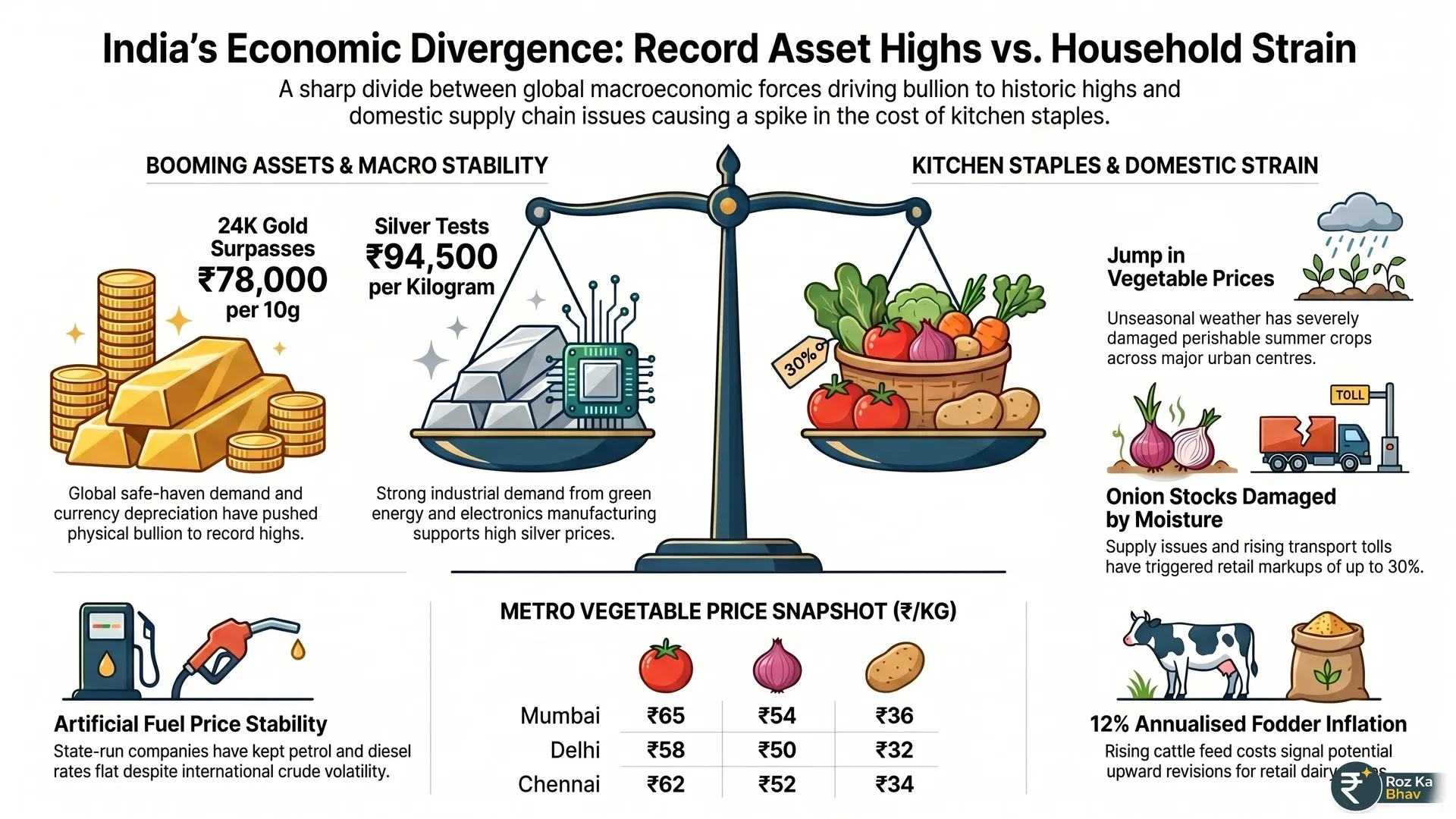
The landscape of the Indian economy today presents a fascinating, albeit challenging, case study in divergence. As macro headwinds alter capital flows globally, retail markets within the country are responding with highly localized volatility. On one hand, physical assets and safe-haven commodities like bullion are capturing record-breaking financial inflows, reflecting global anxieties and currency depreciation; on the other hand, the average consumer’s daily basket predicated heavily on kitchen staples, fresh produce, and public logistics is facing structural supply-side pressures.
What this means for your wallet is immediate and clear: tactical financial planning is no longer optional. While macro investors are celebrating a stellar rally in precious metals, the micro reality across major urban centers like Mumbai, Delhi, Bengaluru, and Chennai is defined by escalating kitchen operational costs. This comprehensive market report unpacks the underlying forces driving these pricing matrices, provides raw localized data, and offers an expert forward-looking trajectory for key consumer commodities.
Table of Contents
1. Bullion Market Today: Gold & Silver Technical Analysis
The gold rush of 2026 shows zero signs of fatigue. Today, the physical bullion markets in India recorded historic milestones, with 24-karat gold comfortably trading above the ₹78,000 per 10 grams threshold in primary trading hubs. Financial analysts on Dalal Street point out that a confluence of three distinct forces is engineering this relentless rally: protracted macroeconomic uncertainty in Western markets, aggressive net buying by central banks including the Reserve Bank of India (RBI), and a structurally weak Indian Rupee trading near all-time lows against the US Dollar.
Silver has mirrored this stellar upward trajectory, testing new resistance boundaries near ₹94,500 per kilogram. Industrial demand for silver particularly driven by India’s expanding green energy manufacturing sector, photovoltaic solar installations, and advanced electronics initiatives is heavily supplementing its traditional role as a monetary hedge. Retail jewelry buyers are increasingly feeling the pinch, leading to a visible shift toward lighter-weight ornaments and digital gold accumulation options.
City-Specific Bullion Breakdown
In Delhi, retail demand remains remarkably resilient despite the price shock, due to an ongoing extended wedding season; 24K gold settled at ₹78,450 per 10 grams today. Meanwhile, Mumbai, the financial nerve center, tracked global spot markets closely, listing 24K gold at ₹78,300 per 10 grams, with institutional bullion dealers reporting highly calculated volume trades.
Down south in Chennai, a market traditionally characterized by heavy physical gold consumption, prices saw an additional regional premium due to local logistics taxes, pushing 24K gold to ₹78,600. In Bengaluru, tech-driven retail demographics are actively turning to sovereign gold bonds and digital silver ETFs, even as physical 24K gold rates hovered around ₹78,380 per 10 grams.
Note: Data based on 2026-05-23.
| City | 22K Gold (per 10g) | 24K Gold (per 10g) | Silver (per 1kg) |
|---|---|---|---|
| Delhi | ₹71,910 | ₹78,450 | ₹94,500 |
| Mumbai | ₹71,770 | ₹78,300 | ₹94,350 |
| Chennai | ₹72,050 | ₹78,600 | ₹95,100 |
| Bengaluru | ₹71,840 | ₹78,380 | ₹94,400 |
2. India Fuel Prices: Petrol, Diesel, and CNG Trends
In contrast to the highly dynamic bullion counters, the Indian energy sector is reflecting artificial stability. State-run Oil Marketing Companies (OMCs) have largely held base prices for retail petrol and diesel steady today, continuing a prolonged policy of minimizing retail price shocks ahead of upcoming state assembly elections. This price freeze persists despite Brent crude oil bouncing unpredictably between $81 and $86 per barrel in the international marketplace due to production curbs by OPEC+ nations.
While petrol and diesel are shielded from direct daily international spikes, compressed natural gas (CNG) is witnessing incremental regional upward revisions. The Ministry of Petroleum and Natural Gas continues to optimize domestic gas allocation, but an increasing reliance on imported Liquefied Natural Gas (LNG) to power urban public transport networks is driving up municipal distribution costs.
City-Specific Energy Analysis
Drivers in Mumbai continue to navigate the highest fuel taxation bracket among Indian metros, with petrol holding firmly at ₹104.21 per liter and diesel at ₹92.15 per liter. The local municipal corporation is facing pressure from consumer groups to reduce state-level value-added taxes (VAT) to support commercial operators.
Conversely, Delhi benefits from a lower local tax infrastructure, keeping retail petrol prices at ₹94.72 per liter and diesel at ₹87.62 per liter. However, Delhi’s massive citywide CNG network saw a marginal price increment of ₹0.50 per kg, bringing the retail price to ₹75.59 per kg, which commercial auto-rickshaw unions warn could lead to fare hikes later this month.
In Bengaluru, transport fuel rates settled at ₹99.84 per liter for petrol, while Chennai consumers paid ₹100.75 per liter, highlighting the localized differences in state surcharges across India.
Note: Data based on 2026-05-23.
| City | Petrol (per Liter) | Diesel (per Liter) | CNG (per kg) |
|---|---|---|---|
| Delhi | ₹94.72 | ₹87.62 | ₹75.59 |
| Mumbai | ₹104.21 | ₹92.15 | ₹80.10 |
| Chennai | ₹100.75 | ₹92.34 | ₹82.50 |
| Bengaluru | ₹99.84 | ₹85.93 | ₹81.20 |
3. Kitchen Essentials Price Index: Vegetable and Dairy Inflation Tracker
The true pain point for the Indian consumer today lies within the retail agriculture markets. Basic kitchen essentials have recorded a steep upward curve over the last fortnight. Agricultural Produce Market Committees (APMCs) across the country report that unseasonal heatwaves followed by sudden, intense pre-monsoon showers have severely damaged standing summer crops, particularly perishables like tomatoes, onions, and green chilies.
Onion prices, which historically possess high political sensitivity, are trending upward because storage stocks from the previous rabi harvest suffered moisture damage. Logistics bottlenecks exacerbated by rising interstate transport toll fees have further prevented rural farm produce from arriving seamlessly at urban wholesale mandis, causing retail markups to swell by up to 30% in high-density residential areas.
In the dairy segment, major cooperatives like Amul and Mother Dairy have maintained standard milk pricing today, but underlying market indicators are flashing warning signs. Fodder inflation has registered a steady 12% annualized growth rate, forcing dairy farmers to demand higher procurement prices. While consumer milk packet prices remain steady this week, value-added products like ghee, butter, and cheese are experiencing quiet, marginal pricing adjustments across retail store shelves.
City-Specific Mandi Highlights
In Mumbai’s Vashi market, vegetable arrivals dropped by approximately 15% today, causing retail tomato prices to shoot up to ₹65 per kilogram. Delhi’s Azadpur Mandi one of Asia’s largest wholesale hubs saw heavy volatility in potato and onion supplies, driving retail onion prices to ₹50 per kg.
Wholesale traders in Chennai reported that supply lines from neighboring agricultural belts in Andhra Pradesh and Karnataka were delayed, pushing the average price of essential green vegetables up significantly. Bengaluru consumers are leaning heavily on quick-commerce delivery platforms, which are currently charging a 10 – 15% convenience premium over local street vendors for fresh organic produce.
Note: Data based on 2026-05-23.
| City | Tomatoes (per kg) | Onions (per kg) | Potatoes (per kg) | Standard Milk (per Liter) |
|---|---|---|---|---|
| Delhi | ₹58 | ₹50 | ₹32 | ₹66 |
| Mumbai | ₹65 | ₹54 | ₹36 | ₹68 |
| Chennai | ₹62 | ₹52 | ₹34 | ₹65 |
| Bengaluru | ₹60 | ₹48 | ₹30 | ₹64 |
4. Frequently Asked Questions (FAQs)
Source & Price Verification – Financial Markets
- Gold & Silver Prices: Data referenced from IBJA, MCX India, and international benchmarks.
- Petrol & Diesel Rates: Daily retail prices sourced from Indian Oil, HPCL, and BPCL.
- Commodity Market Data: Verified using MCX, NCDEX, and government statistical releases.
- Verification Process: Prices are cross-checked with at least two independent official or exchange-based sources before publication.
- Disclaimer: Market prices are indicative and may vary by city, tax structure, or intraday volatility.
Note: Prices are updated daily and cross-checked before publishing. If you notice any discrepancy, please email us at [email protected].
