Quick Summary: Today, May 26, 2026, India’s commodity markets witness a distinct divergence. While bullion builds on its secular bull run with gold trading near historical highs of ₹74,500 per 10 grams due to geopolitical strains, domestic fuel prices remain tightly anchored by strategic interventions. Meanwhile, seasonal heatwaves have sparked a sharp 18% spike in perishables across metropolitan wholesale hubs, leaving Indian households to navigate localized kitchen budget pressures even as structural macroeconomic frameworks hold firm.
India’s complex retail micro-economy is grappling with multi-force macroeconomic push-and-pull today. On one side, external macroeconomic tremors and escalating currency shifts continue to fuel an insatiable appetite for safe-haven assets, driving the domestic bullion complex toward historic resistance levels. Conversely, domestic regulatory measures have successfully isolated core fuel distribution systems from the worst of global crude market volatility. What this means for your wallet is an increasingly uneven cost landscape; while long-term investment portfolios benefit from soaring precious metal valuations, immediate monthly household ledgers are taking significant hits from sharp, climate-induced spikes in essential grocery items and regional dairy logistics.
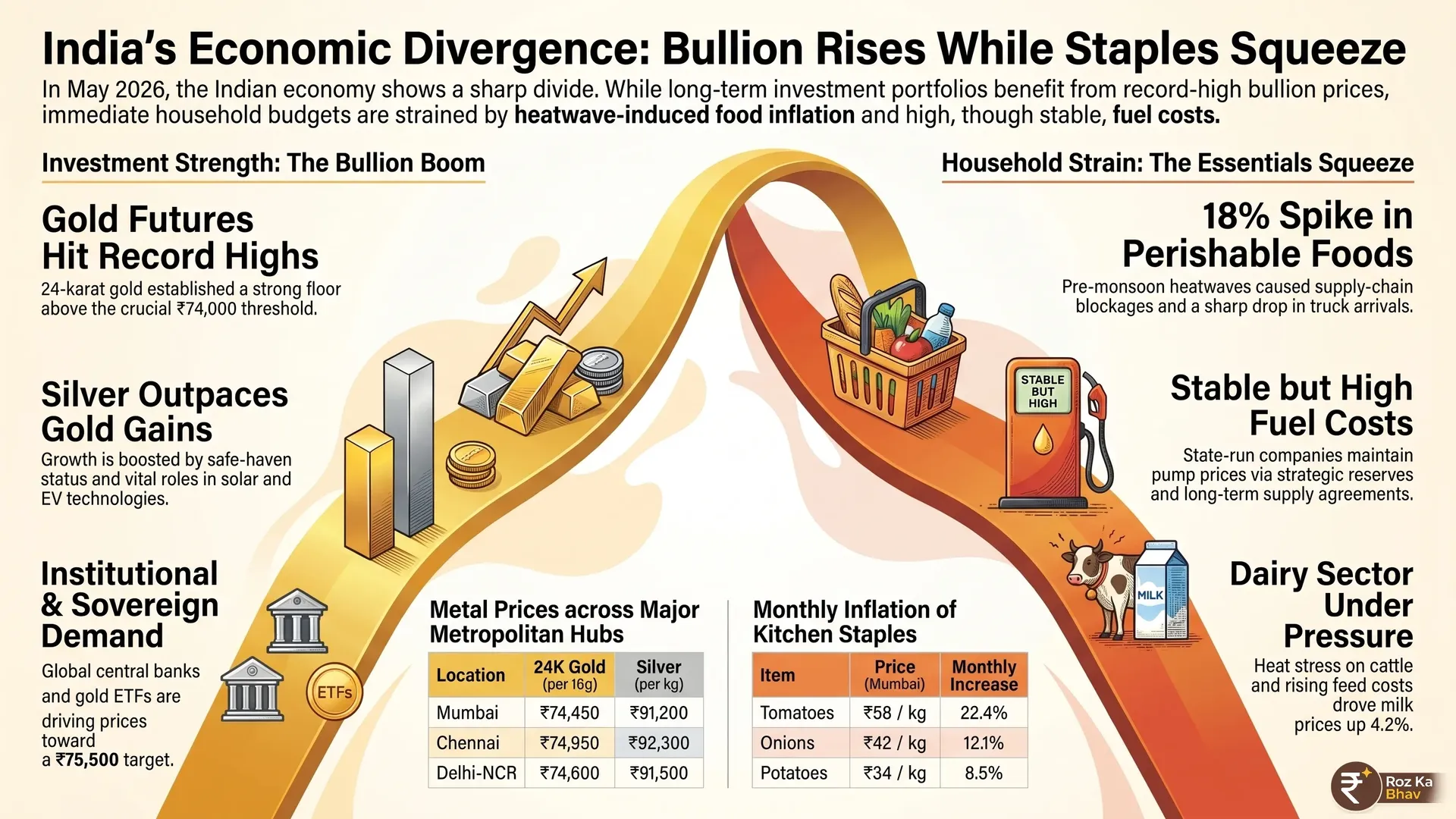
Infographic analyzing the retail market divergence in India on May 26, 2026, highlighting soaring bullion rates alongside stable fuel policies and rising food costs.
1. Bullion Market: Gold and Silver Price Analysis Today
The domestic bullion architecture continues to demonstrate incredible strength today, with gold futures on the Multi Commodity Exchange MCX firmly establishing a strong base above the crucial psychological threshold of ₹74,000 per 10 grams for 24-karat purity. Market analysts at Dalal Street note that the primary driver behind this relentless upward movement is a unique mix of systemic global risk, currency fluctuations, and aggressive asset diversification by institutional players.
As global central banks most notably the Reserve Bank of India continue to steadily increase their sovereign bullion reserves to hedge against long-term structural inflation, retail buyers find themselves competing against massive institutional demand curves. Silver has mirrored this upward trajectory with even greater percentage gains, driven by its dual identity as both a monetary safe-haven asset and a vital industrial component in modern photovoltaic solar installations and next-generation electric vehicle electronics.
Note: Data based on 2026-05-26.
City
24K Gold (per 10g)
22K Gold (per 10g)
Silver (per 1kg)
Mumbai
Status: Stable | Price: ₹74,450
₹68,250
₹91,200
Delhi-NCR
Status: Up 0.15% | Price: ₹74,600
₹68,400
₹91,500
Bengaluru
Status: Stable | Price: ₹74,480
₹68,280
₹91,100
Chennai
Status: Up 0.22% | Price: ₹74,950
₹68,700
₹92,300
Metro City Insights & Gold Technical Levels
In Mumbai, the financial heartbeat of the country, spot cash premiums have stabilized as local jewelry manufacturing hubs report a temporary cooling of physical demand, which is typical at these elevated price ranges. However, institutional gold exchange-traded funds ETFs managed out of Bandra-Kurla Complex: BKC have seen massive inflows, effectively offsetting any softening in retail counter sales.
Moving north to the Delhi-NCR market, physical retail margins remain slightly higher due to seasonal wedding delivery timelines. Bullion desks in Chandni Chowk report that affluent retail buyers are increasingly turning to structured accumulation plans, choosing to buy smaller, fixed-weight denominations rather than large, lump-sum purchases. Technical indicators track strong local support at ₹73,800, with a clear upward target toward ₹75,500 before the end of the current quarter. For real-time spot updates, investors can monitor the official Multi Commodity Exchange of India (MCX).
2. Energy Watch: Petrol, Diesel, and CNG Trends across India
In contrast to the high volatility seen in precious metals, the domestic retail fuel landscape offers a welcome sense of stability for Indian consumers. State-run Oil Marketing Companies OMCs including Indian Oil Corporation; IOCL, Bharat Petroleum; BPCL, and Hindustan Petroleum; HPCL, have held retail pump prices steady for another consecutive pricing cycle. This deliberate stability comes despite ongoing production cuts by OPEC+ and complex geopolitical challenges across vital maritime shipping corridors.
By utilizing a combination of strategic petroleum reserves, long-term bilateral supply agreements, and calibrated tax frameworks, policymakers have successfully insulated domestic commercial logistics from sudden external cost shocks. However, minor regional price differences persist across states, driven entirely by varying local Value Added Tax VAT structures, municipal octroi changes, and freight costs from coastal refining centers to inland distribution points.
Note: Data based on 2026-05-26.
City
Petrol (per Litre)
Diesel (per Litre)
CNG (per kg)
Mumbai
₹104.21
₹92.15
₹79.50
Delhi
₹94.72
₹87.62
₹74.00
Kolkata
₹103.94
₹90.76
₹82.00
Chennai
₹100.75
₹92.34
₹80.50
Regional Fuel Distribution & Retail Adjustments
For commuters and logistics providers in Mumbai, the fuel bill remains the highest among tier-one cities due to local sub-critical cess additions. Nevertheless, the local economy has found solid support in the expanded availability of compressed natural gas; CNG. Mahanagar Gas Limited has accelerated its retail footprint, encouraging commercial delivery fleets to rapidly transition away from diesel to protect operating margins.
In Delhi, retail fuel prices remain highly competitive within the National Capital Region, prompting a steady flow of cross-border refueling traffic from neighboring satellite cities in Haryana and Uttar Pradesh. Energy analysts highlight that while current retail price freezes shield the public, they are placing a heavy financial burden on OMC gross refining margins; GRMs. If global crude prices stay above $85 per barrel for another quarter, we will likely see a modest, post-monsoon calibration of around ₹2 to ₹3 per litre across both primary fuel variants.
3. Kitchen Essentials: Vegetable and Dairy Price Inflation
The most urgent and immediate financial pressure on the average Indian family today comes from the local retail food market. A combination of intense pre-monsoon heatwaves across key farming regions and sudden supply-chain blockages has caused significant inflation in perishable food items. Wholesale food distribution yards, such as Azadpur Mandi in Delhi and Vashi Mandi in Navi Mumbai, report a sharp drop in daily truck arrivals, driving up prices for daily essentials.
At the same time, the dairy sector is dealing with its own set of challenges. Rising costs for cattle feed, higher rural logistics expenses, and increased summer cooling costs for processing plants have forced major milk cooperatives to adjust their pricing. These changes are having a direct, cascading effect on downstream dairy products, including butter, ghee, and fresh paneer.
Note: Data based on 2026-05-26.
Commodity / Item
Mumbai Retail Avg
Delhi Retail Avg
Bengaluru Retail Avg
MoM Change (%)
Tomatoes (per kg)
₹58
₹64
₹52
+22.4%
Onions (per kg)
₹42
₹38
₹45
+12.1%
Potatoes (per kg)
₹34
₹30
₹36
+8.5%
Full Cream Milk (per L)
₹68
₹67
₹66
+4.2%
Agricultural Sourcing Dynamics in Urban Centers
In Bengaluru, agricultural traders note that the surrounding farming districts have been hit hard by changing rainfall patterns, requiring them to source vegetables from more distant locations. This extra travel directly increases transport costs, which are then passed along to consumers at neighborhood retail stores. To better understand these agricultural trends, readers can refer to detailed data updates provided by the Department of Consumer Affairs (India).
To handle these volatile prices, urban families are changing how they shop. Many are shifting their daily vegetable purchases to organized quick-commerce digital applications, which can often offer slightly better prices by sourcing directly from large agricultural hubs. However, for the broader population that relies on traditional local markets, the high cost of fresh vegetables is forcing a shift in monthly spending, requiring families to cut back on discretionary purchases to ensure their core nutritional needs are met.
4. Frequently Asked Questions (FAQ)
Q1: Why are gold and silver prices rising in India despite high domestic interest rates?
A: Domestic precious metal prices are primarily driven by international market dynamics, currency valuation adjustments, and geopolitical tensions. Even with high domestic interest rates, strong institutional buying by global central banks and a steady demand for reliable safe-haven assets keep the bullion market in a solid upward trend.
Q2: Will petrol and diesel prices drop if global crude oil values fall?
A: Not immediately. State-owned oil marketing companies must first recover accumulated under-recoveries from previous periods of high oil prices. Retail price drops happen only when international crude prices stay low for an extended period, and after accounting for central and state tax adjustments.
Q3: When can consumers expect Vegetable Prices to cool down across metros?
A: Retail vegetable prices are expected to stay elevated until the arrival and steady distribution of the monsoon rains across central and northern farming regions. Once the new harvest begins reaching main wholesale markets, prices should normalize by 15% to 25% within a few weeks.
Q4: Why are dairy cooperatives increasing milk prices during the summer months?
A: Milk production naturally declines during the peak summer months due to seasonal heat stress on dairy cattle. Combined with higher costs for cattle feed, increased electricity expenses for cold storage, and rising fuel costs for refrigerated transport, cooperatives must adjust retail prices to maintain supply chain efficiency.
Source & Price Verification – Financial Markets
Gold & Silver Prices: Data referenced from IBJA, MCX India, and international benchmarks.
Petrol & Diesel Rates: Daily retail prices sourced from Indian Oil, HPCL, and BPCL.
Commodity Market Data: Verified using MCX, NCDEX, and government statistical releases.
Verification Process: Prices are cross-checked with at least two independent official or exchange-based sources before publication.
Disclaimer: Market prices are indicative and may vary by city, tax structure, or intraday volatility.
🟢 Verified by Roz Ka Bhav Markets & Research Desk –
Last Checked:
Note: Prices are updated daily and cross-checked before publishing.
If you notice any discrepancy, please email us at
[email protected].
ROZ KA BHAV
Your Privacy Choices
Roz Ka Bhav uses necessary cookies for security and essential website functions. With your permission, we also use preference, analytics and advertising cookies to understand traffic, improve our content and show relevant advertisements. You can accept all optional cookies, reject them or manage your choices.
Choose which optional cookies Roz Ka Bhav may use. Necessary cookies remain active because they support security, consent storage and essential site functions.
Necessary
Always active
Required for website security, basic operation and remembering your privacy choice.
Preferences
Remembers optional choices and settings to make future visits more convenient.
Analytics
Helps us understand visits, traffic sources and content performance so we can improve the website.
Advertising
Allows advertising measurement and, where permitted, the delivery of more relevant advertisements.