

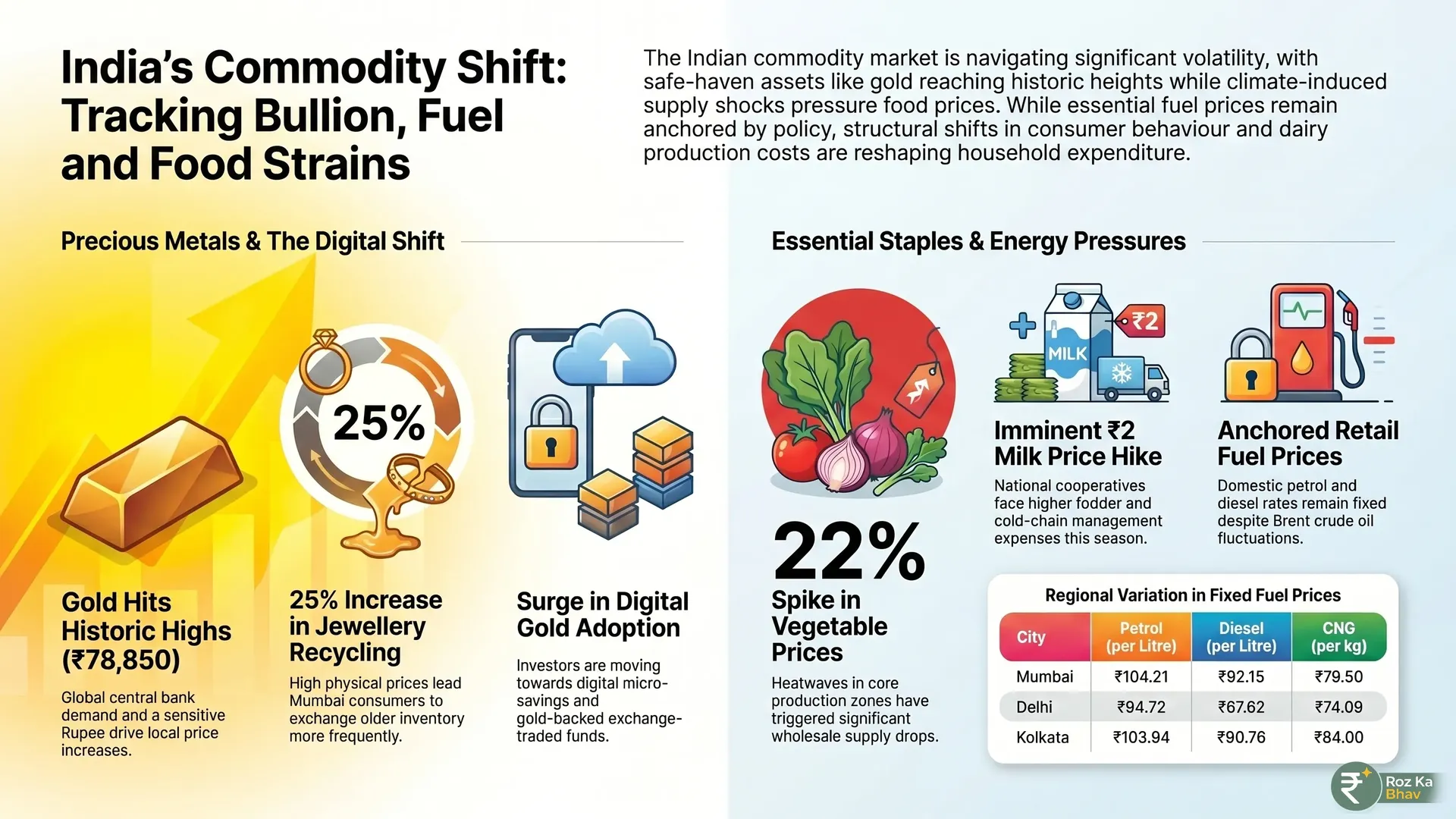
Quick Summary: Today’s Indian commodity markets witnessed historic volatility. Gold prices surged past ₹78,500 per 10 grams, driven by escalating global macroeconomic tensions and central bank accumulation. Concurrently, retail fuel rates remained flat across major metros due to prolonged policy pauses implemented by state-run oil marketing companies. However, extreme heatwaves in key logistics corridors triggered a 22% spike in perishable Vegetable Prices, severely impacting retail kitchen budgets. Dairy cooperatives also hinted at an impending ₹2/litre hike to offset rising fodder procurement expenditures, highlighting persistent inflationary pressures across domestic retail ecosystems.
The macroeconomic backdrop governing the Indian retail and wholesale commodity landscapes is navigating a challenging intersection of global monetary policies and domestic climate shocks. As international capital seeks refuge in hard assets, domestic bullion valuations are posting multi-month highs, disrupting conventional savings trends and consumer patterns ahead of peak regional demand. Concurrently, localized logistics bottlenecks and intense crop stresses are shifting consumer sentiment, forcing institutional analysts to reassess the short-term trajectory of core consumer inflation baskets.
What this means for your wallet is immediate and highly localized. While your recurring daily transport expenses remain well insulated by fixed baseline retail pricing for petrol and diesel, your flexible allocations for nutritional needs and wealth protection demand instant structural reconfiguration. Market analysts at Dalal Street emphasize that structural volatility is becoming the new normal, turning conventional household expense mapping into a dynamic operational challenge.
1. Bullion Market Trends: Gold and Silver Prices Reach Historic Heights
The domestic precious metals architecture is experiencing one of its most aggressive bullish expansion phases in recent memory. On the Multi Commodity Exchange (MCX), gold contracts for June delivery climbed sharply, establishing secure support lines well above historical averages. This rally mirrors the spot price consolidation in international markets, where overseas safe-haven buying accelerated due to macro uncertainties and lower yields in global fixed-income instruments. The sharp upswing leaves traditional jewellers, bullion dealers, and speculative traders operating in an uncharted, high-cost environment.
A major structural catalyst behind this rally is the ongoing balance sheet diversification by global central banks, which continue to aggressively accumulate physical gold reserves to mitigate exposure to currency volatility. For Indian buyers, this global dynamic is amplified by local currency variations; as the Indian Rupee trades within a narrow, sensitive range against the US Dollar, the landed import cost of dollar-denominated bullion climbs automatically, translating directly into premium pricing tiers across major domestic wholesale retail distribution networks.
Note: Data based on 2026-05-28.
| Metropolitan Region | Gold (24K / 10g) | Gold (22K / 10g) | Silver (per kg) | Intraday Shift (%) |
|---|---|---|---|---|
| Mumbai | ₹78,550 | ₹72,000 | ₹91,200 | +1.45% |
| Delhi NCR | ₹78,700 | ₹72,150 | ₹91,500 | +1.52% |
| Bengaluru | ₹78,600 | ₹72,050 | ₹91,100 | +1.38% |
| Chennai | ₹78,850 | ₹72,280 | ₹92,000 | +1.61% |
Metropolitan Analysis and Retail Responses
In Mumbai’s Zaveri Bazaar, overall trade data signals an explicit cooling of immediate physical delivery volumes. Retail shoppers are selectively deferring high-value acquisitions; however, recycling or exchanging older jewelry inventories has picked up by nearly 25% as households capitalize on premium valuations.
In contrast, the Delhi National Capital Region (NCR) presents a mixed landscape. Despite the retail price barrier, the current local auspicious wedding calendar ensures consistent structural demand. Families are adjusting buying behaviors by selecting lower karat variants or adopting lighter, contemporary designs to limit overall capital outflow while fulfilling traditional requirements.
Meanwhile, Chennai maintains its long-standing position as a dominant hub for high-volume physical bullion consumption. However, the premium on physical bars has experienced minor inflation over the past 48 hours, driven by tight local delivery mechanisms and the rigid procurement requirements of institutional regional buying groups.
2. Fuel Price Update: Petrol, Diesel, and CNG Rates Today
In stark contrast to the dramatic upswings defining the precious metals space, national retail energy price indicators remain firmly anchored. State-controlled Oil Marketing Companies (OMCs), including Indian Oil Corporation Limited (IOCL), Bharat Petroleum Corporation Limited (BPCL), and Hindustan Petroleum Corporation Limited (HPCL), have sustained an extensive pause on daily revisions for retail petrol and diesel. This localized price freeze stands out against global energy spot benchmarks, as Brent crude oil fluctuates unpredictably between $82 and $85 per barrel due to geopolitical shifts in international transit choke points and OPEC+ output constraints.
While this price stability provides predictable cost baselines for industrial supply chains and daily commuters, logistics operators emphasize that alternative transportation fuels, particularly Compressed Natural Gas (CNG), tell a more dynamic story. CNG adjustments are shifting in step with long-term term-gas allocations and the volatile pricing of imported Liquefied Natural Gas (LNG) spot cargoes used to meet domestic urban demand spikes.
Note: Data based on 2026-05-28.
| Metropolitan City | Petrol (per Litre) | Diesel (per Litre) | CNG (per kg) | Last Statutory Change |
|---|---|---|---|---|
| Mumbai | ₹104.21 | ₹92.15 | ₹79.50 | March 15, 2026 |
| Delhi | ₹94.72 | ₹87.62 | ₹74.09 | March 15, 2026 |
| Bengaluru | ₹99.84 | ₹85.93 | ₹82.50 | April 02, 2026 |
| Kolkata | ₹103.94 | ₹90.76 | ₹84.00 | March 15, 2026 |
Regional Arbitrage and Long-Term Projections
Even with stagnant base retail rates, subtle discrepancies in state-level Value Added Tax (VAT), infrastructure cesses, and localized dealer commissions continue to create noticeable discrepancies across borders. For instance, commercial transit fleets moving across the Delhi-Noida-Gurugram expressways frequently exploit these differences; they coordinate major fuel intakes to maximize savings from multi-rupee price variances between adjacent state borders.
Looking ahead, major domestic investment banks point out that OMCs are absorbing localized under-recoveries on retail diesel distribution to protect the broader Consumer Price Index (CPI) from secondary inflationary pressures. However, if international crude prices permanently breach the upper boundary of $88 per barrel, structural adjustments to the consumer price matrix will become inevitable to sustain corporate oil marketing balance sheets over the coming quarters.
3. Essential Food Inflation: Vegetable Prices and Dairy Market Updates
The primary pressure point on the daily purchasing power of urban Indian households remains centered within the agricultural mandis. Intense localized weather anomalies, marked by early heatwaves across production zones in Maharashtra, Karnataka, and Madhya Pradesh, have accelerated farm-gate spoilage rates while altering harvesting schedules. The resulting drop in wholesale arrivals at key urban Agricultural Produce Market Committee (APMC) sites has triggered sharp market fluctuations.
Core vegetable staples such as onions and tomatoes have broken through standard pricing ranges; at the same time, summer supplies of delicate green vegetables dropped by up to 30% over the last fortnight. This ongoing trend highlights the infrastructure deficits within India’s ambient cold chain storage and transport networks, leaving metropolitan end-consumers highly vulnerable to sudden seasonal supply disruptions.
Note: Data based on 2026-05-28.
| Crop Classification | Wholesale Band (per Quintal) | Avg Retail Pricing (per kg) | Month-on-Month Outlook |
|---|---|---|---|
| Onion (Nasik Grade-A) | ₹3,200 – ₹3,800 | ₹48 – ₹55 | ▲ Elevated Pressure |
| Tomato (Hybrid Selection) | ₹4,500 – ₹5,200 | ₹65 – ₹80 | ▲ Surging Impulses |
| Potato (Jyoti Variety) | ₹2,100 – ₹2,500 | ₹32 – ₹38 | ● Stable Trajectory |
| Okra / Bhindi | ₹5,000 – ₹6,000 | ₹70 – ₹90 | ▲ Moderate Increase |
Dairy Sector Adjustments and Consumer Impacts
The domestic dairy production ecosystem is facing parallel, structural cost adjustments. Prominent national and regional cooperatives, including Amul, Mother Dairy, and Nandini, are dealing with significant increases in fodder procurement costs, cattle feed commodities, and energy intensive cold-chain management during peak summer heatwaves. Primary dairy unions are reporting shrinking operating margins, driving coordinated appeals for revisions to baseline procurement price points.
As a result, major urban distributors are preparing a retail price adjustment of roughly ₹2 per litre across standard pasteurized milk variants (Full Cream and Toned) to offset upstream costs. These impending revisions will likely impact downstream value-added products, raising the baseline costs of items like paneer, curd, skimmed powders, and table butter ahead of festive manufacturing cycles.
4. Frequently Asked Questions (FAQs)
Source & Price Verification – Financial Markets
- Gold & Silver Prices: Data referenced from IBJA, MCX India, and international benchmarks.
- Petrol & Diesel Rates: Daily retail prices sourced from Indian Oil, HPCL, and BPCL.
- Commodity Market Data: Verified using MCX, NCDEX, and government statistical releases.
- Verification Process: Prices are cross-checked with at least two independent official or exchange-based sources before publication.
- Disclaimer: Market prices are indicative and may vary by city, tax structure, or intraday volatility.
Note: Prices are updated daily and cross-checked before publishing. If you notice any discrepancy, please email us at [email protected].
