

Indian retail and wholesale commodity markets are experiencing stark, divergent trends today. Global macroeconomic shifts, changing monetary policy signals, and localized weather disruptions are combining to alter household budgets and investment portfolios alike. Investors are adjusting to a stronger US dollar, while everyday consumers face rising costs for basic food supplies.
The Reserve Bank of India (RBI) continues to maintain a vigilant stance on domestic headline inflation, closely tracking volatile food pipelines that threaten to disrupt broader economic stability. Meanwhile, domestic fuel prices are displaying a period of calculated stability, shielded from international crude oil volatility by strategic state interventions and policy buffers. Understanding these shifts is crucial for managing your financial choices over the coming months.
Table of Contents
1. Bullion Market Analysis: Gold and Silver Rates Today
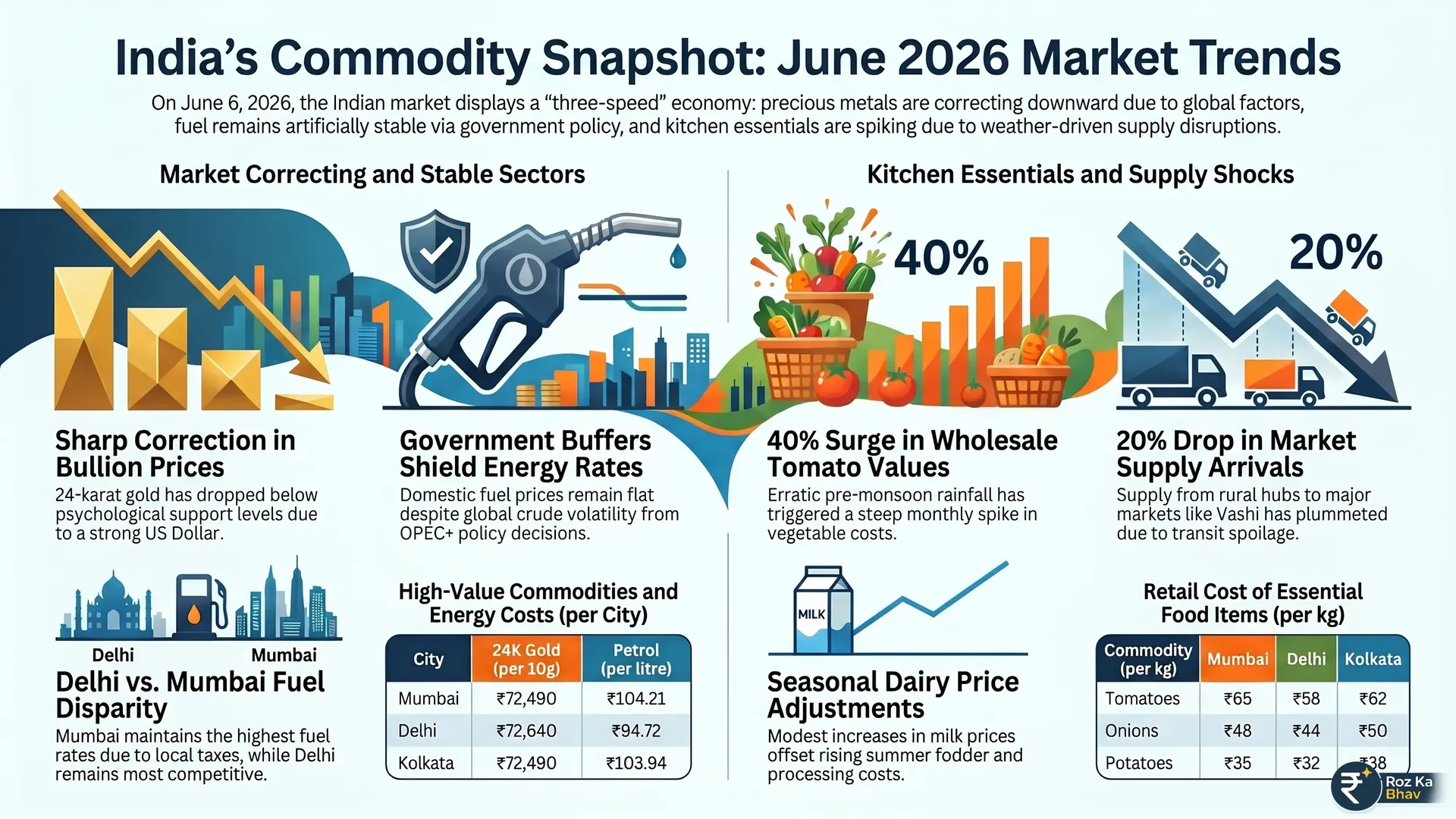
The domestic bullion market observed sharp corrections today, extending a downward path that has caught many retail buyers by surprise. In major physical trading hubs across India, 24-karat gold fell beneath key psychological support levels. This drop follows aggressive selling in international markets, driven by hawkish commentary from central banks abroad and an unexpected strengthening of the US Dollar Index (DXY).
Market analysts on Dalal Street note that the current correction is a logical response to global financial conditions rather than a drop in long-term structural demand. With international spot gold hovering lower, domestic jewelers report an immediate, steady uptick in foot traffic as retail buyers look to lock in lower prices ahead of the upcoming festival season. Silver followed a similar downward trajectory, with industrial demand indicators cooling slightly in response to slower manufacturing data out of major global economies.
Note: Data based on 2026-06-06.
| City | 22K Gold (per 10g) | 24K Gold (per 10g) | Silver (per 1kg) |
|---|---|---|---|
| Mumbai | ₹66,450 | ₹72,490 | ₹88,200 |
| Delhi | ₹66,600 | ₹72,640 | ₹88,200 |
| Chennai | ₹66,500 | ₹72,550 | ₹89,100 |
| Kolkata | ₹66,450 | ₹72,490 | ₹88,200 |
City-Specific Bullion Breakdown
In Mumbai, the financial hub, physical gold volumes remained high at Zaveri Bazaar despite the drop in value. Dealers reported that institutional hedging limited deeper local discounts. Delhi saw slightly higher retail premiums due to local logistical and transportation adjustments, keeping the capital’s prices marginally above the national average.
Down south in Chennai, silver maintained a distinct premium compared to northern hubs. This variation reflects deep-seated regional demand for heavy silverware and traditional wedding jewelry, which often keeps local physical silver premiums elevated even during global market pullbacks.
2. Energy Watch: Petrol, Diesel, and CNG Prices
In contrast to the volatile precious metals market, domestic fuel prices remained remarkably unchanged today. State-run Oil Marketing Companies (OMCs) – including Indian Oil Corporation (IOCL), Bharat Petroleum (BPCL), and Hindustan Petroleum (HPCL) – kept retail pump rates flat. This stability persists even as global Brent crude benchmarks show heightened volatility from production policy decisions by OPEC+.
What this means for your wallet is predictable commuting and logistics planning over the near term. However, transport unions warn that elevated base diesel rates are already keeping freight costs high, putting structural pressure on consumer goods companies. Meanwhile, Compressed Natural Gas (CNG) rates are showing a slight upward bias in city gas distribution networks due to changing domestic gas allocation policies.
Note: Data based on 2026-06-06.
| Metropolitan City | Petrol (per Litre) | Diesel (per Litre) | CNG (per Kg) |
|---|---|---|---|
| Mumbai | ₹104.21 | ₹92.15 | ₹89.50 |
| Delhi | ₹94.72 | ₹87.62 | ₹77.40 |
| Bengaluru | ₹102.84 | ₹88.95 | ₹82.00 |
| Kolkata | ₹103.94 | ₹90.76 | ₹84.50 |
Metropolitan Energy Dynamics
Mumbai continues to carry the highest fuel prices among tier-1 metros, primarily driven by higher state-level Value Added Tax (VAT) and local cess collections. This high cost of fuel increases operating pressures for local fleet operators and commercial delivery networks throughout the Mumbai Metropolitan Region.
Conversely, Delhi maintains the most competitive retail pricing among the four major metros. This lower pricing is a direct result of the local government’s lower tax structures on petroleum products. This tax gap keeps cross-border fuel smuggling a regular concern for filling stations located in neighboring regions like Noida and Gurugram.
3. Kitchen Essentials: Vegetable Prices and Dairy Inflation
The most immediate pressure on household budgets is the significant price increase inside Indian kitchens. Retail food inflation has picked up speed over the past few weeks. Erratic pre-monsoon rainfall across major agricultural hubs has delayed harvest timelines and caused substantial spoilage of perishable crops during transit.
Basic staples like tomatoes, onions, and potatoes have seen sharp price jumps at wholesale Agricultural Produce Market Committees (APMCs) nationwide. For instance; top-quality tomatoes have surged by nearly 40% in wholesale value over the past month. At the same time, major dairy cooperatives have implemented modest price increases to offset higher fodder and processing costs incurred during the summer peak.
Note: Data based on 2026-06-06.
| Commodity Item | Mumbai Retail Avg | Delhi Retail Avg | Kolkata Retail Avg |
|---|---|---|---|
| Tomatoes (per Kg) | ₹65 | ₹58 | ₹62 |
| Onions (per Kg) | ₹48 | ₹44 | ₹50 |
| Potatoes (per Kg) | ₹35 | ₹32 | ₹38 |
| Full Cream Milk (Litre) | ₹68 | ₹66 | ₹67 |
Urban Supply Center Analysis
In Mumbai’s Vashi market, supply arrivals from rural Maharashtra dropped by roughly 20% this week. This supply squeeze caused immediate price increases at local retail vegetable stalls in South Mumbai and the Western Suburbs, forcing families to adjust their weekly budgets.
Meanwhile, Delhi’s Azadpur Mandi one of Asia’s largest wholesale fruit and vegetable markets saw high price volatility for green chilies, coriander, and tomatoes. Inter-state supply lines from Himachal Pradesh and Punjab have been inconsistent, keeping retail prices high across the National Capital Region (NCR).
4. Frequently Asked Questions (FAQ)
For more detailed financial analysis and live commodity market tracking, you can review official market disclosures on the Multi Commodity Exchange of India (MCX) or explore macro policy updates directly from the Reserve Bank of India (RBI).
Source & Price Verification – Financial Markets
- Gold & Silver Prices: Data referenced from IBJA, MCX India, and international benchmarks.
- Petrol & Diesel Rates: Daily retail prices sourced from Indian Oil, HPCL, and BPCL.
- Commodity Market Data: Verified using MCX, NCDEX, and government statistical releases.
- Verification Process: Prices are cross-checked with at least two independent official or exchange-based sources before publication.
- Disclaimer: Market prices are indicative and may vary by city, tax structure, or intraday volatility.
Note: Prices are updated daily and cross-checked before publishing. If you notice any discrepancy, please email us at [email protected].
