

India’s domestic commodity landscape is navigating a complex crossroads today, marked by divergent trajectories across key asset classes. In the bullion pits, gold and silver are experiencing a substantial retraction, primarily pulled down by international macroeconomic currents. Strong employment indicators out of the United States, combined with persistent, hawkish commentary from Federal Reserve officials, have systematically crushed hopes for near-term interest rate cuts. This macro shift has re-energized the US Dollar Index (DXY) and sent Treasury yields higher, creating strong headwinds for non-yielding precious metals.
What this means for your wallet is highly dependent on where you look. While investors are finding attractive buying opportunities as precious metals drop from their recent historic peaks, daily household budgets face significant stress. At the same time, India’s domestic energy infrastructure continues to operate under controlled, rigid pricing models. Even as international Brent crude fluctuates sharply due to geopolitical tensions in Eastern Europe and the Middle East, domestic oil marketing companies (OMCs) have kept pump rates remarkably stable, providing a temporary shield against global energy shocks.
The most immediate risk to macroeconomic stability is currently playing out in local retail markets. A prolonged, intense summer heatwave across central, western, and northern agricultural Belts has disrupted traditional crop cycles. Essential kitchen staples: tomatoes, onions, and green chillies; are experiencing sharp, double-digit weekly price hikes due to falling arrivals at major Agricultural Produce Market Committees (APMCs). This supply-driven surge in food costs threatens to keep retail inflation sticky, presenting a continuous challenge for the Reserve Bank of India’s (RBI) monetary policy framework.
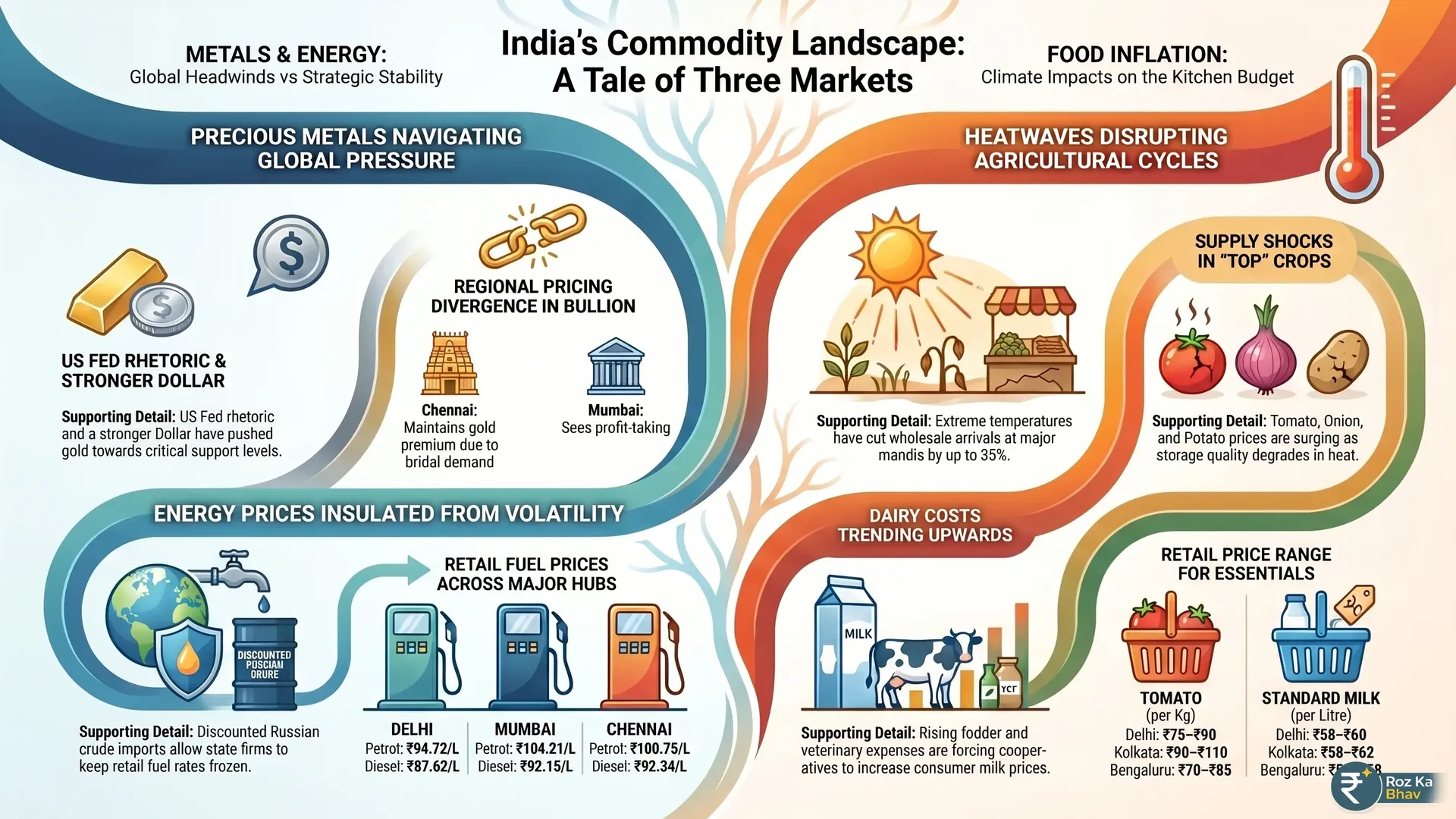
1. Bullion Market: Gold and Silver Price Trends
The domestic bullion market is undergoing a significant correction, driven by global financial dynamics. On the Multi Commodity Exchange (MCX), gold futures for August delivery dropped below critical psychological support lines, tracking a parallel move on COMEX where spot gold fell toward the $2,300 per ounce mark. The primary driver behind this sell-off is a fundamental shift in interest rate expectations. Stronger-than-expected economic data from developed nations has forced market participants to push back their timelines for central bank policy easing, supporting the dollar and making gold more expensive for holders of other currencies.
Market analysts at Dalal Street note that the recent pause in gold accumulation by major central banks, particularly the People’s Bank of China (PBOC), has removed a key structural pillar that drove gold to all-time highs earlier this year. Silver has experienced an even sharper decline due to its dual nature as both a financial and an industrial asset. Spot silver fell heavily toward the $29 per ounce threshold, impacting domestic MCX rates. Industrial demand from solar photovoltaic manufacturing and electronics sectors remains healthy, but near-term speculative positioning has pulled back sharply, leading to heightened volatility in local zari and industrial industrial hubs.
Note: Data based on 2026-06-08.
| City | 22K Gold (per 10g) | 24K Gold (per 10g) | Silver (per 1kg) |
|---|---|---|---|
| Mumbai | ₹65,850 | ₹71,840 | ₹87,500 |
| Delhi | ₹66,000 | ₹71,990 | ₹87,500 |
| Chennai | ₹66,450 | ₹72,490 | ₹91,100 |
| Kolkata | ₹65,850 | ₹71,840 | ₹87,500 |
| Bengaluru | ₹65,850 | ₹71,840 | ₹88,250 |
Detailed Metro City Analysis
In Delhi, retail jewelry hubs like Karol Bagh and Chandni Chowk report steady footfalls despite the correction, as consumers capitalize on lower prices ahead of the upcoming autumn wedding season. In contrast, Mumbai’s Zaveri Bazar is seeing a surge in institutional scrap inflows, with retail investors locking in profits from older holdings.
Further south in Chennai, the gold rate continues to command a premium due to strong regional demand for high-carat jewelry and bridal collections. Chennai’s silver prices also stay elevated relative to northern hubs, driven by steady demand from industrial units in neighboring electronics and automotive corridors.
2. Energy Watch: Petrol, Diesel, and CNG Market Trends
The domestic energy matrix remains remarkably stable, offering a contrast to the high volatility seen in global oil benchmarks. In international markets, Brent crude futures continue to trade within a volatile range between $78 and $84 per barrel. This volatility is driven by a balancing act between supply cuts from the OPEC+ alliance and concerns over slowing demand growth in major Western economies. However, Indian state-run Oil Marketing Companies (OMCs)—including Indian Oil Corporation (IOCL), Bharat Petroleum Corporation Limited (BPCL), and Hindustan Petroleum Corporation Limited (HPCL)—have left retail pump prices unchanged across major metropolitan areas.
This extended price stability highlights the structural buffer created by India’s strategic crude sourcing policies, which include increased imports of discounted Urals grade crude from Russia. This sourcing strategy has successfully insulated domestic consumers from direct exposure to global shipping disruptions in the Red Sea. Meanwhile, City Gas Distribution (CGD) networks have maintained a stable pricing structure for Compressed Natural Gas (CNG), providing relief to commercial transport fleets, auto-rickshaw networks, and urban commuters who rely on alternative fuels.
Note: Data based on 2026-06-08.
| City | Petrol (per Liter) | Diesel (per Liter) | CNG (per Kg) |
|---|---|---|---|
| Delhi | ₹94.72 | ₹87.62 | ₹74.09 |
| Mumbai | ₹104.21 | ₹92.15 | ₹89.50 |
| Chennai | ₹100.75 | ₹92.34 | ₹87.50 |
| Kolkata | ₹103.94 | ₹90.76 | ₹84.50 |
| Bengaluru | ₹102.84 | ₹88.95 | ₹82.50 |
Detailed Metro City Analysis
In Mumbai, fuel prices remain among the highest among tier-one metros due to local state value-added taxes (VAT) and municipal surcharges, maintaining pressure on logistics providers and commercial freight operators. Delhi benefits from a lower tax structure, allowing it to offer more competitive fuel rates within the National Capital Region (NCR). This price gap continues to shift refueling traffic from neighboring Uttar Pradesh and Haryana toward Delhi’s retail stations.
In Bengaluru, stable fuel and CNG pricing has provided predictable cost metrics for large ride-hailing and last-mile delivery fleets. This cost stability has helped mitigate wider inflationary impacts across the city’s fast-growing e-commerce and retail delivery sectors.
3. Kitchen Essentials: Vegetable and Dairy Price Surge Analysis
In sharp contrast to the stable energy markets and declining bullion prices, India’s retail food sector is dealing with severe supply-side inflation. Wholesale and retail prices for basic perishable vegetables have risen sharply over the past few weeks. This increase is primarily due to extreme weather patterns across major production centers. Extended heatwaves throughout Maharashtra, Karnataka, Madhya Pradesh, and Uttar Pradesh have reduced crop yields, lowered water table levels, and compromised the shelf life of mature crops during transit.
The impact is most visible in the pricing of the vital tomato-onion-potato (TOP) crop combination. tomato prices have more than doubled in several wholesale markets due to reduced supply from key growing regions like Kolar in Karnataka and Madanapalle in Andhra Pradesh. Onion prices are also under upward pressure as the high-moisture rabi harvest faces quality degradation in traditional storage facilities. Additionally, the dairy sector is experiencing steady cost increases, driven by rising procurement expenses for fodder, feed, and veterinary care, forcing major cooperatives to adjust consumer milk prices upward.
Note: Data based on 2026-06-08.
| City | Tomatoes (per Kg) | Onions (per Kg) | Potatoes (per Kg) | Standard Milk (per Liter) |
|---|---|---|---|---|
| Delhi | ₹75 – ₹90 | ₹50 – ₹65 | ₹35 – ₹45 | ₹58 – ₹60 |
| Mumbai | ₹80 – ₹100 | ₹55 – ₹70 | ₹40 – ₹50 | ₹60 – ₹64 |
| Chennai | ₹85 – ₹105 | ₹52 – ₹68 | ₹38 – ₹48 | ₹56 – ₹62 |
| Kolkata | ₹90 – ₹110 | ₹60 – ₹75 | ₹42 – ₹52 | ₹58 – ₹62 |
| Bengaluru | ₹70 – ₹85 | ₹48 – ₹60 | ₹35 – ₹42 | ₹54 – ₹58 |
Detailed Metro City Analysis
In Kolkata, vegetable markets are seeing high price volatility due to supply disruptions from neighboring districts and increased logistical costs for inter-state shipments. Local authorities are monitoring the situation closely to prevent speculative hoarding at major distribution hubs. Meanwhile, in Chennai, reliance on supply links from southern Andhra Pradesh and interior Tamil Nadu has exposed the retail market to immediate climate impacts, keeping Vegetable Prices at a premium.
In Delhi, wholesale inflows at the Azadpur APMC mandi have dropped by nearly 30 – 35% for key perishables. This supply shortfall has triggered a chain reaction through local retail vendors, weekly markets, and quick-commerce delivery platforms, leading to varying price premiums across different neighborhoods.
Frequently Asked Questions (FAQs)
1. Why are gold and silver prices falling sharply in India today?
Domestic precious metal prices are adjusting downward in response to global macroeconomic data. Strong economic and employment indicators from the United States have reduced market expectations for near-term interest rate cuts by the Federal Reserve. This has supported the US Dollar and pushed Treasury yields higher, reducing investor demand for non-interest-bearing assets like gold and silver.
2. Why do petrol and diesel prices remain unchanged despite global oil volatility?
Indian state-owned oil marketing companies maintain steady retail fuel prices by balancing international crude fluctuations against long-term supply arrangements. Increased access to diversified, cost-effective crude imports has helped insulate the domestic retail market from daily volatility in global benchmarks like Brent crude.
3. What is causing the sudden spike in vegetable prices across metro cities?
The recent increase in vegetable prices is primarily driven by supply chain disruptions caused by extreme seasonal weather and intense heatwaves across major agricultural belts. These weather conditions have reduced crop yields, impacted transport logistics, and led to a significant drop in wholesale arrivals across major domestic mandis.
4. How are dairy prices impacting overall household food inflation?
Dairy prices are facing upward pressure due to rising operational costs, including higher expenses for cattle feed, fodder, and processing. Because dairy is a primary source of protein and a daily staple for Indian households, these steady increases contribute directly to core food inflation metrics.
Source & Price Verification – Financial Markets
- Gold & Silver Prices: Data referenced from IBJA, MCX India, and international benchmarks.
- Petrol & Diesel Rates: Daily retail prices sourced from Indian Oil, HPCL, and BPCL.
- Commodity Market Data: Verified using MCX, NCDEX, and government statistical releases.
- Verification Process: Prices are cross-checked with at least two independent official or exchange-based sources before publication.
- Disclaimer: Market prices are indicative and may vary by city, tax structure, or intraday volatility.
Note: Prices are updated daily and cross-checked before publishing. If you notice any discrepancy, please email us at [email protected].