

The macroeconomic landscape in India presents a complex mix of global trends and localized supply bottlenecks today. As investors analyze the latest policy commentary from international central banks, domestic equity and commodity segments are pricing in risk premiums accordingly. The immediate impact on household wallets is clear: while macro hedges like precious metals stay anchored near lifetime highs, micro realities like the cost of daily meals face upward pressure from logistics challenges and uneven seasonal yields.
Market analysts on Dalal Street point out that the resilience of the Indian rupee against an aggressive US dollar index has partially insulated the domestic economy from imported energy inflation. However, structural friction within internal logistics corridors keeps urban retail food networks vulnerable to sudden price spikes. Investors and everyday consumers must navigate a financial environment where long-term investment asset stability contrasts sharply with short-term cost of living volatility.
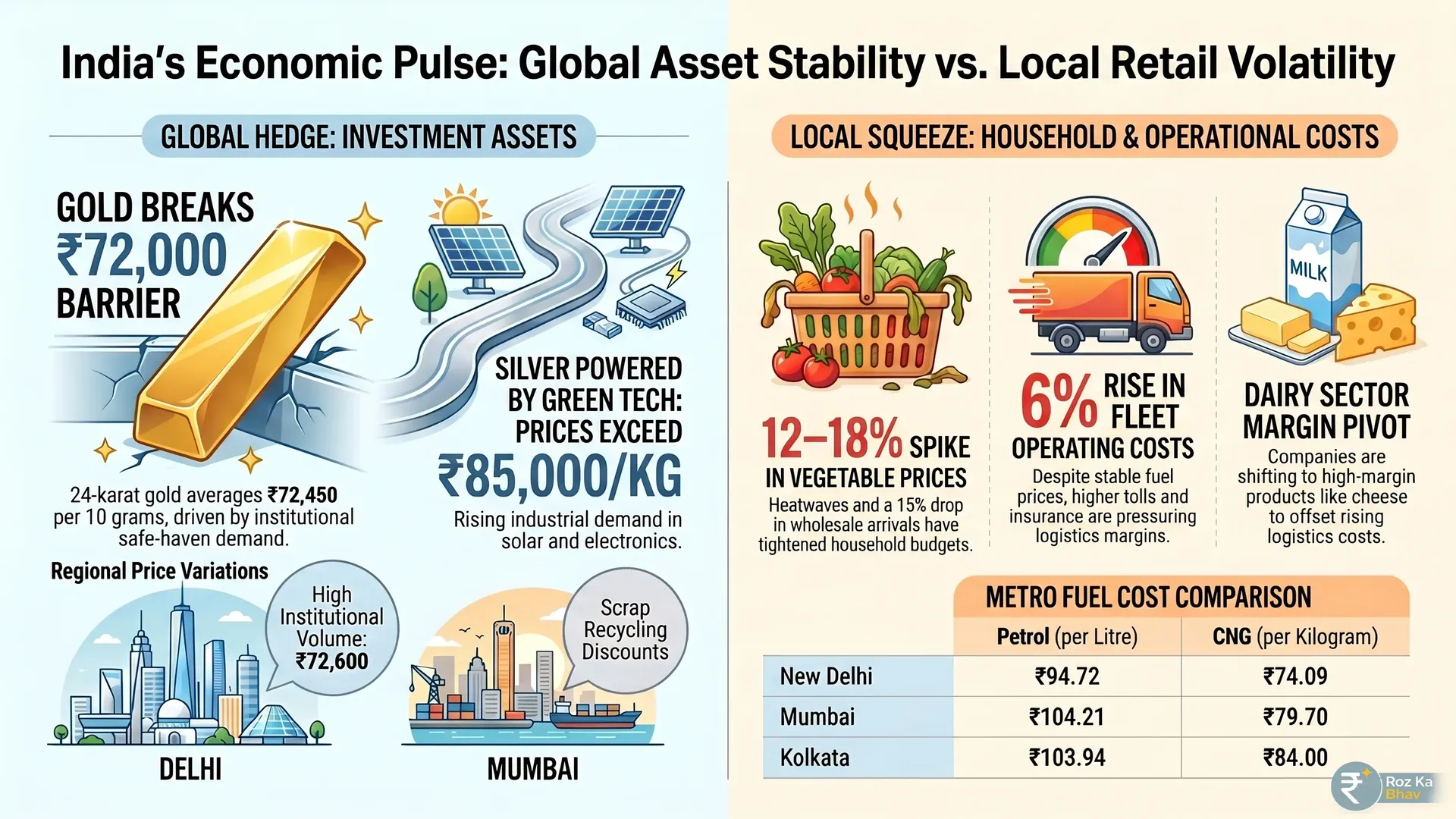
1. Gold and Silver Price Analysis: Bullion Trends Today
Precious metals maintained an upward bias through early morning trade today, reflecting sustained safe-haven demand on the global stage. Institutional buyers across India are increasing defensive allocations as international equity markets experience heightened volatility. Financial institutions indicate that the floor for gold has firmly shifted higher, supported by structural buying programs from global central banks looking to diversify reserves away from traditional paper currencies.
In physical retail markets across India, 24-karat gold holds steady above the psychological milestone of ₹72,000 per 10 grams. This high-valuation phase tests retail consumer demand, particularly during traditional wedding and festive purchase windows. Physical jewelers report a shift in consumer preferences, with many buyers opting for lower-karat options or exchanging older holdings to offset the increased capital outlay required for new pieces.
Silver mirrors the strength of gold, supported by expanding industrial applications in green energy technologies alongside its traditional role as a monetary store of value. Growing demand from solar photovoltaic and electronics manufacturing sectors across Western India keeps physical silver spot prices well above ₹85,000 per kilogram. Analysts forecast that silver will continue to show higher volatility than gold, presenting both risks and opportunities for short-term derivative traders.
Note: Data based on 2026-06-11.
| Commodity & Purity | Standard Base Unit | Average Retail Price (INR) | Daily Percentage Change | Primary Market Driver |
|---|---|---|---|---|
| Gold (24-Karat) | 10 Grams | ₹72,450 | +0.34% | Safe-haven positioning |
| Gold (22-Karat) | 10 Grams | ₹66,410 | +0.31% | Retail jewelry alignment |
| Silver (Fine) | 1 Kilogram | ₹85,800 | +0.52% | Industrial & green tech demand |
Gold Rates Today in Major Indian Cities
In Delhi, retail 24-karat gold prices hover around ₹72,600 per 10 grams, driven by high institutional volume and a concentration of high-net-worth retail buyers. Meanwhile, Mumbai’s Zaveri Bazar reported a slight spot discount of ₹150 per 10 grams due to high volumes of scrap gold recycling, which temporarily improved local liquid supplies.
Across southern hubs like Bengaluru and Chennai, physical delivery requests remain steady despite the elevated price environment. Southern markets continue to lead overall volumes for physical gold bars, as traditional investment habits favor physical assets over electronic exchange-traded funds (ETFs). Traders in these cities anticipate that prices will remain in this consolidated range until clearer signals emerge from upcoming macroeconomic policy data releases.
2. Fuel Rates in India: Petrol, Diesel, and CNG Trends
On the energy front, domestic retail prices for petrol and diesel remain stable, offering a predictable anchor for the wider transportation sector. This pricing consistency comes as international crude benchmarks, specifically Brent crude, fluctuate within a band of $81 to $84 per barrel. State-owned Oil Marketing Companies (OMCs) continue to balance their past downstream recovery margins against current international refining spreads, resulting in stable prices at consumer pumps.
While retail liquid fuel prices stay flat, compressed natural gas (CNG) distribution networks face minor regulatory pricing pressure. This stems from variations in the allocation of cheaper domestic administrative price mechanism (APM) natural gas to city gas distribution firms. The resulting shortfall is filled with imported liquefied natural gas (LNG); this exposes public transit networks to international price swings and creates localized margin pressure for operating companies.
Note: Data based on 2026-06-11.
| Metropolitan Center | Petrol (Per Liter) | Diesel (Per Liter) | CNG (Per Kilogram) | Last Pricing Revision |
|---|---|---|---|---|
| New Delhi | ₹94.72 | ₹87.62 | ₹74.09 | Stable over 24 Hours |
| Mumbai | ₹104.21 | ₹92.15 | ₹79.70 | Stable over 24 Hours |
| Kolkata | ₹103.94 | ₹90.76 | ₹84.00 | Stable over 24 Hours |
| Chennai | ₹100.75 | ₹92.34 | ₹81.50 | Stable over 24 Hours |
Regional Fuel Logistics and Alternative Energy Adaptation
In Mumbai, the higher tax structure on petroleum products keeps pump prices elevated compared to the national capital. This cost difference ripples through local delivery networks, putting pressure on intra-city logistics providers. Commercial fleet owners in Maharashtra are expanding their adoption of electric and alternative-fuel light commercial vehicles to protect operating margins from high liquid fuel overheads.
In the eastern hub of Kolkata, industrial consumers monitor natural gas allocations closely. High fuel costs in neighboring manufacturing hubs have increased shipping expenses for industrial goods arriving from the hinterland. Energy consultants suggest that while OMCs have the financial buffer to absorb short-term global crude spikes, any sustained move past $88 per barrel would likely require a direct adjustment to retail consumer prices across all states.
3. Kitchen Essentials and Food Inflation: Vegetable and Dairy Prices
The agricultural sector shows sharp daily price fluctuations, with urban consumers bearing the brunt of a sudden rise in fresh produce costs. Wholesale arrivals at major Agricultural Produce Market Committees (APMCs) like Azadpur in Delhi and Vashi in Navi Mumbai dropped by nearly 15% this week. This decline is largely due to intense heatwaves in key growing regions, which reduced harvest yields and caused heat damage to perishable crops during transit.
Basic vegetables like onions, tomatoes, and potatoes see strong upward price momentum. Cold storage owners explain that while potato stocks remain adequate, the costs to run cooling equipment during peak summer heat have risen sharply, driving up storage fees. At the same time, leafy green vegetables face short supply cycles, causing retail shelf prices to double in some suburban micro-markets within just forty-eight hours.
The dairy market offers a more stable outlook, though it faces structural cost challenges of its own. Major cooperatives note that higher feed costs keep procurement expenses elevated. While retail milk prices stayed flat over the last 24 hours, companies are shifting focus toward higher-margin products like cheese, butter, and ice cream to offset lower returns on liquid milk distribution.
Note: Data based on 2026-06-11.
| Product Classification | Standard Quantity | Wholesale Price Range | Urban Retail Price Range | Supply Chain Outlook |
|---|---|---|---|---|
| Onions (Nasik Grade) | 1 Kilogram | ₹32 – ₹38 | ₹50 – ₹62 | Tight supply until next harvest |
| Tomatoes (Hybrid) | 1 Kilogram | ₹40 – ₹48 | ₹65 – ₹80 | High heat damage risks |
| Potatoes (Jyoti/Jyoti-Mix) | 1 Kilogram | ₹22 – ₹26 | ₹36 – ₹45 | Relying on cold-storage releases |
| Standard Toned Milk | 1 Liter | ₹48 – ₹50 | ₹56 – ₹58 | Stable supply, high inputs |
Retail Food Squeeze Across Consumer Hubs
In New Delhi, retail vegetable markets face considerable price pressure, with tomatoes reaching up to ₹80 per kilogram in premium residential pockets. Local street vendors blame these high rates on reduced supply lines from neighboring states like Haryana and Uttar Pradesh, where extreme weather conditions affected early crop picking schedules.
In Bengaluru, agricultural supplies stay relatively resilient due to steadier inflows from rural Karnataka distribution points. However, retail prices for fresh items still carry an 8% premium over wholesale baselines due to rising last-mile delivery costs. Consumer rights groups advise shoppers to use state-backed cooperative retail outlets, which offer direct sourcing from farmers to help bypass middleman markups during supply squeezes.
4. Frequently Asked Questions (FAQ)
Q1: Why are retail gold prices remaining high in India despite weak local physical demand?
Answer: Domestic gold pricing is primarily tied to international spot markets and global currency shifts. Even when local retail demand slows due to high prices, steady buying from global central banks, international inflation concerns, and geopolitical tensions keep global gold values strong; this directly translates to high prices in India, amplified by local import duties and taxes.
Q2: Is there any expectation of a reduction in domestic petrol and diesel prices soon?
Answer: Retail oil prices are managed by state-owned Oil Marketing Companies based on multi-week Brent crude price averages. While current global prices around $82 per barrel keep fuel distribution profitable, companies use these steady margins to balance out earlier losses from high-price cycles. As a result, a retail price cut is unlikely unless international crude falls below $75 per barrel for an extended period.
Q3: What factors are driving the sharp increase in vegetable prices across metros this month?
Answer: The current spike is mainly caused by severe weather conditions in key agricultural belts, which reduce crop yields and shorten the shelf life of fresh produce. These supply drops are made worse by higher transit losses from summer heat and rising transport costs, causing wholesale price increases to pass quickly to urban retail consumers.
Q4: Are milk and dairy prices expected to rise further in the coming quarter?
Answer: Dairy cooperatives deal with higher overall production expenses, driven by rising cattle feed costs and more expensive cold chain logistics. While they keep liquid milk prices steady for now to protect consumer demand, any further increases in feed or transport costs may lead to minor retail adjustments of ₹1 to ₹2 per liter later in the year.
Source & Price Verification – Financial Markets
- Gold & Silver Prices: Data referenced from IBJA, MCX India, and international benchmarks.
- Petrol & Diesel Rates: Daily retail prices sourced from Indian Oil, HPCL, and BPCL.
- Commodity Market Data: Verified using MCX, NCDEX, and government statistical releases.
- Verification Process: Prices are cross-checked with at least two independent official or exchange-based sources before publication.
- Disclaimer: Market prices are indicative and may vary by city, tax structure, or intraday volatility.
Note: Prices are updated daily and cross-checked before publishing. If you notice any discrepancy, please email us at [email protected].