

Table of Contents
1. India Macroeconomic Outlook & GDP Shifts
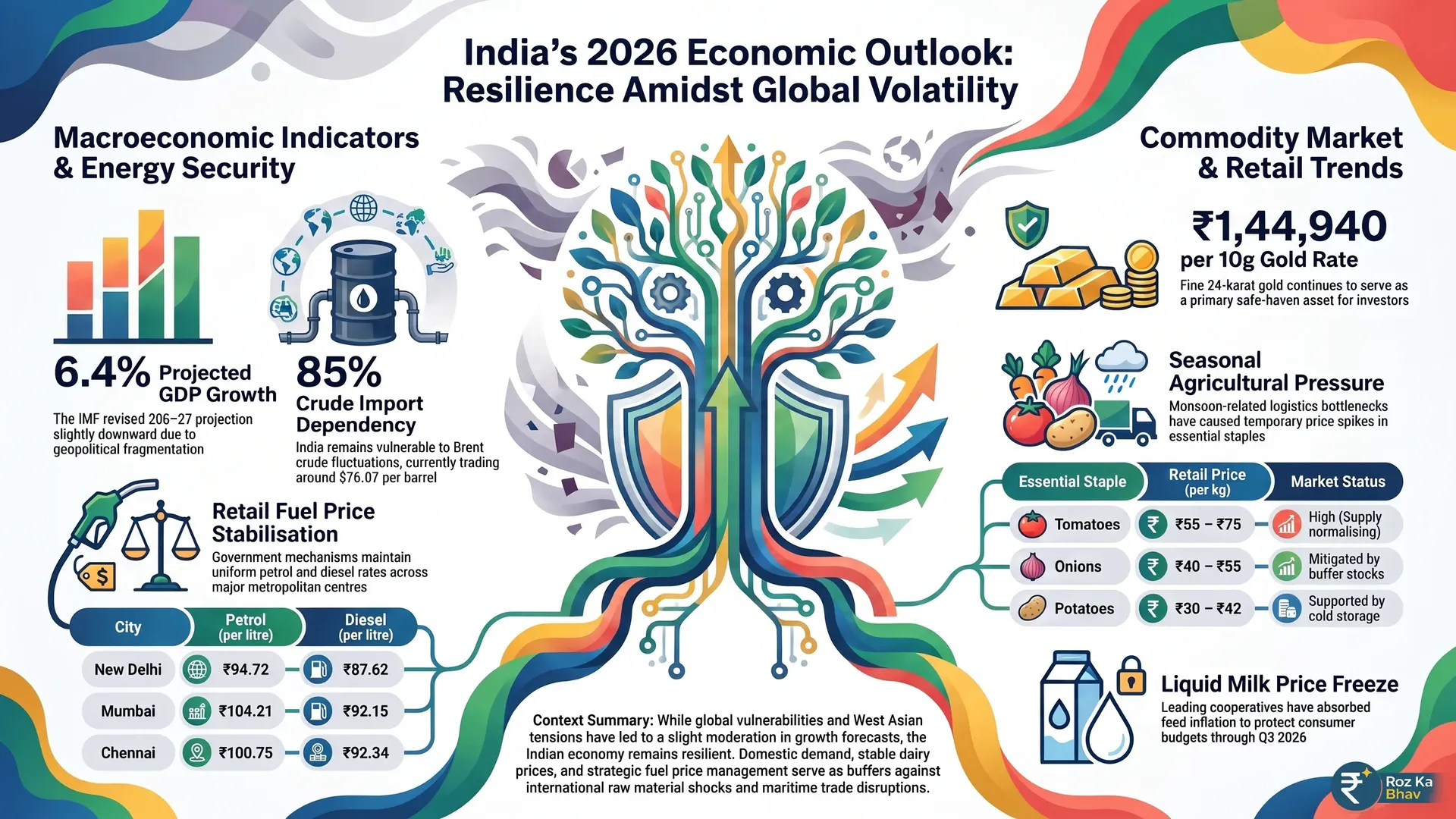
The Indian economy finds itself navigating a landscape of resilient domestic demand contrasted against growing external global vulnerabilities in mid-2026. According to the International Monetary Fund’s (IMF) newly released July 2026 World Economic Outlook Update, India continues to be positioned as one of the fastest-growing major economies globally. However, reflecting international headwinds and rising supply chain stresses, the IMF marginally trimmed India’s near-term growth projection for Fiscal Year 2026 – 27 to 6.4%, down from its prior 6.5% baseline forecast.
This subtle recalibration stems primarily from persistent geopolitical fragmentation; specifically, escalating tensions in West Asia have reshaped trade routes and created volatile commodity baselines. Despite these pressures, the fundamental engine of Indian growth remains firmly grounded in robust private consumption and a highly adaptive services sector. For context, the country recorded a strong GDP expansion of 7.7% in FY 2025 – 26, closing out the final quarter (January March 2026) at an impressive 7.8% clip.
On the policy front, the Reserve Bank of India (RBI) Monetary Policy Committee, under the stewardship of Governor Sanjay Malhotra, has maintained a highly vigilant stance. Aligning with global macro realities, the central bank had previously revised its annual growth expectation to 6.6%, acknowledging risks tied to erratic monsoon baselines and international raw material price shocks. Financial analysts are watching the core retail inflation indexes closely, as domestic consumption metrics continue to prove that local markets can absorb structural adjustments without plunging into sudden demand-side recessions.
2. Global Energy Markets & India Fuel Price Dynamics
Energy security remains a cornerstone of India’s current fiscal health. Global crude benchmarks have experienced notable friction recently, directly influenced by strategic shifts in West Asian diplomatic ties and critical maritime corridor operations. Brent crude oil has been actively trading around the $76.07 per barrel mark, exhibiting upward momentum following fresh geopolitical standoffs involving regional producers.
For India, an economy that imports roughly 85% of its crude requirements, these fluctuations demand constant fiscal balancing. The direct domestic manifestation remains tightly controlled via government price mechanisms and oil marketing companies (OMCs). State-run providers have largely cushioned retail prices from extreme international spikes, holding fuel rates uniform across key metropolitan centers to suppress downstream logistics inflation.
Retail Fuel Prices Across Major Metro Cities (INR/Liter)
Note: Data based on 2026-07-10.
| Metropolitan City | Petrol Price (per Liter) | Diesel Price (per Liter) | Primary Drivers |
|---|---|---|---|
| New Delhi | ₹94.72 | ₹87.62 | Base pricing, lower local VAT structures |
| Mumbai | ₹104.21 | ₹92.15 | State cess and localized transport adjustments |
| Kolkata | ₹103.94 | ₹90.76 | Inland freight metrics and regional tariffs |
| Chennai | ₹100.75 | ₹92.34 | Port proximity advantages versus state duties |
The stabilization of retail fuel prices has prevented an unmitigated surge in heavy freight transportation expenses. Nevertheless, market experts suggest that if Brent crude sustains a trajectory above the $80 cushion for consecutive quarters, OMCs may pass a fractional cost increase down to the consumer before the onset of the third quarter of FY27.
3. Indian Bullion Deep-Dive: Gold & Silver Rates Today
The precious metals sector has mirrored intense global macroeconomic anxieties, turning bullion into a primary battleground for safe-haven asset allocation. Over the current week, domestic retail gold rates in India have experienced minor corrective dips from historic highs, driven by a strengthening U.S. Dollar Index and fluctuating expectations surrounding global central bank rate adjustments.
As of today, July 10, 2026, spot gold rates across the national capital and prominent retail markets show slight intraday upward movements following a multi-day correction. Highlighting institutional benchmarks, the India Bullion and Jewellers Association (IBJA) registered closing rates for fine 24-karat gold (999 purity) hovering closely around ₹14,337 to ₹14,490 per gram depending on customized regional market dynamics.
Gold Purity Price Breakdown (National Average)
Note: Data based on 2026-07-10.
| Gold Purity Type | Rate per Gram (INR) | Rate per 10 Grams (INR) | Market Sentiment |
|---|---|---|---|
| 24 Karat (99.9% Pure) | ₹14,494 | ₹1,44,940 | Strong retail hedge; volatile global cues |
| 22 Karat (91.6% Pure) | ₹13,290 | ₹1,32,900 | High jewelry demand across domestic bridal hubs |
| 18 Karat (75.0% Pure) | ₹11,613 | ₹1,16,130 | Steady traction in modern lightweight premium wear |
Simultaneously, industrial demand combined with retail interest has kept the silver market remarkably active. The official silver rate today is holding ground at approximately ₹2,23,300 to ₹2,44,000 per kilogram, subject to localized local taxes, Octroi, and specific value-added processing fees instituted by major retail networks. Investors are leveraging silver heavily as an industrial play, given its growing necessity in next-generation electronic components and renewable energy infrastructure setups deployed heavily across South Asia.
4. Agri-Commodities and Seasonal Vegetable Inflation Trends
Transitioning from precious metals to essential household indices, the vegetable and agricultural retail complex is feeling the predictable seasonal pressures associated with the monsoon progression across central and northern distribution zones. Per early monsoon tracking, the localized logistical bottlenecks created by sudden heavy downpours have temporarily restricted high-volume agricultural arrivals at critical Wholesale APMC (Agricultural Produce Market Committee) hubs.
The core data from consumer food price indexes indicates that the primary pressure points continue to center on essential staples: onions, tomatoes, and potatoes. While wholesale supply chains are structurally sound, retail markups remain elevated across tier-1 urban spaces due to increased inter-state transport costs and perishable wastage management fees.
Average Market Rates for Essential Vegetables (Major Urban Hubs)
Note: Data based on 2026-07-10.
| Vegetable Item | Wholesale Price (per Quintal) | Retail Price (per Kg – Range) | Supply Chain Status |
|---|---|---|---|
| Tomatoes | ₹3,200 – ₹4,500 | ₹55 – ₹75 | Highly seasonal; supply normalizes as southern crops arrive |
| Onions | ₹2,800 – ₹3,600 | ₹40 – ₹55 | Stable buffer stock releases by NAFED mitigating spikes |
| Potatoes | ₹1,800 – ₹2,400 | ₹30 – ₹42 | Cold storage releases meeting structural domestic shortfalls |
| Green Chillies / Ginger | ₹6,000 – ₹8,500 | ₹110 – ₹150 | High rainfall in growing corridors capping immediate yields |
To curb speculative hoarding, the Ministry of Consumer Affairs has maintained strict monitoring mandates on essential cold storage holdings. Officials are projecting that vegetable retail inflation will cool significantly heading into late August as the secondary Kharif cropping cycles start augmenting wholesale arrivals across northern distribution nodes.
5. FMCG Market & Indian Dairy Supply Economics
The Indian dairy sector, one of the largest self-sustained agricultural ecosystems globally, continues to operate with stable margins heading into the third quarter of 2026. After absorbing sharp input-side animal feed inflation over the last fiscal calendar, leading dairy co-operatives like GCMMF (Amul), Mother Dairy, and prominent regional federations have managed to freeze retail price revisions for basic liquid milk variations.
The steady pricing environment has provided substantial comfort to the average consumer food budget, keeping daily expenditure indicators well within predictable bounds. Analysts attribute this stability to exceptional structural yields realized during the winter procurement season, alongside optimized cold-chain transportation logistics across rural cooperatives.
However, processed sub-categories like ghee, butter, and targeted dairy-based FMCG goods are seeing steady premium pricing, mirroring high consumer preference shifts towards premium packaged items. Procurement costs at the farmgate level currently hold a steady equilibrium average of ₹38 to ₹42 per liter for cow milk and ₹54 to ₹60 per liter for buffalo milk across major milk sheds in Punjab, Gujarat, and western Uttar Pradesh.
6. Summary, Strategic Takeaways & Market Projections
As India looks toward the second half of 2026, the overarching economic narrative is one of calculated optimism. While global bodies like the IMF calibrate expectations around the 6.4% framework to factor in high international borrowing costs and localized maritime trade realignments, India’s core domestic demand is demonstrating robust structural health.
For investors, corporate entities, and domestic consumers, navigating the upcoming quarters will require tracking three pivotal domestic variables:
- The spatial distribution of monsoon rains across essential rain-fed agricultural states.
- The stabilization of global crude below historical flashpoints to safeguard internal transport metrics.
- The trajectory of capital expenditure inflows as international corporations continue utilizing China+1 alternative manufacturing blueprints within Indian borders.
The commodity markets ranging from the high-value gleam of record bullion metrics to the volatile realities of kitchen essentials remain highly functional and liquid. This dual reality of high domestic consumption matched with tight administrative regulatory safety nets positions India to maintain its title as a premier engine of global wealth creation throughout the remainder of 2026.
Disclaimer: The economic analysis, price tracking, and commodity data presented in this report are compiled for informational purposes based on live updates from major national bullion, energy, and retail market exchanges. Readers are advised to consult certified financial planning professionals before making heavy market asset allocations.
Source & Price Verification – Financial Markets
- Gold & Silver Prices: Data referenced from IBJA, MCX India, and international benchmarks.
- Petrol & Diesel Rates: Daily retail prices sourced from Indian Oil, HPCL, and BPCL.
- Commodity Market Data: Verified using MCX, NCDEX, and government statistical releases.
- Verification Process: Prices are cross-checked with at least two independent official or exchange-based sources before publication.
- Disclaimer: Market prices are indicative and may vary by city, tax structure, or intraday volatility.
Note: Prices are updated daily and cross-checked before publishing. If you notice any discrepancy, please email us at [email protected].
