

Featured SnippetQuick Summary: Today’s Indian commodity market exhibits a fascinating matrix of volatility: bullion markets are stabilizing at record historical highs, with 24-carat gold holding firmly above ₹1,43,000 per 10 grams following mild profit booking. Concurrently, global crude corrections to $72 per barrel have led domestic fuel pump prices to flatten after early-year policy interventions. On the retail essential front, a highly volatile monsoon layout triggers short-term price escalations in household staples, with tomatoes and cauliflowers exhibiting sticky high-inflation trends despite macro WPI improvements.
The post-monsoon economic landscape across India is navigating dynamic policy corrections, geopolitical realignments, and agricultural supply chain stresses. The Indian benchmark indices, NSE Nifty and BSE Sensex, have heavily reclaimed vital positions over the last weekly close: this reflects robust corporate earnings and calming geopolitical friction overseas. However, what matters most to your household wallet is how these macroeconomic shifts filter into daily retail pricing. For the ordinary citizen, the financial ecosystem presents an intricate balance of relief and anxiety: bullion prices are correcting marginally but remain out of reach for traditional buyers; global energy adjustments are reshaping logistics costs; and seasonal rainfall swings are transforming local grocery baskets into unpredictable economic indicators.
Table of Contents
1. Bullion Market: Gold and Silver Analysis
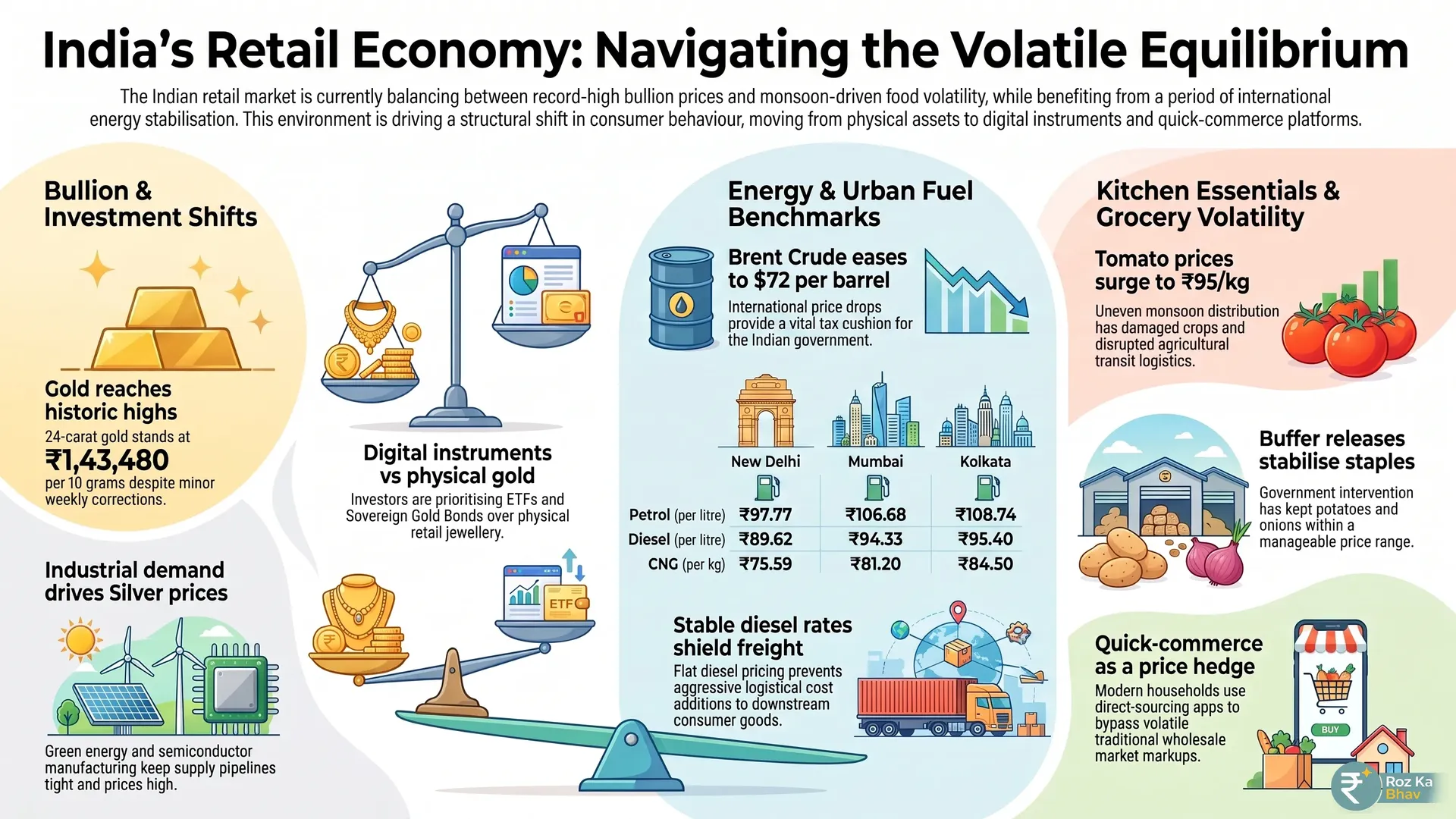
Gold continues to act as a resilient hedge amid global macroeconomic resets: the precious metal is hovering around historic boundaries, holding steady above the ₹1,43,000 mark per 10 grams for 24-carat variants. While domestic buyers previously anticipated breathing room, current demand spikes are mostly driven by institutional hedging, currency adjustments, and digital platform investments like Sovereign Gold Bonds (SGBs) and Exchange-Traded Funds (ETFs). Analysts tracking commodities closely at Dalal Street report that although haven-driven panic has cooled off, minor dollar fluctuations and sticky global asset cycles keep physical gold out of its historic comfort zones.
Silver has simultaneously registered major moves, locking a trading band around ₹2,36,429 per kilogram. This represents massive structural changes over the past twenty-four months: largely led by surging industrial integration. The modern tech push across green hydrogen plants, advanced semiconductor packaging, and vast localized solar module manufacturing keeps structural supply pipelines tightly choked leading to persistent upward price pressure.
Note: Data based on 2026-07-12.
| Commodity / Quality | Standard Unit | Current Retail Price (INR) | Weekly Trend Performance |
|---|---|---|---|
| 24-Karat Pure Gold | 10 Grams | ₹1,43,480 | Minor Correction (-0.3%) |
| 22-Karat Standard Gold | 10 Grams | ₹1,31,523 | Stable / Mild Easing |
| Industrial Grade Silver | 1 Kilogram | ₹2,36,429 | Neutral to Soft |
Metro Breakdown: Bullion on the High Street
In Delhi, retail jewelers report that wedding jewelry demand is increasingly shifting toward digital formats and lighter 18-karat custom alloy items, as standard 22-karat pure variations press families into unexpected asset reallocations. Meanwhile, structural retail spaces across Mumbai show a stark dichotomy; traditional bullion physical buying has dropped by nearly 18% volume-wise year-on-year, yet high-net-worth algorithmic investing into precious metals paper equivalents continues to hit newer peaks monthly.
2. Energy Watch: Petrol, Diesel, and CNG Volatility
On the international front, Brent Crude has observed structural easing, tracking closer to the $72 per barrel territory: this correction stems from expectations of enhanced production output by OPEC+ blocks and sluggish heavy industrial expansion across core global economies. For Indian consumers, this structural cool-off provides substantial relief: preserving the massive excise alterations made earlier this fiscal year. State-run Oil Marketing Companies (OMCs) have managed to absorb legacy refining losses, resulting in long-awaited stability across primary retail pump stations.
The stabilization of public diesel rates serves as a strong tailwind for national freight corridors. Because heavy interstate logistics networks depend primarily on diesel metrics, keeping this benchmark linear shields downstream consumer packages from aggressive logistical cost additions. Concurrently, environmental regulations are driving a significant transition to compressed natural gas (CNG) – which remains an economically viable option for intra-city transport networks.
Note: Data based on 2026-07-12.
| Indian Metropolitan City | Petrol Price (per Litre) | Diesel Price (per Litre) | CNG Price (per Kg) |
|---|---|---|---|
| New Delhi | ₹97.77 | ₹89.62 | ₹75.59 |
| Mumbai | ₹106.68 | ₹94.33 | ₹81.20 |
| Kolkata | ₹108.74 | ₹95.40 | ₹84.50 |
| Chennai | ₹103.67 | ₹95.24 | ₹82.15 |
The stabilization of crude markets near the mid-$70 boundaries has allowed domestic regulatory pillars to extend the life of tax cushions without jeopardizing critical infrastructure deficits. — Senior Energy Analyst, Energy Research Group India.
Regional Dynamics: Fuel Distribution Disparities
In southern hubs like Bengaluru and Chennai, localized distribution costs and varying state-level value-added taxes (VAT) keep the pump index somewhat higher compared to northern centers: this discrepancy directly impacts long-haul logistics networks. Urban commuter bodies are reacting to these price levels by rapidly adopting municipal public transportation lines and accelerating the adoption of private battery-electric scooters.
3. Kitchen Essentials: Vegetable and Dairy Prices
Your grocery bill tells an entirely different story compared to macro fuel charts: the Consumer Food Price Index (CFPI) highlights underlying stress patterns across the country. Unpredictable monsoon distributions have left several key farming regions dry, while simultaneously submerging downstream logistics infrastructure in other states; the result is a highly volatile supply landscape where perishable items, such as fresh vegetables, face sharp localized price spikes.
Tomatoes and cauliflowers are leading the current retail inflationary trend. In contrast, core staples like potatoes and onions have stabilized due to strategic buffer releases managed by government agencies. On the dairy front, major milk cooperatives have held prices steady following consecutive upward adjustments over the past few seasons allowing household budgets some breathing room on essential proteins.
Note: Data based on 2026-07-12.
| Essential Grocery Item | Standard Retail Unit | Average Price Range (INR) | Supply Situation Status |
|---|---|---|---|
| Hybrid Tomatoes | 1 Kilogram | ₹75 – ₹95 | Tight Supply / Highly Volatile |
| Storage Onions | 1 Kilogram | ₹40 – ₹55 | Stable due to Government Buffers |
| Premium Potatoes | 1 Kilogram | ₹30 – ₹42 | Comfortable Inflow |
| Full Cream Milk | 1 Litre Pack | ₹66 – ₹68 | Adequate / Stable Production |
Urban Ground Reality: Fresh Produce Pricing
Families living in high-density pockets across Kolkata and Delhi are feeling the squeeze of rising kitchen costs, with retail vegetable rates surging ahead of wholesale benchmarks due to mid-tier handling markups. To mitigate this impact, modern households are increasingly using quick-commerce digital applications: these platforms leverage direct farm sourcing to offer more stable pricing, helping consumers bypass volatile traditional wholesale markets.
4. Frequently Asked Questions (FAQs)
Q1: Why are domestic gold and silver rates correcting despite ongoing global uncertainties?
Ans: The marginal drop in bullion stems from profit-booking at historic highs and a temporary stabilization of the US dollar index. However, robust demand from institutional investors and industrial usage keeps long-term prices firmly supported.
Q2: Will global crude oil price drops lead to a further reduction in Indian petrol prices?
Ans: While Brent crude sliding toward $72 provides financial breathing room, domestic state-run oil companies are currently prioritizing the recovery of past refining losses and balancing state revenues before implementing further retail cuts.
Q3: What factors are causing the high inflation rates in vegetable prices like tomatoes?
Ans: The recent surge is primarily driven by uneven monsoon distribution, which damaged standing crops and disrupted transit logistics between major agricultural belts and urban wholesale centers.
Q4: Is it a good time to invest in digital gold versus physical gold alternatives?
Ans: Financial advisors often recommend digital gold instruments, such as gold ETFs or mutual funds, over physical gold: these digital alternatives eliminate storage costs, security risks, and making charges while offering immediate liquidity.
For comprehensive historical insights on India’s evolving fuel pricing structures, visit the official ClearTax Fuel History Tracker. For verification of industrial indices and broader financial data frameworks, review the real-time commodity indices at IIFL Commodity Trends Overview.
Source & Price Verification – Financial Markets
- Gold & Silver Prices: Data referenced from IBJA, MCX India, and international benchmarks.
- Petrol & Diesel Rates: Daily retail prices sourced from Indian Oil, HPCL, and BPCL.
- Commodity Market Data: Verified using MCX, NCDEX, and government statistical releases.
- Verification Process: Prices are cross-checked with at least two independent official or exchange-based sources before publication.
- Disclaimer: Market prices are indicative and may vary by city, tax structure, or intraday volatility.
Note: Prices are updated daily and cross-checked before publishing. If you notice any discrepancy, please email us at [email protected].
