

Indian commodity markets today reflect a complex interplay between domestic consumption patterns and persistent foreign economic signals. For households, investors, and retail traders, understanding these daily fluctuations is critical to managing capital allocations and household expenditure. In this detailed analysis, we break down the latest price ticks across precious metals, energy sector updates, and retail kitchen essentials to keep you ahead of the curve.
Table of Contents
1. Bullion Market Analysis: Gold & Silver Rate Trends
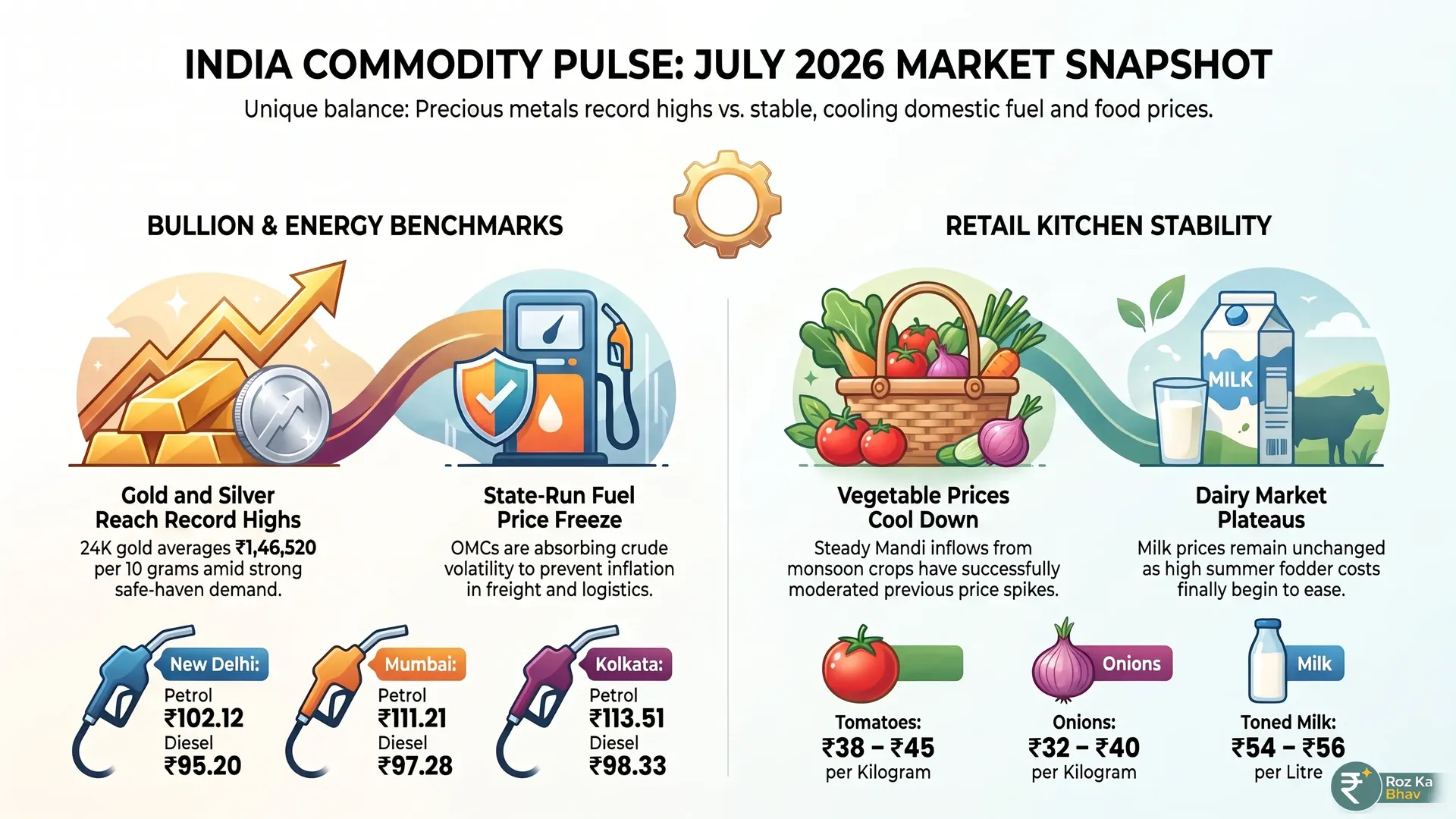
The domestic bullion market continues to display strong pricing power: gold prices in India are hovering near unprecedented territories as international spot rates maintain their resilience. Ongoing geopolitical recalibrations and shifting expectations around global central bank interest rate trajectories have kept safe-haven assets in high demand.
Retail buyers in major Indian cities are seeing 24K fine gold hovering firmly around the ₹1,46,000 to ₹1,46,600 mark per 10 grams. Jewelry demand for 22K gold the standard for traditional Indian ornaments remains supportive despite higher price barriers. Meanwhile, industrial and retail demand for silver has consolidated high prices, keeping the metal well above ₹2,26,000 per kilogram.
Current Bullion Rates in India Today
Note: Data based on 2026-07-24.
| Metal Category | Purity Grade | National Avg Price (₹) | Daily Change |
|---|---|---|---|
| Gold (10 grams) | 24K (999 Fine) | ₹1,46,520 | -₹10.00 |
| Gold (10 grams) | 22K (Standard) | ₹1,34,310 | -₹10.00 |
| Gold (10 grams) | 18K (Ornaments) | ₹10,989 (per gram) | -₹1.00/g |
| Silver (1 kilogram) | 999 Fine Silver | ₹2,27,690 | +₹420.00 |
Looking ahead, technical charts on the MCX indicate strong support levels for gold, suggesting limited downside risks in the near term. Investors are advised to consider systematic allocation strategies rather than lump-sum buying at elevated levels.
2. Energy Watch: Petrol, Diesel & CNG Updates
Fuel prices in India remain stable as state-run Oil Marketing Companies (OMCs) like IOCL, BPCL, and HPCL hold retail pumps steady across key economic zones. Despite fluctuating Brent crude benchmark prices in international energy markets, domestic retail pump prices haven’t seen sudden spikes.
The fuel price stability is largely supported by the OMCs’ buffering strategy: absorbing day-to-day volatility to prevent cascading inflationary pressures across the logistics supply chain. However, localized differences persist due to varying state-level Value Added Tax (VAT) structures and local freight levies.
Retail Fuel Rates Across Key Metros
Note: Data based on 2026-07-24.
| Metropolitan Region | Petrol Price (₹/Litre) | Diesel Price (₹/Litre) | CNG Price (₹/Kg) |
|---|---|---|---|
| New Delhi | ₹102.12 | ₹95.20 | ₹75.59 |
| Mumbai | ₹111.21 | ₹97.28 | ₹79.50 |
| Kolkata | ₹113.51 | ₹98.33 | ₹84.00 |
| Chennai | ₹107.87 | ₹94.24 | ₹80.50 |
| Bengaluru | ₹110.89 | ₹96.02 | ₹82.50 |
What this means for your wallet: with transport fuel prices holding key levels, freight costs remain predictable. This price predictability offers relief to daily commuters and long-haul transport operators, directly helping curb secondary inflation on essential goods.
3. Kitchen Essentials: Vegetable & Dairy Rates
In wholesale and retail Mandis across northern and western India, fresh crop arrivals have stabilized green vegetable prices. Perishable commodities like tomatoes and leafy greens, which often surge during seasonal transitions, are showing improved supply lines due to smoother highway logistics and favorable monsoon distribution.
On the dairy front, prices have stabilized after earlier adjustments driven by elevated fodder costs and summer procurement premiums. Major milk cooperatives and private dairies are keeping consumer liquid milk prices steady: ensuring household food budgets remain relatively balanced.
Average Retail Kitchen Basket Rates Today
Note: Data based on 2026-07-24.
| Commodity | Unit Quantity | Retail Price Range (₹) | Supply Trend |
|---|---|---|---|
| Tomatoes | 1 Kg | ₹38 – ₹45 | Stable Supply |
| Onions | 1 Kg | ₹32 – ₹40 | Adequate Buffer Stock |
| Potatoes | 1 Kg | ₹25 – ₹30 | Steady Mandi Inflow |
| Toned Milk | 1 Litre | ₹54 – ₹56 | Unchanged |
| Full Cream Milk | 1 Litre | ₹66 – ₹68 | Unchanged |
4. City Deep-Dive: Regional Commodity Price Trends
Delhi-NCR Market Trends
In the National Capital Region, gold rates for 24K registered near ₹14,667 per 10 grams. Vegetable supply at Azadpur Mandi saw high inflow from neighboring agricultural states, keeping essential produce affordable for urban consumers. Fuel rates in New Delhi remain among the lowest among major metros: anchored by petrol at ₹102.12/litre.
Mumbai Metropolitan Region Updates
Financial hub Mumbai experienced gold trading near ₹14,662 for 24K. Petrol stands at ₹111.21 per litre, primarily reflecting higher state-level VAT. Milk retail prices in Mumbai stay supported as procurement cooperatives maintain steady distribution networks throughout the region.
Chennai & Southern Metropolitan Markets
Southern bullion hubs, particularly Chennai, continue to record a slight local premium on gold due to strong physical jewelry demand: with 24K rates trading near ₹14,662 per 10g. Fuel prices in Chennai show petrol at ₹107.87/litre and diesel at ₹94.24/litre. Supply of vegetables across Koyambedu wholesale market registered normal volume levels, keeping local retail markup under check.
5. Frequently Asked Questions (FAQs)
Q1: Why are gold prices remaining high in India right now?
Answer: Gold prices are elevated primarily due to persistent international macroeconomic uncertainties, geopolitical safe-haven buying, and fluctuating currency exchange rates against the US Dollar. Strong domestic physical demand during key consumer seasons also maintains a elevated price floor.
Q2: How often are fuel (petrol and diesel) prices updated in India?
Answer: Fuel prices are officially reviewed daily by state oil marketing companies (OMCs) at 6:00 AM IST. Changes reflect real-time shifts in international crude oil prices and foreign exchange rates.
Q3: Why do fuel prices differ significantly from state to state?
Answer: While base crude prices are uniform, final retail prices vary across states due to state-specific Value Added Tax (VAT), local cesses, and transportation freight charges applied by individual state governments.
Q4: Are vegetable prices expected to remain stable this season?
Answer: Agricultural economists project stable vegetable prices over the coming weeks as post-monsoon harvest inflows enter wholesale Mandis: improving supply chains across major consumption urban centers.
Source & Price Verification – Financial Markets
- Gold & Silver Prices: Data referenced from IBJA, MCX India, and international benchmarks.
- Petrol & Diesel Rates: Daily retail prices sourced from Indian Oil, HPCL, and BPCL.
- Commodity Market Data: Verified using MCX, NCDEX, and government statistical releases.
- Verification Process: Prices are cross-checked with at least two independent official or exchange-based sources before publication.
- Disclaimer: Market prices are indicative and may vary by city, tax structure, or intraday volatility.
Note: Prices are updated daily and cross-checked before publishing. If you notice any discrepancy, please email us at [email protected].
