

Crude Oil Shockwaves and Bullion Stability: Impact on Your Finances
As the sun rose over Mumbai’s financial district this morning, market screens flashed a deep shade of red for oil importers. High-stakes drama in Islamabad over the weekend unfortunately concluded without a resolution; the failure of U.S. – Iran negotiations has sent immediate shockwaves through global energy corridors. The market had largely banked on de-escalation; however, the announcement of a naval blockade in the Strait of Hormuz has shifted the calculus entirely.
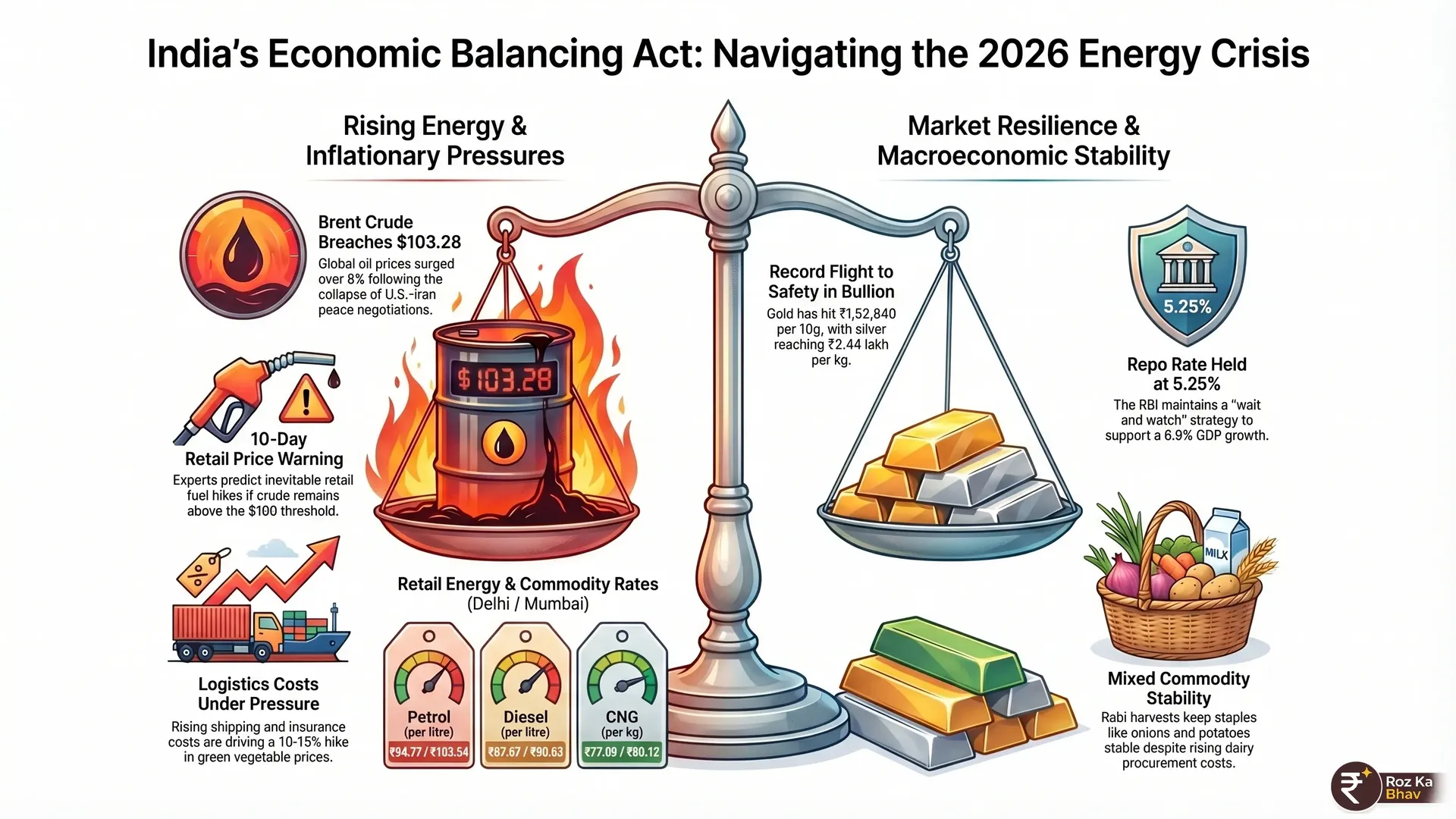
Brent crude didn’t just climb it leaped. Trading at approximately $103.28 per barrel, the price serves as a stark reminder of how vulnerable domestic inflation is to West Asian geopolitics. For the average Indian commuter, pump prices have not budged yet; but do not let that delay fool you. Oil Marketing Companies (OMCs) are currently absorbing significant under-recoveries. The math is simple: if crude stays above $100, the current retail freeze becomes unsustainable we are likely looking at a price correction that could hit your wallet by next week.
1. Bullion Market: Gold and Silver Analysis
2. Energy Watch: Fuel and CNG Trends
3. Kitchen Essentials: Veggies and Dairy
4. Macro Outlook: RBI and Growth
5. Frequently Asked Questions
Bullion Market: Gold Stays High as Uncertainty Prevails
Gold continues to serve as the ultimate safety net for Indian households. Despite massive volatility in other sectors, bullion remains remarkably resilient. In major hubs like Delhi and Mumbai, 24-karat gold is retailing around ₹1,52,840 per 10 grams. While global prices saw a slight technical correction today, the domestic jewelry premium remains elevated due to the approaching wedding season.
Silver often described as the poor man’s gold is no longer particularly cheap. It is currently hovering near ₹2.44 lakh per kilogram. Strong industrial demand for silver in green energy components is maintaining a high price floor, even when retail buyers hesitate. If you are planning a purchase for a wedding, the current trend suggests a staggered approach rather than buying in bulk.
Note: Data based on 2026-04-13.
| City | 24K Gold (per 10g) | 22K Gold (per 10g) | Silver (per kg) |
|---|---|---|---|
| Delhi | ₹1,52,840 | ₹1,40,100 | ₹2,43,370 |
| Mumbai | ₹1,52,840 | ₹1,40,100 | ₹2,43,790 |
| Chennai | ₹1,54,300 | ₹1,41,600 | ₹2,44,500 |
| Bangalore | ₹1,52,840 | ₹1,40,100 | ₹2,43,980 |
Energy Watch: The Calm Before the Petrol Storm
Today presents a unique situation at local petrol pumps. While prices remain identical to yesterday with Delhi at ₹94.77 for petrol and ₹87.67 for diesel the underlying pressure is mounting. Reports indicate under-recoveries of nearly ₹24 per litre on petrol and over ₹100 on diesel due to the global spike. You can find the latest city-wise breakdown here for specific state tax tracking.
The Strait of Hormuz blockade is the defining issue: roughly 20% of the world’s oil passes through that narrow passage. If the U.S. Navy maintains this stance, we may move beyond a $103 barrel toward the $120 range. For now, the government is utilizing the excise duty cushion; however, that buffer is thinning rapidly.
Current Fuel Rates (April 13, 2026)
Note: Data based on 2026-04-13.
| Fuel Type | Price (Delhi) | Price (Mumbai) | Status |
|---|---|---|---|
| Petrol (Regular) | ₹94.77 /L | ₹103.54 /L | Stable (For now) |
| Diesel (Regular) | ₹87.67 /L | ₹90.03 /L | Stable |
| CNG (IGL/MGL) | ₹77.09 /kg | ₹80.12 /kg | Unchanged |
| LPG (14.2kg) | ₹913.00 | ₹915.50 | Steady |
Kitchen Essentials: Dairy and Vegetable Trends
While global oil headlines dominate the news, local mandis are where everyday inflation is most visible. Prices have been mixed this morning: onions and potatoes remain relatively stable thanks to healthy rabi harvest arrivals. However, green vegetables like spinach and coriander have seen a 10 – 15% jump in wholesale prices over the last week primarily due to rising transport costs and localized heatwaves in the north.
Dairy prices are also shifting: the FAO Dairy Price Index recently ticked up by 1.2%, which is reflecting in the domestic market. Procurement prices for milk are under pressure as feed costs rise. While major cooperatives like Amul and Mother Dairy are holding rates for now, a hike of 2 – 3 rupees per litre is being discussed for the upcoming quarter.
Average Retail Prices (NCR Region)
- Potatoes: ₹22 – 28 per kg
- Onions: ₹35 – 45 per kg
- Tomatoes: ₹40 – 55 per kg (Rising)
- Full Cream Milk: ₹66 – 68 per litre
The Macro View: RBI’s “Wait and Watch” Strategy
Last week, RBI Governor Sanjay Malhotra and the MPC decided to keep the repo rate unchanged at 5.25%. This was a unanimous and pragmatic decision given the current climate. The central bank has transitioned to a neutral stance; effectively indicating they wish to support growth while remaining ready to act if inflation spikes. You can read the full RBI policy breakdown here.
The 2026 – 27 GDP growth projection stands at 6.9%. While respectable, the West Asia risk remains a major caveat. If energy costs stay elevated, they will inevitably erode the disposable income of the Indian middle class slowing the consumption engine that drives the economy. It is a delicate balancing act for the North Block to manage in the months ahead.
Frequently Asked Questions (FAQs)
1. Why are petrol prices not increasing despite crude oil hitting $103?
Indian OMCs typically benchmark retail prices against a 15-day rolling average. Additionally, the government often intervenes during geopolitical crises to prevent immediate price shocks; however, this leads to under-recoveries that are usually settled later via price hikes or subsidies.
2. Is this a good time to invest in gold?
Analysts suggest that while gold is near all-time highs above ₹1.52 lakh it serves as a crucial hedge against currency depreciation and geopolitical instability. Most advisors recommend buying on dips rather than entering at the peak.
3. Will the RBI increase interest rates in the next meeting?
The RBI currently maintains a neutral stance. However, if crude oil stays above $100 for an extended period, it could push CPI inflation above the 4.6% target; potentially forcing the MPC to consider a rate hike to stabilize the rupee.
4. How is the Strait of Hormuz blockade affecting India?
India imports over 80% of its oil, much of it from the Middle East. Any disruption in the Strait of Hormuz increases shipping insurance costs and causes supply delays: factors that directly impact the domestic cost of energy and logistics.
Source & Price Verification – Financial Markets
- Gold & Silver Prices: Data referenced from IBJA, MCX India, and international benchmarks.
- Petrol & Diesel Rates: Daily retail prices sourced from Indian Oil, HPCL, and BPCL.
- Commodity Market Data: Verified using MCX, NCDEX, and government statistical releases.
- Verification Process: Prices are cross-checked with at least two independent official or exchange-based sources before publication.
- Disclaimer: Market prices are indicative and may vary by city, tax structure, or intraday volatility.
Note: Prices are updated daily and cross-checked before publishing. If you notice any discrepancy, please email us at [email protected].