

As the sun rose over Delhi this Sunday, the hustle at local Mandis and the quiet hum of digital bullion exchanges told two very different stories. For the average consumer, the day brings a mixed bag of relief and anxiety. While fuel pumps haven’t delivered a fresh shock to the wallet today, the glitter of gold has become considerably more expensive for those planning weddings or seeking safe-haven investments. Based on current exchange data, the Indian rupee is punching below its weight even as our macroeconomic fundamentals remain among the strongest globally with a real growth rate hovering near 7%.
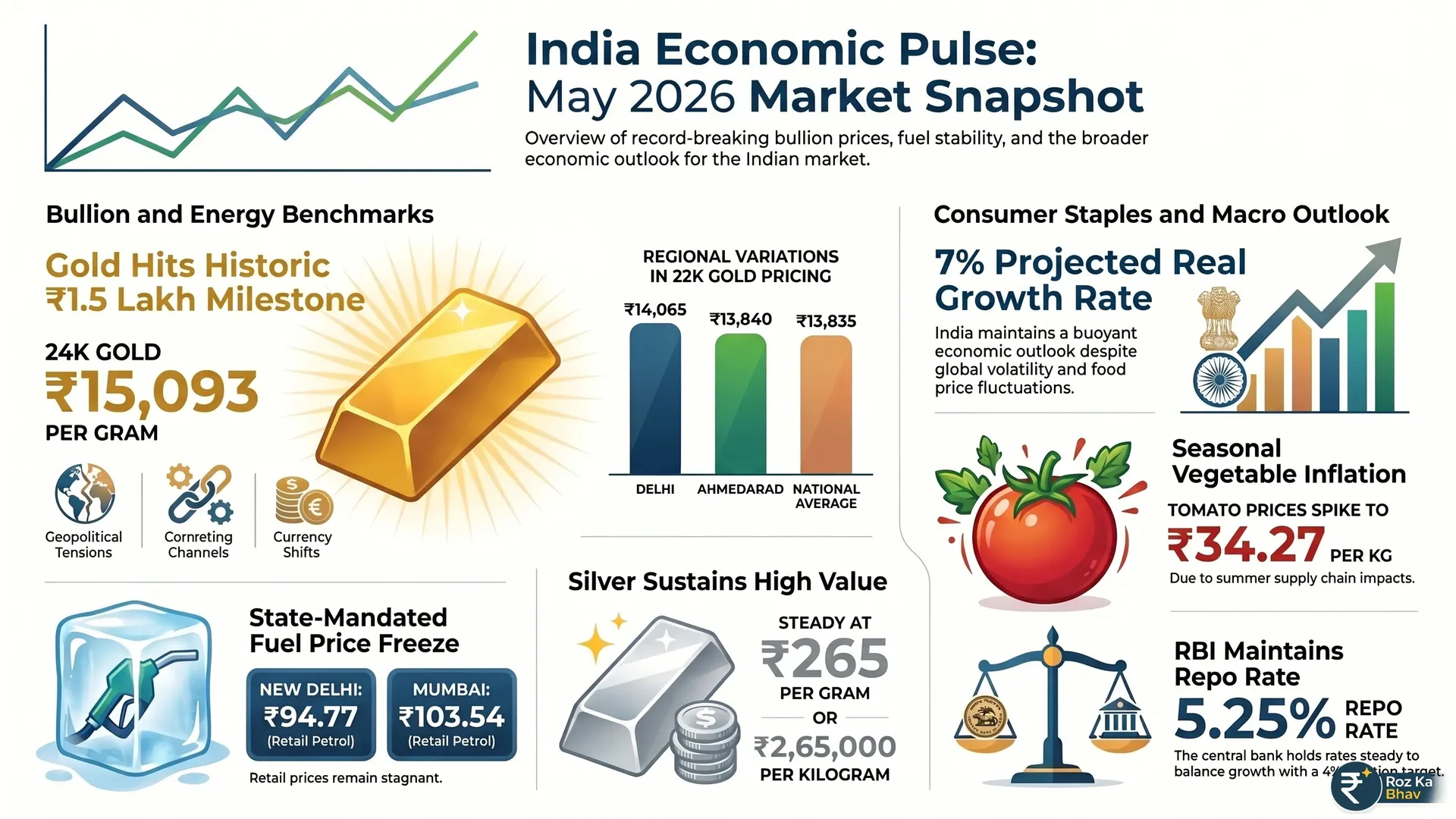
The reality of the 2026 market is one of managed stability colliding with global geopolitical tail risks. We are witnessing a world that is less coordinated; this is reflected in gold’s behavior over the last year jumping from USD 2,607 to well over USD 4,000 per ounce internationally. Domestically, this has pushed 24K gold past that psychological ₹1.5 lakh barrier: a level many analysts wouldn’t have bet on just 24 months ago.
1. Bullion Market: Gold & Silver Analysis
2. Energy Watch: Fuel & CNG Rates
3. Kitchen Essentials: Veggies & Dairy
4. Analyst’s Economic Outlook
5. Frequently Asked Questions
Bullion Market: Gold and Silver Analysis
If you are looking to buy gold today, you will need deep pockets. Our market tracking shows that 24-carat gold is trading at ₹15,093 per gram. For a standard 10-gram bar, you are looking at a cost of ₹1,50,930. Interestingly, 22-carat gold the standard for most jewelry has stabilized at ₹13,835 per gram. It is a significant figure honestly but demand does not seem to be cooling down despite the high entry point.
Silver, often called the poor man’s gold, is not exactly cheap anymore either. It is holding steady at ₹265 per gram; that is ₹2,65,000 for a full kilogram. In cities like Chennai, prices are slightly higher due to local taxes and demand-supply gaps. If you compare this to international markets, the gap is widening largely due to import duties and the current valuation of the Rupee against the Dollar.
Note: Data based on 2026-05-03.
| Metal / Purity | Price per Gram (Today) | Price per 10g (Today) | Change vs Yesterday |
|---|---|---|---|
| Gold 24K (99.9%) | ₹15,093 | ₹1,50,930 | Steady |
| Gold 22K (91.6%) | ₹13,835 | ₹1,38,350 | Steady |
| Gold 18K (75.0%) | ₹11,320 | ₹1,13,200 | Steady |
| Silver (99.9%) | ₹265 | ₹2,650 | Steady |
City-wise Gold Trends (22K)
Prices vary depending on your location. In Delhi, for instance, Policybazaar reports that 22K gold is hitting ₹14,065 per gram today slightly higher than the national average. Meanwhile, Ahmedabad is more competitive at ₹13,840. These differences usually stem from local octroi and the transportation costs of physical metal.
Energy Watch: Petrol, Diesel, and CNG
Regarding the fuel pumps: for those commuting in the Delhi-NCR region, the news is relatively flat which, in this economy, is good news. Petrol in the capital is holding at ₹94.77 per liter. If you are in Mumbai, you are still paying that premium price of ₹103.54. It is quite frustrating isn’t it? The disparity between states remains a major talking point at local tea stalls.
Diesel continues to hover around the ₹87 to ₹90 mark in most northern states. However, a quiet concern is brewing among analysts. Oil Marketing Companies (OMCs) have been absorbing volatility in global crude which has led to some under-recoveries. While Rajnath Singh recently mentioned that prices will not hike immediately; the pressure is certainly there.
Note: Data based on 2026-05-03.
| City | Petrol (per L) | Diesel (per L) | CNG (per Kg) |
|---|---|---|---|
| New Delhi | ₹94.77 | ₹87.67 | ₹77.09 |
| Mumbai | ₹103.54 | ₹90.03 | ₹81.00 |
| Bangalore | ₹102.96 | ₹90.99 | ₹90.00 |
| Chennai | ₹100.84 | ₹92.39 | ₹91.50 |
Kitchen Essentials: Vegetables and Dairy
This is where real inflation hits home for most Indian households. According to the Price Monitoring Division of the Department of Consumer Affairs, we are seeing seasonal heat in the veggie basket. Tomatoes have taken a jump now averaging ₹34.27 per kg across India. Just a few weeks ago, they were in the high 20s.
Onions and potatoes are staying somewhat behaved. You can pick up potatoes for about ₹20.36 per kg on average. But here is the thing: dairy is where the slow creep is happening. milk prices have stabilized at an average of ₹59.84 per liter but that is nearly a 2% increase compared to last year. If you are a heavy consumer of ghee or butter, you have likely noticed the pinch already.
Retail Price Breakdown (National Average)
- Tomato: ₹34.27 / Kg (Rising)
- Onion: ₹24.68 / Kg (Stable)
- Potato: ₹20.36 / Kg (Stable)
- Milk: ₹59.84 / Ltr (Marginal Rise)
- Arhar Dal: ₹122.17 / Kg (Falling slightly)
Analyst’s Economic Outlook
What does this mean for your pocket? The RBI has kept the repo rate at 5.25% as of the last review. This is a wait and watch stance. They want to ensure inflation stays within that 4% comfort zone but food prices are the wildcard. The FAO Food Price Index rose recently, reflecting global trends in cereals and meat; however, India’s sugar harvest has been favorable enough to keep domestic prices around ₹46.46 per kg.
Investment-wise, it is a tricky time. With gold at record highs, some are pivoting toward digital gold or Sovereign Gold Bonds (SGBs) to avoid making charges. Others are looking at the stock market which is anticipating a 7% growth rate for FY26. It is a period of dynamism; it is also one where you really have to watch where every rupee goes.
Frequently Asked Questions
1. Why is the gold rate so high in India today?
It is a combination of global geopolitical tension and a weakening currency. Investors tend to flock to gold when the global system feels less certain driving up prices worldwide. In India, high import duties add to this base price.
2. Will petrol prices go down anytime soon?
This is unlikely in the short term. While the government is trying to shield consumers, the under-recoveries of oil companies mean any drop in global crude will likely be used to balance their books rather than being passed on to the pump immediately.
3. Are Vegetable Prices expected to rise further in May?
Yes, typically. As summer heat intensifies, supply chains for perishables like tomatoes and leafy greens often get hit leading to seasonal price spikes through May and June.
4. Is it a good time to invest in Silver?
Silver at ₹2.65 lakh per kg is high, but it often follows gold’s trajectory with higher volatility. Many analysts see it as an industrial play as well given the push for green energy and electronics in India’s Make in India 2.0 phase.
Source & Price Verification – Financial Markets
- Gold & Silver Prices: Data referenced from IBJA, MCX India, and international benchmarks.
- Petrol & Diesel Rates: Daily retail prices sourced from Indian Oil, HPCL, and BPCL.
- Commodity Market Data: Verified using MCX, NCDEX, and government statistical releases.
- Verification Process: Prices are cross-checked with at least two independent official or exchange-based sources before publication.
- Disclaimer: Market prices are indicative and may vary by city, tax structure, or intraday volatility.
Note: Prices are updated daily and cross-checked before publishing. If you notice any discrepancy, please email us at [email protected].