

Navigate This Report
India Gold and Silver Rates: A Brief Pause in the Rally?
If you checked gold prices this morning, you likely noticed a shift from the record-breaking peaks seen earlier this week. The bullion market is currently searching for a baseline after a volatile few days. Driven by “safe-haven” demand as tensions escalated in the Middle East, investors rushed toward the yellow metal, pushing prices to unprecedented levels.
Today, we are seeing signs of profit-taking. Market data shows that in Delhi, 24K gold is retailing at approximately ₹1,67,770 per 10 grams, marking a decline of nearly ₹2,890 from the previous session. This doesn’t necessarily mean the geopolitical anxiety has faded; rather, the market reached an “overbought” state, prompting traders to lock in gains.
Silver has followed a similar trajectory. After nearing the ₹3.15 lakh per kg mark on March 2nd, prices have retreated. In the national capital, silver is trading at ₹2,94,900 per kg today. While these rates remain high by historical standards, the initial wave of panic buying appears to have moderated for the time being.
Today’s Gold & Silver Rates (March 4, 2026)
Note: Data based on 2026-03-04.
| City | 24K Gold (per 10g) | 22K Gold (per 10g) | Silver (per kg) |
|---|---|---|---|
| Delhi | ₹1,67,770 | ₹1,53,800 | ₹2,94,900 |
| Mumbai | ₹1,67,610 | ₹1,53,640 | ₹2,95,000 |
| Chennai | ₹1,68,710 | ₹1,54,640 | ₹2,94,900 |
| Bengaluru | ₹1,67,620 | ₹1,53,650 | ₹2,94,900 |
Fuel Prices in India: Why Rates Haven’t Spiked Yet
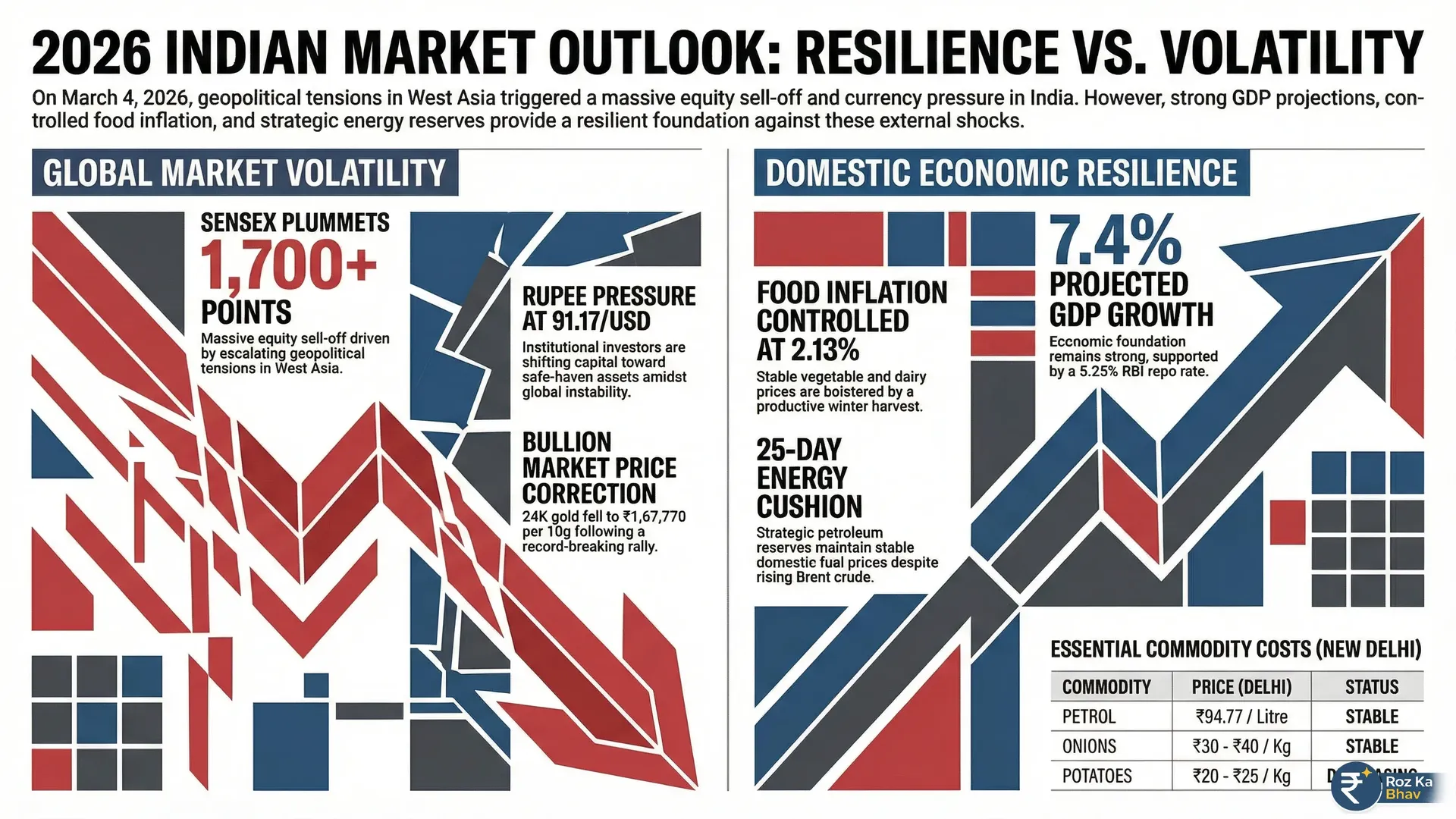
As the day began, many commuters in Delhi and Mumbai expected a price hike at the pumps, especially with Brent crude climbing toward $82 per barrel. Surprisingly, fuel rates have stayed quite steady. In Delhi, petrol remains at ₹94.77, and diesel is holding at ₹87.67.
The reason behind this stability lies in India’s strategic positioning. Government reports indicate that the country maintains approximately 25 days of crude oil and fuel reserves. This cushion has allowed state-run oil marketing companies (OMCs) to absorb the international price spike without immediate impact on consumers. That said, if the Strait of Hormuz which facilitates about 55% of India’s oil imports becomes a long-term flashpoint, this price stability will be difficult to maintain.
Current Fuel Prices in Major Metros
Note: Data based on 2026-03-04.
| City | Petrol (per Litre) | Diesel (per Litre) | CNG (approx.) |
|---|---|---|---|
| New Delhi | ₹94.77 | ₹87.67 | ₹75.59 |
| Mumbai | ₹103.44 | ₹90.03 | ₹81.12 |
| Kolkata | ₹105.45 | ₹92.02 | ₹84.00 |
| Chennai | ₹100.80 | ₹92.39 | ₹82.50 |
While metro prices are stable, some cities like Bhubaneswar saw a minor decrease of 40 paise today due to local VAT adjustments. It provides a small bit of localized relief, but for most of the country, it remains a “wait and watch” situation.
Food Inflation and Grocery Prices: Vegetable and Dairy Update
Shifting focus to daily household expenses, food inflation in India has stayed relatively controlled recently, sitting around 2.13% according to Trading Economics data.
In local mandis, Vegetable Prices are holding steady thanks to a productive winter harvest. Onions and tomatoes have avoided the drastic price spikes we have seen in previous years. However, the cost of leafy greens is starting to creep up as the weather warms.
Dairy Market and Milk Prices
In the dairy sector, major suppliers like Amul and Mother Dairy have kept their pricing flat over the last quarter. Global dairy indices have actually declined slightly, helping domestic producers maintain their margins without passing additional costs to the consumer.
Note: Data based on 2026-03-04.
| Product | Average Price (Delhi) | Trend |
|---|---|---|
| Onion (per Kg) | ₹30 – ₹40 | Stable |
| Tomato (per Kg) | ₹25 – ₹35 | Stable |
| Milk (Full Cream, 1L) | ₹66 – ₹68 | No Change |
| Potato (per Kg) | ₹20 – ₹25 | Decreasing |
The Economic Outlook: Understanding Today’s Market Trends
Today’s downturn on the NSE and BSE reflects global nerves. When the Sensex drops 1,700 points, it indicates that institutional investors are moving capital into “safe-haven” assets, typically the US Dollar or Gold.
However, it is worth noting that the Reserve Bank of India (RBI) recently maintained the repo rate at 5.25%, highlighting the resilience of the domestic economy. With a projected GDP growth of 7.4% this year, India’s core economic engine remains strong despite the geopolitical headlines and commodity price swings.
Many market observers feel that a correction was inevitable after the significant gains seen in 2025. Markets rarely move in a single direction forever, and current geopolitical tensions have served as the catalyst for this overdue adjustment.
Frequently Asked Questions
1. Why did gold prices fall today despite the conflict?
This is primarily due to profit-taking. After gold reached record highs, many investors sold their holdings to secure gains. Additionally, a stronger US Dollar makes gold more expensive for international buyers, which can slightly dampen demand.
2. Are petrol prices expected to rise tomorrow?
While global crude prices are up, India’s significant fuel reserves provide a buffer. Unless there is a prolonged blockade in the Strait of Hormuz, retail prices are expected to remain stable in the immediate future.
3. Is now a good time to buy silver?
Silver is currently consolidating around ₹2.94 lakh per kg. While these dips can be attractive for long-term investors, the current 2% daily price swings make it a high-risk asset for short-term trading.
4. How is the Rupee trending against the US Dollar?
The Rupee has been under some pressure, trading near 91.17 against the USD. A weaker Rupee generally increases the cost of imports like oil and gold, which keeps domestic prices elevated even when global rates experience a slight dip.
In conclusion, today’s market suggests a need for caution. Whether you are managing a household budget or an investment portfolio, volatility is the defining factor right now. We will continue to monitor West Asia developments and their impact on local commodity prices.
Source & Price Verification – Financial Markets
- Gold & Silver Prices: Data referenced from IBJA, MCX India, and international benchmarks.
- Petrol & Diesel Rates: Daily retail prices sourced from Indian Oil, HPCL, and BPCL.
- Commodity Market Data: Verified using MCX, NCDEX, and government statistical releases.
- Verification Process: Prices are cross-checked with at least two independent official or exchange-based sources before publication.
- Disclaimer: Market prices are indicative and may vary by city, tax structure, or intraday volatility.
Note: Prices are updated daily and cross-checked before publishing. If you notice any discrepancy, please email us at [email protected].