

March 2026 Commodity Pulse: Analyzing Shifting Consumer Costs
This morning, the average Indian consumer might feel a sense of cautious relief mixed with ongoing concern. Headlines are currently dominated by West Asian tensions and soaring crude oil. However, at the local level, the impact varies significantly depending on whether you are visiting a jewelry shop or a petrol pump. It is certainly a mixed bag for the economy today.
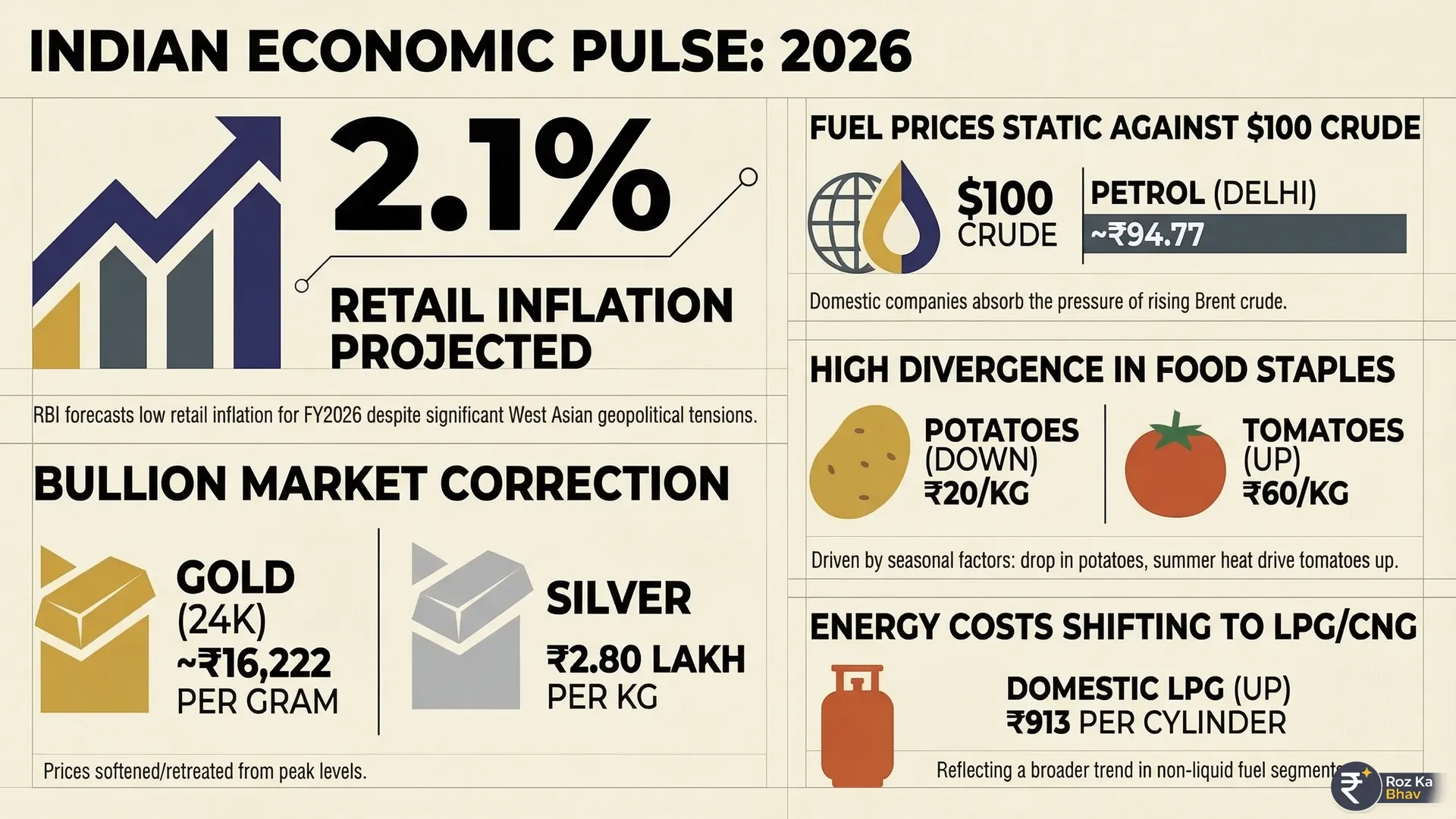
The global energy shock many feared after Brent crude surged past $100 has not yet translated into higher costs for commuters. This is largely because Oil Marketing Companies (OMCs) are absorbing the price pressure, a strategy that is becoming a familiar script for the Indian economy. Conversely, the bullion market is seeing some profit-booking. After a frantic rally earlier this month, investors seem to be taking chips off the table, leading to a dip in gold and silver prices.
The broader economic context is vital here. The Reserve Bank of India recently projected retail inflation for FY26 at around 2.1 percent, but officials were quick to point out that “geopolitical uncertainties” remain the biggest wildcard. While today might feel stable, underlying pressures are building. Let’s look at the specifics of each sector.
Bullion Market Analysis: Is Now a Good Time to Buy Gold?
For those planning weddings or looking to invest, today offers a welcome “cooling off” period. Based on current exchange data and retail market tracking, gold prices have softened by approximately ₹100 to ₹150 per gram compared to the highs seen just a few days ago. In Delhi, 24K gold is currently quoted at ₹16,237 per gram. It is a slight retreat, though we are still operating at historically high levels.
Silver has also seen a significant correction. After flirting with the ₹3.15 lakh per kg mark earlier this month, it has settled closer to the ₹2.80 lakh to ₹2.90 lakh range today. This volatility highlights silver’s dual nature as both an industrial metal and a precious asset. Here is a snapshot of the rates across major cities:
Note: Data based on 2026-03-13.
| City | 24K Gold (per gram) | 22K Gold (per gram) | Silver (per kg) |
|---|---|---|---|
| Delhi | ₹16,237 | ₹14,885 | ₹2,80,000 |
| Mumbai | ₹16,222 | ₹14,870 | ₹2,80,000 |
| Chennai | ₹16,331 | ₹14,970 | ₹2,90,000 |
| Kolkata | ₹16,222 | ₹14,870 | ₹2,80,000 |
Why Gold Prices Vary by Region
Interestingly, Chennai continues its reputation as one of the most expensive markets for gold in India. This is often attributed to higher local demand and different tax structures compared to northern states. Meanwhile, silver rates in Hyderabad and Kerala are hovering slightly higher at ₹2,90,000 per kg, reflecting localized supply constraints. If you are looking to buy, it is always worth checking with local jewelers like Tanishq or Kalyan Jewellers for precise rates.
Energy Sector Update: Crude Oil Impacts on Petrol and Diesel
The energy story is taking an interesting turn. On the global stage, Brent crude has been dancing around the $100 mark. While you might expect petrol prices to skyrocket, the price at the pump has remained remarkably static. In Delhi, petrol is still at ₹94.77, and diesel is at ₹87.67. This represents a fiscal tightrope walk for the government.
According to reports from The Economic Times, government sources suggest fuel companies can absorb losses until crude breaches the $130 per barrel mark. This “shielding” helps our daily commute, but it raises questions about long-term sustainability if global prices do not cool down soon.
Note: Data based on 2026-03-13.
| City | Petrol (per Litre) | Diesel (per Litre) | CNG (per kg) |
|---|---|---|---|
| New Delhi | ₹94.77 | ₹87.67 | ₹77.09 |
| Mumbai | ₹103.54 | ₹90.03 | ₹77.00 |
| Kolkata | ₹105.41 | ₹92.02 | ₹93.50 |
| Bengaluru | ₹102.96 | ₹90.99 | ₹90.10 |
LPG and CNG Price Trends
While petrol is steady, kitchen budgets have taken a hit recently. Earlier this month, domestic LPG prices were hiked by ₹60, bringing the cost of a 14.2kg cylinder to ₹913 in Delhi. CNG has also seen a slow, incremental creep upward, currently sitting at ₹77.09 per kg in the capital. While still cheaper than petrol, it is not as budget-friendly as it was a year ago. It is a subtle shift that adds up over the month.
Food Inflation: Vegetable and Dairy Price Forecast
Vegetable prices remain the ultimate “mercurial” commodity in India. Today, we see a clear divide. Basic staples like potatoes and onions are relatively stable, with wholesale prices showing a downward trend in some regions due to healthy harvest arrivals. However, “green” vegetables like tomatoes and capsicum are feeling the heat as early summer temperatures begin to affect yields.
Dairy is another area to watch. Following several price corrections in late 2025, major cooperatives like Amul and Mother Dairy have kept prices steady this month. However, the cost of “value-added” products like ghee and butter has seen a marginal uptick of 2% to 3% in retail stores, likely due to increased packaging and logistics costs.
Note: Data based on 2026-03-13.
| Commodity | Current Rate (Avg) | Weekly Trend |
|---|---|---|
| Onions (per kg) | ₹30 – ₹40 | Stable |
| Tomatoes (per kg) | ₹45 – ₹60 | Rising ↑ |
| Potatoes (per kg) | ₹20 – ₹25 | Falling ↓ |
| Milk (per Litre) | ₹56 – ₹68 | Stable |
What is the bottom line? If you are managing a household budget, it is a good time to buy staples in bulk, but you may want to go easy on out-of-season greens. The Indian economy is showing resilience, but the “global noise” is getting louder. Between Strait of Hormuz tensions and shifting monsoon predictions for later this year, there is plenty to keep an eye on. Staying informed is the best way to navigate these shifts without being caught off guard.
Frequently Asked Questions
1. Why are petrol prices not increasing despite crude oil hitting $100?
The Indian government often uses Oil Marketing Companies (OMCs) to buffer the domestic market from global shocks. By absorbing higher costs or adjusting excise duties, they keep retail prices stable to prevent a sudden spike in inflation, at least until crude reaches a critical threshold like $130.
2. Is it a good time to buy gold in India today?
With prices correcting slightly to around ₹16,222 per gram for 24K, this is a better entry point than last week. However, the market remains volatile due to geopolitical tensions. Many experts suggest a “buy on dips” strategy rather than making a single large purchase.
3. Why is there a difference in fuel prices between Delhi and Mumbai?
Fuel prices in India vary by state primarily because of Value Added Tax (VAT) and local freight charges. States like Maharashtra and Telangana have higher VAT compared to Delhi, which explains why petrol costs more in Mumbai or Hyderabad.
4. Are vegetable prices expected to rise further in March 2026?
Typically, as we move into hotter months, the supply of leafy greens and delicate vegetables decreases, leading to higher prices. However, a bumper crop of staples like potatoes should keep the overall food basket from becoming too expensive.
Source & Price Verification – Financial Markets
- Gold & Silver Prices: Data referenced from IBJA, MCX India, and international benchmarks.
- Petrol & Diesel Rates: Daily retail prices sourced from Indian Oil, HPCL, and BPCL.
- Commodity Market Data: Verified using MCX, NCDEX, and government statistical releases.
- Verification Process: Prices are cross-checked with at least two independent official or exchange-based sources before publication.
- Disclaimer: Market prices are indicative and may vary by city, tax structure, or intraday volatility.
Note: Prices are updated daily and cross-checked before publishing. If you notice any discrepancy, please email us at [email protected].