

As the sun hit the trading desks in Mumbai’s Zaveri Bazaar this morning, a palpable sense of “wait-and-watch” took hold among market veterans. For several weeks, the Indian economy has moved to a global rhythm dictated by geopolitical tensions and shifting currency markers. If you have been tracking your monthly expenses lately, it is clear that the relief many hoped for in 2026 is taking its time to arrive. Whether it is the gold jewelry intended for the wedding season or a simple liter of milk for morning tea; the numbers are forcing a second look.
Today’s market behavior is largely driven by a stabilizing Indian Rupee, allowing precious metals to enter a consolidation phase after the volatility of early April. However, the energy sector remains unpredictable. With Brent crude flirting with the $100 mark, domestic fuel stability feels like a temporary ceasefire rather than a lasting peace. For consumers, this suggests a period of “hidden inflation”: the cost of moving goods eventually impacts grocery bills, even when the price at the petrol pump remains still.
Table of Contents
Bullion Market: Gold Prices Stabilize While Silver Maintains Industrial Strength
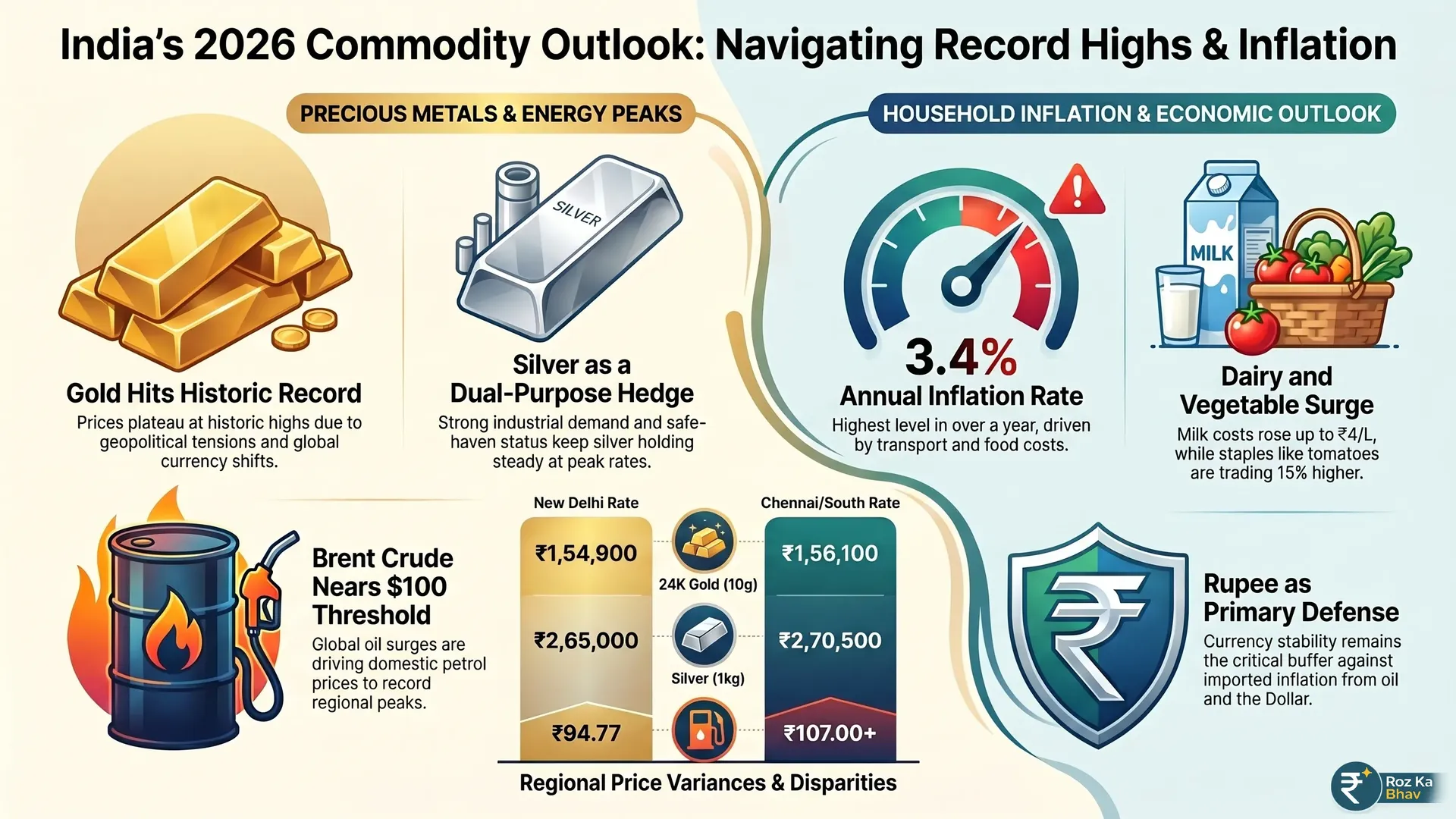
Gold prices in India have reached a plateau today, but it is a historically high one. Currently, 24-carat gold is trading near ₹1,54,900 per 10 grams in the national capital. This represents a recovery from the sharp sell-offs seen earlier this month; however, these rates would have seemed like science fiction just a year ago. Investors are no longer in a state of panic instead, they are pivoting toward value-based accumulation as the shock of West Asian volatility begins to subside.
Silver is behaving quite differently. It continues to trade at elevated levels, supported by its safe-haven status and a surge in industrial demand. Unlike gold which is heavily influenced by central bank policies silver is riding the wave of India’s manufacturing expansion. In Chennai, silver trades at a premium compared to northern states; a difference of nearly ₹5,000 per kg is common due to regional logistics and local demand spikes.
Note: Data based on 2026-04-22.
| City | 24K Gold (per 10g) | Silver (per 1kg) | Daily Trend |
|---|---|---|---|
| New Delhi | ₹1,54,900 | ₹2,65,000 | Steady |
| Mumbai | ₹1,54,750 | ₹2,65,000 | Steady |
| Chennai | ₹1,56,100 | ₹2,70,500 | Marginal Up |
| Bengaluru | ₹1,54,750 | ₹2,65,000 | Steady |
Why Gold Rates Differ Across Indian Cities
If you are wondering why a cousin in Chennai sees a different price than you do in Delhi, the answer lies in local taxes and logistics. Moving physical bullion across the country adds cost, but the primary drivers are regional jewelry associations. These bodies set daily benchmarks based on local supply and demand. According to reports from
Business Today,
regional disparities are widening as southern states experience higher retail demand during the current festival window.
Energy Watch: Crude Oil Volatility and the Petrol Pump
For the average commuter, the news is a mixed bag. On the surface, petrol and diesel prices have not budged today. In Delhi, the rate remains ₹94.77 for petrol. While this appears stable, the global backdrop is concerning: Brent Crude is hovering near $98 per barrel. Tension in the Persian Gulf remains a significant factor for energy markets potentially acting as a ticking time bomb.
The government and state-run oil marketing companies (OMCs) are currently absorbing high input costs to prevent retail shocks. However, private players like Nayara and Shell have begun subtle adjustments in specific regions. In Hyderabad, petrol prices have crossed the ₹107 mark due to higher state VAT a reminder that location dictates how much a commute affects savings.
Note: Data based on 2026-04-22.
| Metro City | Petrol (per Litre) | Diesel (per Litre) | CNG (per Kg) |
|---|---|---|---|
| New Delhi | ₹94.77 | ₹87.67 | ₹77.09 |
| Mumbai | ₹103.50 | ₹90.03 | ₹80.50 |
| Kolkata | ₹105.41 | ₹92.02 | ₹93.50 |
| Hyderabad | ₹107.46 | ₹95.70 | ₹97.00 |
CNG remains a small relief for public transport users in the capital, staying flat at ₹77.09 per kg. However, in hilly regions like Himachal or Uttarakhand, prices have spiked toward ₹98 per kg reflecting the reality of transport costs in 2026. Experts at
The Economic Times
suggest that OMCs may not be able to hold these rates if Brent breaches the $100 mark.
Kitchen Essentials: Addressing the Household Inflation Crisis
While the stock market and gold dominate the headlines, the real battle for the Indian middle class is in the kitchen. We are seeing a strange divergence: global dairy prices are softening due to oversupply in Europe, but India faces a “margin recalibration.” Unseasonal rains in northern milk belts have reduced inventories, leading to a ₹2 – ₹4 hike per liter over the last month.
Vegetable Prices are equally volatile. Despite being in the heart of the spring harvest, logistical costs driven by high fuel floors are keeping staples like tomatoes and onions 15% higher than last year. Farmers are seeking better prices for their crops, yet by the time produce reaches vendors in Bengaluru or Delhi, transport costs have often erased any potential for a budget-friendly meal.
Note: Data based on 2026-04-22.
| Product | Price Range (Retail) | Trend |
|---|---|---|
| Milk (Full Cream/Litre) | ₹68 – ₹76 | Increasing |
| Tomatoes (per Kg) | ₹45 – ₹60 | Volatile |
| Onions (per Kg) | ₹35 – ₹50 | Stable but High |
| Sunflower Oil (per Litre) | ₹165 – ₹185 | Rising |
The Broader Economic Outlook: Navigating 2026
Looking at the big picture, India’s annual inflation rate recently rose to 3.4%. While this is within the RBI’s comfort band of 2 – 6%, it is the highest level seen in over a year. The government recently reaffirmed its 4% inflation target through 2031 signaling a commitment to stability. Yet for the consumer, stability at 4% feels quite different when essential bills are jumping by double digits.
The rupee’s performance against the dollar is the critical anchor. As long as it remains steady, we may avoid the worst of “imported inflation.” However, if global oil prices spike or the dollar strengthens, gold and fuel will be the first to react. For now, the strategy for most Indian households remains cautious spending and a preference for value-based investments over speculative ones.
Frequently Asked Questions (FAQs)
It depends on your investment horizon. With prices near ₹1.55 lakh, gold is expensive by historical standards. However, over a 5-year window, analysts suggest gold remains a solid hedge against currency volatility. If buying for a wedding, “averaging” your purchase over several weeks may be a wiser strategy than a bulk buy today.
This is due to a combination of Value Added Tax (VAT) and freight costs. Each state government levies a different tax percentage. Furthermore, cities located far from oil refineries or ports face higher transportation charges which is why petrol in Hyderabad or Jaipur is pricier than in Delhi.
Current outlooks suggest prices will remain firm. High fodder costs for cattle and increased transport expenses for vegetables are structural issues. While a favorable monsoon might bring slight cooling, a return to 2024 price levels is unlikely in the near term.
High crude prices increase production costs for nearly everything. While you might not see an immediate hike at the pump due to government intervention, it appears in “hidden” ways such as higher delivery fees, pricier plastic goods, and increased costs for airline tickets.
Disclaimer: This report is for informational purposes only. Market prices are subject to change throughout the day. Please consult with a financial advisor before making significant investment decisions.
Source & Price Verification – Financial Markets
- Gold & Silver Prices: Data referenced from IBJA, MCX India, and international benchmarks.
- Petrol & Diesel Rates: Daily retail prices sourced from Indian Oil, HPCL, and BPCL.
- Commodity Market Data: Verified using MCX, NCDEX, and government statistical releases.
- Verification Process: Prices are cross-checked with at least two independent official or exchange-based sources before publication.
- Disclaimer: Market prices are indicative and may vary by city, tax structure, or intraday volatility.
Note: Prices are updated daily and cross-checked before publishing. If you notice any discrepancy, please email us at [email protected].
