

Current Market Trends and Economic Shifts
As the sun rose over Dalal Street this morning, the atmosphere felt distinctly tense. Investors were busy adjusting their spreadsheets before finishing their first cup of chai. We are currently navigating a unique financial era where gold is soaring to levels that would have sounded like fiction just a few years ago. Many people are watching their portfolios grow on paper while simultaneously worrying about the rising cost of basic groceries.
It is a fascinating disconnect. While global institutional buyers drive metal prices to historic highs, the average consumer in Delhi or Mumbai is simply trying to determine if fueling their car will strain the weekly budget. Macroeconomics eventually reaches your local market stall; whether you are buying a wedding necklace or a liter of milk, the underlying forces of inflation, currency rates, and government tax policies are all interconnected. Let’s break down exactly what is happening today.
Table of Contents
Bullion Market: The Historic Golden Surge
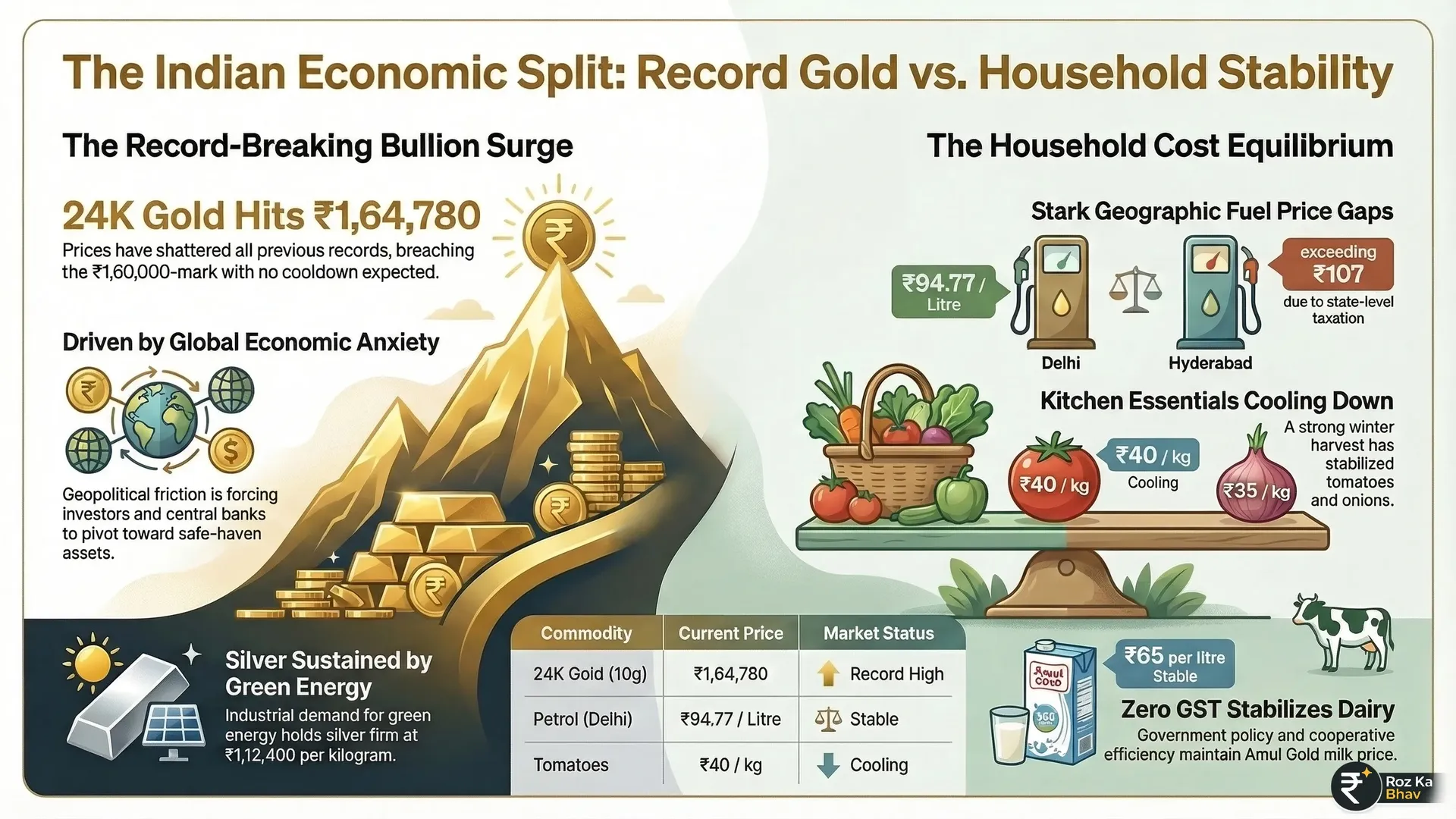
The precious metals sector is on fire right now, and that isn’t an exaggeration. Gold has breached the ₹1,60,000 mark for 10 grams of 24-karat, showing no immediate signs of slowing down. Retail buyers visiting jewelry showrooms this weekend have been visibly stunned by the prices. Just a month ago, the numbers were entirely different; the sheer velocity of this bullion rally has caught many by surprise.
This surge stems from a combination of global anxiety and local currency dynamics. Investors worldwide are seeking safe havens, hesitant to trust equity markets amid ongoing geopolitical friction. When the US dollar weakens or the Federal Reserve hints at rate adjustments, gold becomes the primary parking spot for wealth.
Silver is also on the move, typically following gold’s trajectory with even higher volatility. Industrial demand for silver within the green energy sector has kept prices remarkably robust. For detailed daily charts, you can visit the Upstox gold rate tracker, which updates these shifts in real-time.
Today’s Gold and Silver Rates by City
Note: Data based on 2026-03-08.
| City | 24K Gold (per 10g) | 22K Gold (per 10g) | Silver (per 1kg) |
|---|---|---|---|
| New Delhi | ₹1,63,930 | ₹1,50,280 | ₹1,12,400 |
| Mumbai | ₹1,63,780 | ₹1,50,140 | ₹1,12,400 |
| Chennai | ₹1,63,840 | ₹1,50,190 | ₹1,13,000 |
| Kolkata | ₹1,63,760 | ₹1,50,120 | ₹1,12,400 |
Energy Watch: Fuel Prices Hold Steady
Shifting to energy, the situation at the fuel pump is remarkably quiet. Petrol prices have flatlined across major metros today, with New Delhi holding steady at ₹94.77 per litre. You might wonder why local prices aren’t fluctuating alongside international crude oil markets.
The answer involves taxation and the buffering strategies of Oil Marketing Companies (OMCs). Roughly half of the price per litre goes toward taxes. The central government levies a fixed excise duty, while individual states apply their own Value Added Tax (VAT). This explains why a driver in Hyderabad pays over twelve rupees more per litre than one in Delhi. The base price of the fuel is only a fraction of the final retail cost.
OMCs frequently absorb minor shocks in global crude prices to maintain steady retail rates, particularly during sensitive political periods. While state governments occasionally adjust VAT, things are currently stable. If you are planning a long drive, check ABP Live’s regional fuel breakdown to find the best places to refuel.
Current Fuel Prices in Major Indian Cities
Note: Data based on 2026-03-08.
| City | Petrol (per litre) | Diesel (per litre) | CNG (per kg) |
|---|---|---|---|
| New Delhi | ₹94.77 | ₹87.62 | ₹74.09 |
| Mumbai | ₹103.50 | ₹92.15 | ₹83.50 |
| Bengaluru | ₹102.92 | ₹88.94 | ₹82.50 |
| Hyderabad | ₹107.50 | ₹95.65 | ₹90.00 |
Kitchen Essentials: Stability for Household Budgets
Anyone managing a household knows the feeling of visiting the local mandi only to find basic vegetables priced like luxury imports. Fortunately, that isn’t the case this week. We are seeing a welcome cooling period for several kitchen staples.
tomato prices, which often spike without warning, have settled at a reasonable ₹40 per kilogram in most urban centers. Onions are hovering around ₹35 per kilogram. A strong winter harvest helped build decent buffer stocks, and the supply chain hasn’t faced major weather disruptions lately. While unseasonal rain could impact transport routes, consumers can breathe easy for now.
The State of Dairy Pricing
Milk pricing follows its own unique dynamic. Last year, cooperatives like Amul and Mother Dairy raised prices due to high cattle feed costs. Following this, the government provided relief by reducing the GST on specific packaged UHT milk to zero percent.
This policy shift has now fully integrated into the market. Amul Gold, the popular full cream variant, is currently priced at ₹65 per litre. These cooperatives operate on a model where nearly 80% of consumer payments go directly back to rural milk producers. It is a delicate balance to keep urban prices fair while ensuring farmers can afford to maintain their herds. You can read more about the context of these shifts in this Economic Times dairy report.
Average Retail Prices for Groceries
Note: Data based on 2026-03-08.
| Item | Average Price (Retail) | Recent Trend |
|---|---|---|
| Tomatoes (1 kg) | ₹40 – ₹45 | Stable |
| Onions (1 kg) | ₹35 – ₹40 | Stable |
| Potatoes (1 kg) | ₹25 – ₹30 | Slight Decrease |
| Amul Gold Milk (1 L) | ₹65 | Stable |
Frequently Asked Questions
1. Why is the gold rate increasing so rapidly in 2026?
Gold prices are surging primarily due to international demand. Central banks are purchasing gold in large quantities to diversify reserves. Additionally, geopolitical tensions and inflation concerns lead investors to gold as a reliable safe-haven asset.
2. Will petrol prices drop soon in India?
A significant drop is unlikely in the near future. Even if global crude prices fall, governments rely heavily on fuel taxes for revenue. Retail prices will likely remain at current levels unless there is a major policy shift regarding excise duties or state VAT.
3. What caused the recent changes in Amul milk pricing?
Initially, high cattle feed and transport costs forced dairy companies to raise prices. Later, a government decision to set GST on certain packaged milks to zero percent helped stabilize and slightly reduce the retail cost.
4. Are Vegetable Prices expected to rise during the monsoon?
Historical trends suggest prices often hike during the monsoon season. Heavy rains can disrupt supply chains and damage crops. Items like tomatoes and onions are particularly susceptible to these seasonal weather shocks.
Source & Price Verification – Financial Markets
- Gold & Silver Prices: Data referenced from IBJA, MCX India, and international benchmarks.
- Petrol & Diesel Rates: Daily retail prices sourced from Indian Oil, HPCL, and BPCL.
- Commodity Market Data: Verified using MCX, NCDEX, and government statistical releases.
- Verification Process: Prices are cross-checked with at least two independent official or exchange-based sources before publication.
- Disclaimer: Market prices are indicative and may vary by city, tax structure, or intraday volatility.
Note: Prices are updated daily and cross-checked before publishing. If you notice any discrepancy, please email us at [email protected].