

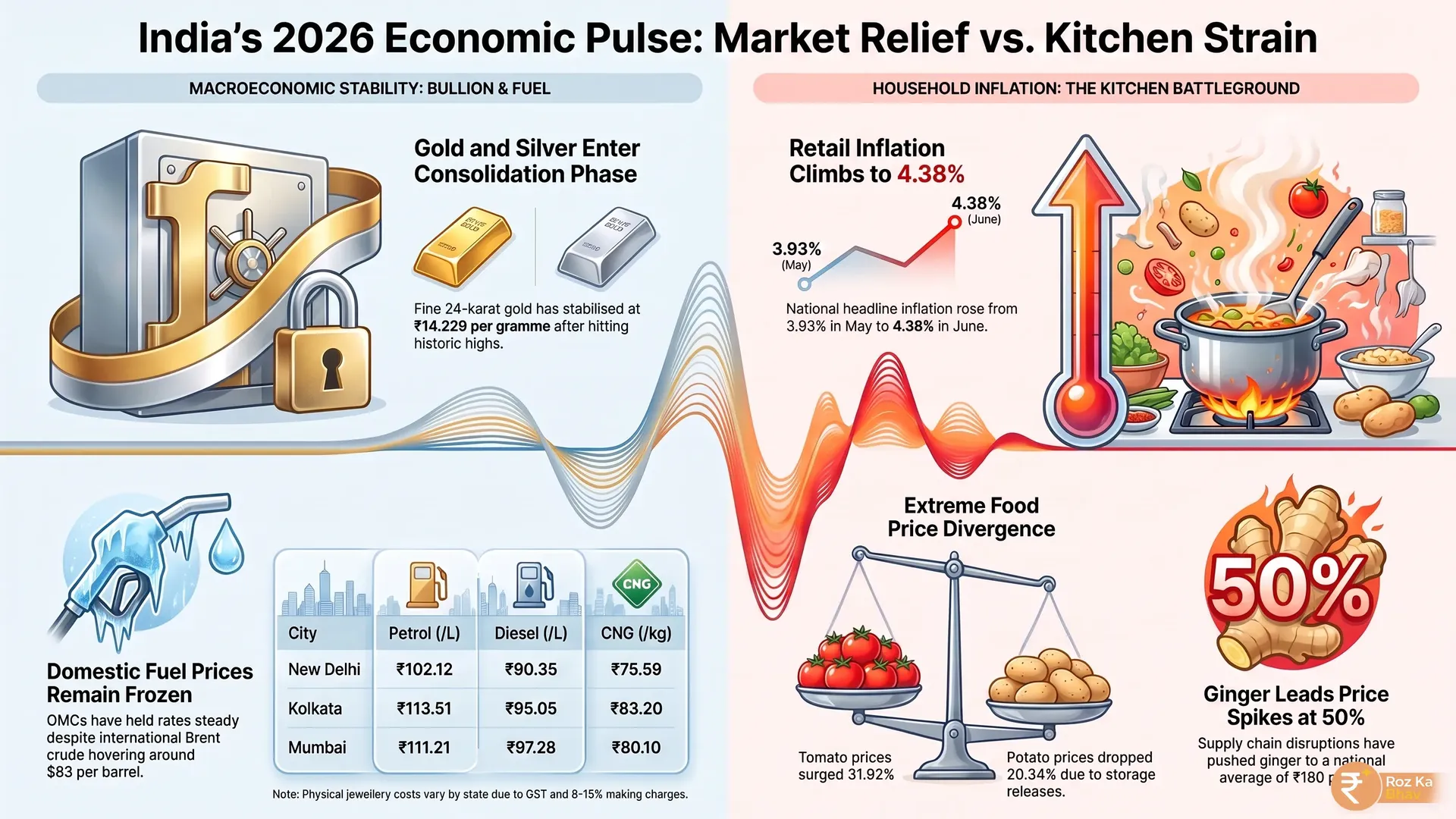
Quick Summary: On July 14, 2026, Indian households navigate contrasting financial signals. Freshly released data reveals that India’s retail inflation climbed to 4.38% in June 2026, with food inflation surging to 5.32% driven by extreme localized weather pushing tomato and ginger prices higher. Conversely, the bullion market offers mild relief as 24k gold stabilizes at ₹14,229 per gram after a brief downward correction, and silver settles near ₹2,17,235 per kg. Meanwhile, domestic state-run oil companies have kept fuel rates unchanged, with Delhi petrol holding firm at ₹102.12 per litre.
The Indian consumer landscape is experiencing a bifurcated reality; macro commodity markets like gold and crude oil are settling into comfortable trading ranges, yet immediate household budgets feel the pinch of volatile micro-commodities. The Ministry of Statistics and Programme Implementation (MoSPI) recently published its updated Consumer Price Index (CPI) metrics, confirming a rise in headline retail inflation to 4.38%, up from May’s 3.93%. The primary engine behind this acceleration remains the newly weighted Consumer Food Price Index (CFPI), which spiked to 5.32% sequentially. For everyday citizens, this fiscal transition is felt directly at the local mandi rather than the stock exchange; domestic grocery baskets continue to bear the brunt of localized supply disruptions. Here is a deep-dive analysis of how major financial assets and kitchen staples are pricing today, July 14, 2026.
Table of Contents
1. Bullion Market: Gold and Silver Price Analysis Today
Gold continues to trade near historic highs on a yearly basis, although the immediate week-on-week trend shows a healthy correction. According to India Bullion and Jewellers Association (IBJA) indicative retail rates, fine 24-karat gold (999 purity) is trading at ₹14,229 per gram, which equates to ₹1,42,290 per 10 grams. This value reflects a slight decline from the ₹14,337 peak witnessed last week.
Market analysts at Dalal Street point to a cooling of geopolitical risk premiums in international markets and a stabilizing Indian Rupee as primary reasons for this breather. Furthermore, domestic jewellers note that while off-season wedding buying has kept physical retail volume modest, investment demand via Sovereign Gold Bonds (SGBs) and gold ETFs remains incredibly robust; long-term accumulation remains steady.
Silver has mirrored gold’s trajectory. Spot silver of 999 purity has pulled back to ₹2,17,235 per kilogram, down from ₹2,20,390 per kg recorded at the end of last week. Market experts believe this drop represents a classic consolidation phase rather than a structural trend reversal. Industrial demand for silver especially within India’s green energy infrastructure, solar PV manufacturing, and electric vehicle production sectors is expected to cushion any major downward slides during the second half of 2026.
Note: Data based on 2026-07-14.
| Metal / Purity | Rate as of July 10, 2026 (PM) | Current Rate (July 14, 2026) | Net Price Change |
|---|---|---|---|
| Fine Gold (24K / 999) | ₹14,337 / g | ₹14,229 / g | ↓ ₹108 / g |
| Jewellery Gold (22K / 916) | ₹13,993 / g | ₹13,887 / g | ↓ ₹106 / g |
| Standard Gold (18K) | ₹11,613 / g | ₹11,525 / g | ↓ ₹88 / g |
| Silver (999 purity) | ₹2,20,390 / kg | ₹2,17,235 / kg | ↓ ₹3,155 / kg |
Note for Buyers: The rates mentioned above represent base indicators sourced from IBJA. Actual retail jewelry prices will vary across different regions because of localized state GST, transport overheads, and the making charges (which average 8% to 15%) levied by brands like Tanishq, Malabar, and Kalyan Jewellers.
2. Energy Watch: Petrol, Diesel, and CNG Trends Across Metros
In contrast to volatile bullion, domestic retail fuel rates remain stagnant. Oil Marketing Companies (OMCs) like Indian Oil (IOCL), Bharat Petroleum (BPCL), and Hindustan Petroleum (HPCL) have maintained a steady hand on prices. This stability persists despite fluctuations in global Brent crude futures, which are currently hovering around $83 per barrel.
In New Delhi, petrol is retailing at ₹102.12 per litre, maintaining its long-term average, while diesel stands at ₹90.35 per litre. Other major metros, which impose higher localized value-added tax (VAT), continue to see steeper pricing; for instance, Mumbai retains the highest petrol cost among tier-1 cities at ₹111.21 per litre, followed closely by Kolkata at ₹113.51 per litre.
Note: Data based on 2026-07-14.
| Metro City | Petrol Price (per Litre) | Diesel Price (per Litre) | CNG Price (per kg) |
|---|---|---|---|
| New Delhi | ₹102.12 | ₹90.35 | ₹75.59 |
| Mumbai | ₹111.21 | ₹97.28 | ₹80.10 |
| Bengaluru | ₹110.44 | ₹96.12 | ₹82.50 |
| Chennai | ₹107.94 | ₹94.33 | ₹81.00 |
| Kolkata | ₹113.51 | ₹95.05 | ₹83.20 |
While fuel is steady today, energy analysts suggest that if international crude oil remains above the $85 threshold for consecutive weeks, OMCs may be forced to pass down minor hikes of ₹1 to ₹2 in the coming quarter. What this means for your wallet is simple: transportation costs will remain flat for now, but there is no immediate drop in logistics fees on the horizon.
3. Kitchen Essentials: Vegetable Prices and Dairy Inflation
The real battlefield for the middle-class budget lies inside the kitchen. Today’s market data points to a highly uneven harvest season. A delayed and erratic onset of the Southwest monsoon led to a rainfall deficit in early June, causing severe agricultural supply disruptions, though a mid-July recovery is slowly narrowing that gap.
As a result, perishable commodities have experienced extreme price spikes. According to the statistics ministry’s retail basket tracking, tomato inflation stands at a whopping 31.92% year-on-year. In retail mandis of urban hubs like Delhi and Mumbai, premium tomatoes are commanding up to ₹80 to ₹100 per kg. Similarly, ginger has registered an astronomical 50.41% jump year-on-year, pushing it out of reach for many lower-income households.
Fortunately, it is not all bad news. Root vegetables like potato have actually dropped in price, down 20.34% compared to this time last year due to strong cold storage releases. Peas have also shown a healthy decline of 9.67%. On the dairy front, major cooperatives like Amul and Mother Dairy have kept retail milk prices stable over the last two months, though warning that rising fodder and transport costs might spark a marginal 2% hike by autumn.
Note: Data based on 2026-07-14.
| Kitchen Commodity | Average Retail Price (per kg / Litre) | Year-on-Year Trend |
|---|---|---|
| Tomatoes | ₹85 / kg | ↑ 31.92% |
| Ginger | ₹180 / kg | ↑ 50.41% |
| Potatoes | ₹28 / kg | ↓ 20.34% |
| Onions | ₹45 / kg | ↑ 12.5% |
| Amul Gold Milk | ₹68 / Litre | Flat |
4. City-Wise Retail Breakdown and Local Commodity Rates
The vast size of India means localized supply chains heavily dictate how much you pay. Let’s look at how key cities are fairing on July 14, 2026:
New Delhi Market Status
Delhi residents are witnessing a heavy divergence. While the city benefits from proximity to North Indian agricultural belts, premium 22-karat gold jewellery at prominent retail showrooms like Tanishq sits around ₹13,145 per gram. Vegetable rates remain moderately elevated due to logistics delays caused by monsoon showers in neighboring Haryana and Western UP; transit choke points continue to limit wholesale inflows.
Mumbai Market Status
Mumbai faces the double brunt of steep local taxes and high real estate premiums. In the commercial capital, petrol stands stubbornly at ₹111.21 per litre. The vegetable supply has also seen monsoon-related delays at the Vashi APMC market, forcing retail vendors to mark up leafy vegetables by 20% compared to last month.
Bengaluru Market Status
In Bengaluru, tech professionals face higher living costs. Petrol is currently retailing at ₹110.44 per litre. On the gold front, 22-karat gold jewellery matches Delhi showrooms at ₹13,100 to ₹13,145 per gram. Meanwhile, local vegetable supplies from Kolar are helping stabilize tomato rates compared to northern states.
Kolkata Market Status
Kolkata remains highly vulnerable to supply disruptions from neighboring eastern states. Fuel costs are high, with petrol at ₹113.51 per litre. However, dairy and local fish markets have remained relatively isolated from the extreme inflationary spikes seen in Western and Northern India.
5. Frequently Asked Questions (FAQs) – Retail Market Dynamics
Q1: Why is food inflation in India rising to 5.32% despite stable fuel prices?
While fuel prices are steady, food inflation is driven by supply-side shocks rather than transport costs. Localized heatwaves and an uneven monsoon distribution have damaged perishable crops like tomatoes and ginger, causing sharp supply drops and localized price hikes.
Q2: Is it a good time to buy gold in India right now?
With gold correcting down slightly to ₹14,229 per gram (24K), it presents a healthy entry point for long-term investors. Historically, mild mid-year corrections offer buying windows ahead of the heavy festive season demand starting in autumn.
Q3: Why is there a price difference in petrol across different Indian states?
The variation is due to state-level Value Added Tax (VAT) and local cess. While the base excise duty and dealer commissions are relatively uniform, different state governments levy varying percentages of taxes, resulting in petrol costing ₹102.12 in Delhi but ₹111.21 in Mumbai.
Q4: Will potato and pea prices remain low in the coming months?
Yes. Because of bumper cold storage reserves and stable off-season yields, root vegetables and peas are expected to remain financially viable for consumers through the next monsoon cycle, offsetting the spikes seen in leafy greens and tomatoes.
Source & Price Verification – Financial Markets
- Gold & Silver Prices: Data referenced from IBJA, MCX India, and international benchmarks.
- Petrol & Diesel Rates: Daily retail prices sourced from Indian Oil, HPCL, and BPCL.
- Commodity Market Data: Verified using MCX, NCDEX, and government statistical releases.
- Verification Process: Prices are cross-checked with at least two independent official or exchange-based sources before publication.
- Disclaimer: Market prices are indicative and may vary by city, tax structure, or intraday volatility.
Note: Prices are updated daily and cross-checked before publishing. If you notice any discrepancy, please email us at [email protected].
