

The Indian economy confronts a multifaceted commodity price surge today: presenting fresh macro challenges for both fiscal policymakers and the Reserve Bank of India (RBI). Global geopolitical shifts, paired with uneven domestic monsoon distributions, have triggered a synchronous rally across critical asset classes. From luxury investments like gold to basic household necessities like tomatoes and milk; the retail price landscape shifts fast. Market analysts at Dalal Street note that this broad-based appreciation threatens to derail the central bank’s medium-term headline inflation target of 4%; sparking intense speculation regarding prolonged high-interest-rate environments.
What this means for your wallet is immediate and tangible. The purchasing power of urban and rural households alike faces an aggressive squeeze. As transport logistics costs remain sticky due to high crude premiums; input cost pressures shift directly onto retail consumers. In this deep-dive market report, our editorial desk analyzes the driving forces behind these shifts: breaking down the cold hard data across bullion, energy, and kitchen essentials across India’s primary metro hubs.
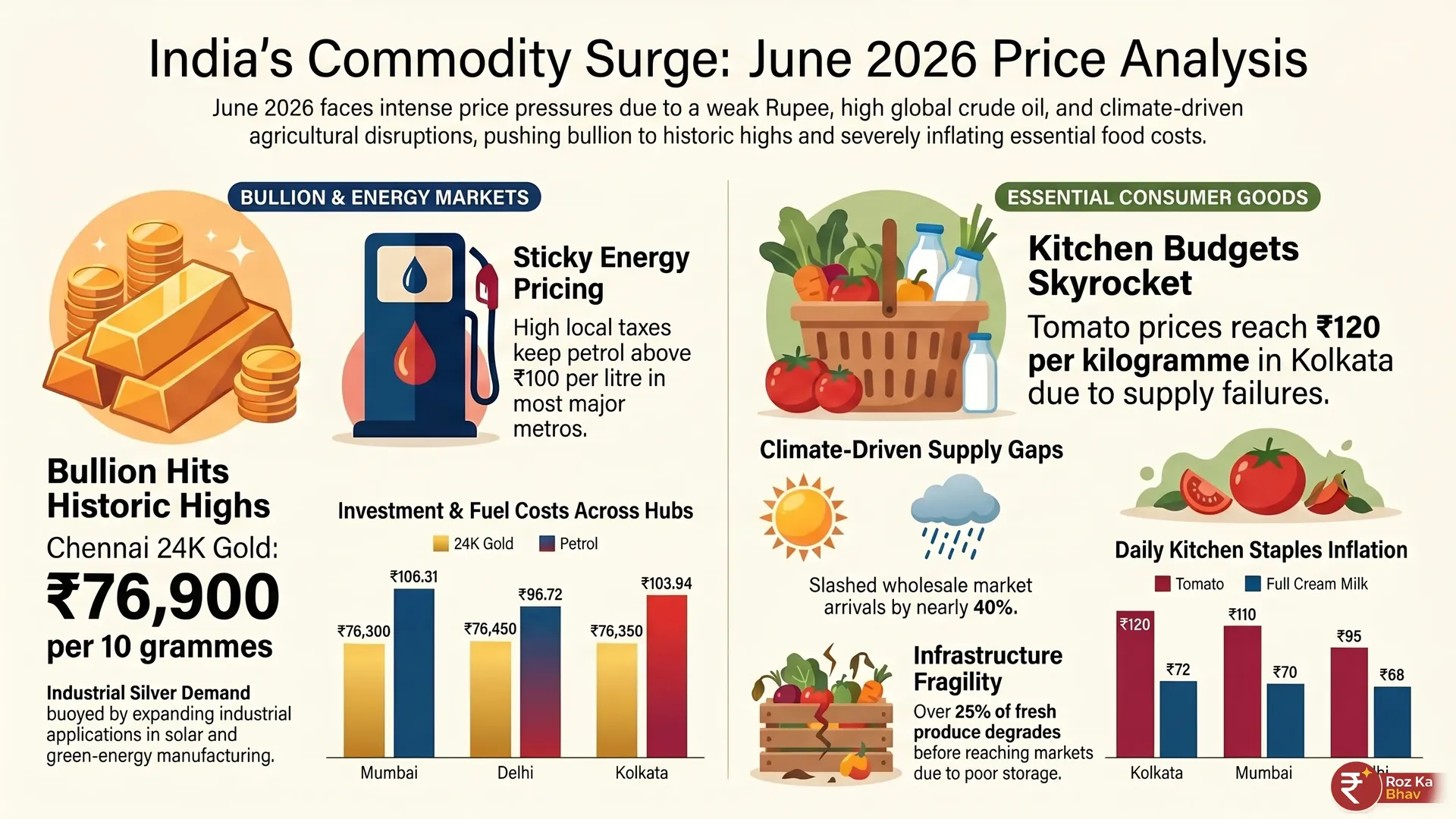
1. Gold and Silver Prices Reach Historic Highs: Bullion Market Analysis
Gold and silver markets inside the Indian subcontinent trade at unprecedented premium levels today. Financial desks attribute this stellar surge to an aggressive mix of international structural adjustments. A softening US Dollar Index, coupled with sustained asset diversification by global central banks, fundamentally redirects capital into safe-haven avenues. On the Multi Commodity Exchange (MCX), gold futures breach critical psychological resistance zones: reflecting a robust domestic demand curve that remains completely unfazed by high entry prices.
Compounding this international momentum is the steady structural depreciation of the Indian Rupee against the US Dollar; which automatically inflates the landing cost of imported bullion. Physical gold demand across major retail centers like Mumbai’s Zaveri Bazaar and Chennai’s T-Nagar indicates that wedding-season purchasing, alongside institutional hedging, actively absorbs available market supply. Silver follows an even more volatile upward trajectory; heavily supported by expanding green-energy industrial applications, specifically in solar photovoltaic manufacturing and next-generation electronic components.
Note: Data based on 2026-06-22.
| City | 24K Gold Price (per 10g) | 22K Gold Price (per 10g) | Silver Price (per 1kg) | Daily Change (%) |
|---|---|---|---|---|
| Delhi | ₹76,450 | ₹70,100 | ₹92,500 | +1.45% |
| Mumbai | ₹76,300 | ₹69,950 | ₹92,200 | +1.38% |
| Kolkata | ₹76,350 | ₹70,000 | ₹92,300 | +1.41% |
| Chennai | ₹76,900 | ₹70,500 | ₹93,100 | +1.62% |
Detailed Regional Bullion Insights
Delhi NCR: The bullion market in the national capital exhibits immense retail resilience. Traders report a 20% year-on-year increase in advanced bookings for sovereign gold coins: as high-net-worth individuals seek shelter from equity market corrections. Institutional desks expect physical premium levels over the international spot price to persist through the quarter.
Mumbai: As the primary hub of bullion importation, Mumbai’s landed costs dictate pan-India benchmarks. High logistics security premiums and local octroi-related compliance costs keep physical metal tightly priced: with local jewelers noting a structural shift towards lighter, high-purity wearable investments.
Chennai: Consistently the highest consumer of physical gold in India, Chennai leads the pricing charts. South Indian retail buyers aggressively prioritize 22K jewelry items despite the massive price tag; viewing the asset as an ultimate financial safety net against broader economic turbulence.
2. Fuel Rates, CNG Pressures, and Transportation Metrics: Energy Watch
The energy matrix across major Indian states remains highly rigid, operating under severe fiscal strain. With international Brent crude oil benchmarks hovering comfortably above the $85-per-barrel mark due to strict OPEC+ production limits and shipping disruptions along major maritime trade corridors; Indian Oil Marketing Companies (OMCs) maintain high retail price points. The freeze on major retail fuel price revisions protects corporate balance sheets but continues to strain consumer disposable incomes.
The operational overheads of freight carriers escalated substantially over the past three quarters. This sticky fuel pricing regime acts as a foundational inflationary force: instantly compounding the transport costs of every single tangible commodity moving across the country. Simultaneously, compressed natural gas (CNG) prices climb steadily across municipal networks; driven by a higher reliance on imported Liquefied Natural Gas (LNG) blends to satisfy India’s growing domestic clean-energy mandates.
Note: Data based on 2026-06-22.
| City | Petrol Price (per Liter) | Diesel Price (per Liter) | CNG Price (per Kg) | Commercial LPG (19kg) |
|---|---|---|---|---|
| Delhi | ₹96.72 | ₹89.62 | ₹79.56 | ₹1,745.00 |
| Mumbai | ₹106.31 | ₹94.27 | ₹87.25 | ₹1,698.00 |
| Kolkata | ₹103.94 | ₹90.76 | ₹84.20 | ₹1,852.00 |
| Chennai | ₹102.63 | ₹94.24 | ₹88.50 | ₹1,910.00 |
Metropolitan Energy Dynamics
Mumbai Fuel Infrastructure: Mumbai continues to bear the highest fuel tax burden among the top metros due to state-specific value-added tax (VAT) layers. Local transport unions officially petitioned for a reduction in cess; warning that commercial freight margins have completely eroded, forcing long-haul operators to cut capacity by nearly 15%.
Kolkata Logistics: In eastern India, supply chains are acutely sensitive to diesel cost fluctuations. The state’s extensive inland waterways and highway corridors see higher operational costs; causing secondary distribution networks to raise delivery surcharges on retail consumer packaged goods.
3. Vegetable and Dairy Prices Skyrocket Across Metros: Kitchen Essentials
Nothing hits closer to home than the current explosive situation in the country’s wholesale and retail food agricultural markets. The average Indian kitchen budget expanded radically over the past sixty days. Agricultural monitoring agencies trace the roots of this current crisis to extreme climatic swings: a severe heatwave disrupted early flower settings in tomato crops, which was immediately followed by heavy, unseasonal downpours that waterlogged key harvest tracts across Maharashtra, Karnataka, and Andhra Pradesh.
The impact on staple items like tomatoes, onions, and potatoes has been brutal. Wholesale arrivals at the Azadpur Mandi in Delhi and the APMC market in Vashi dropped by nearly 40%; triggering panic buying among institutional aggregators and quick-commerce delivery platforms. Concurrently, dairy co-operatives like Amul and Mother Dairy introduced incremental retail price increases for milk variants; citing rising cattle feed expenses and higher processing plant energy bills.
Note: Data based on 2026-06-22.
| City | Tomatoes (per Kg) | Onions (per Kg) | Potatoes (per Kg) | Full Cream Milk (per Liter) |
|---|---|---|---|---|
| Delhi | ₹95 | ₹58 | ₹38 | ₹68 |
| Mumbai | ₹110 | ₹62 | ₹42 | ₹70 |
| Kolkata | ₹120 | ₹65 | ₹40 | ₹72 |
| Chennai | ₹105 | ₹60 | ₹45 | ₹69 |
Evaluating the Food Supply Chain Squeeze
- Perishable Supply Disruptions: Cold storage infrastructure limitations mean that over 25% of fresh arrivals experience quality degradation before reaching secondary retail markets; compounding the upward price spiral.
- The Quick-Commerce Effect: The rapid growth of instant delivery apps alters local market pricing. These tech platforms purchase vast volumes directly from farm gates; outbidding traditional local vendors and driving up neighborhood retail costs.
- Dairy Industry Cost Structure: Structural shifts in dairy operations, along with regular veterinary healthcare cost increases, suggest that these new, higher milk prices are permanent adjustments rather than temporary fluctuations.
Looking ahead, market trackers believe that relief depends entirely on how effectively the monsoon progresses into Central and Northern India. Government interventions, including selling subsidized onions from buffer stocks and easing import rules for pulses, provide minor breathing room, but the broader retail landscape remains highly volatile.
4. Frequently Asked Questions (FAQ)
A: Domestic gold prices climb due to a combination of international safe-haven buying, global currency volatility, and structural depreciation of the Indian Rupee against the US Dollar. These factors automatically elevate the landed cost of imported bullion.
A: Immediate price relief is unlikely. Wholesale traders expect prices to remain elevated for the next 3 to 4 weeks; until fresh harvest cycles from late-monsoon sowing begin arriving at major regional distribution hubs.
A: Retail fuel prices vary across Indian states primarily due to different Value Added Tax (VAT) structures, local municipal cesses, and transportation costs from oil refineries to regional retail outlets.
A: The RBI maintains a highly cautious monetary stance. Economists expect the central bank to keep benchmark repo rates unchanged to prevent these supply-side food shocks from turning into generalized core inflation.
Source & Price Verification – Financial Markets
- Gold & Silver Prices: Data referenced from IBJA, MCX India, and international benchmarks.
- Petrol & Diesel Rates: Daily retail prices sourced from Indian Oil, HPCL, and BPCL.
- Commodity Market Data: Verified using MCX, NCDEX, and government statistical releases.
- Verification Process: Prices are cross-checked with at least two independent official or exchange-based sources before publication.
- Disclaimer: Market prices are indicative and may vary by city, tax structure, or intraday volatility.
Note: Prices are updated daily and cross-checked before publishing. If you notice any discrepancy, please email us at [email protected].