

A complicated matrix of global geopolitical friction, currency fluctuations, and domestic agricultural developments is actively redefining the Indian macroeconomic landscape today. As we step into the fresh trading month of June 2026, both corporate treasuries and everyday consumers are adjusting to structural shifts across core asset classes. The Reserve Bank of India’s updated consumer price framework remains under intense scrutiny; while structural changes in the updated Consumer Price Index (CPI) basket have slightly insulated the official top-line retail print by expanding non-food items, families on the ground continue to face persistent pressure from essential grocery and dairy products. Analysts on Dalal Street point out that while wholesale energy markers show minor moderation, domestic supply bottlenecks act as an immediate floor for kitchen-table inflation.
Understanding these granular trends is absolutely essential for navigating today’s household budget allocations and institutional trading desks alike. The direct impact on consumer wallets is clear: while headline energy bills remain relatively stable, immediate dietary and luxury-hedging costs demand a more defensive fiscal strategy. In this deep-dive market intelligence report, we break down the localized and macroeconomic data driving the bullion, energy, and agri-commodity spaces across primary municipal economic zones in India.
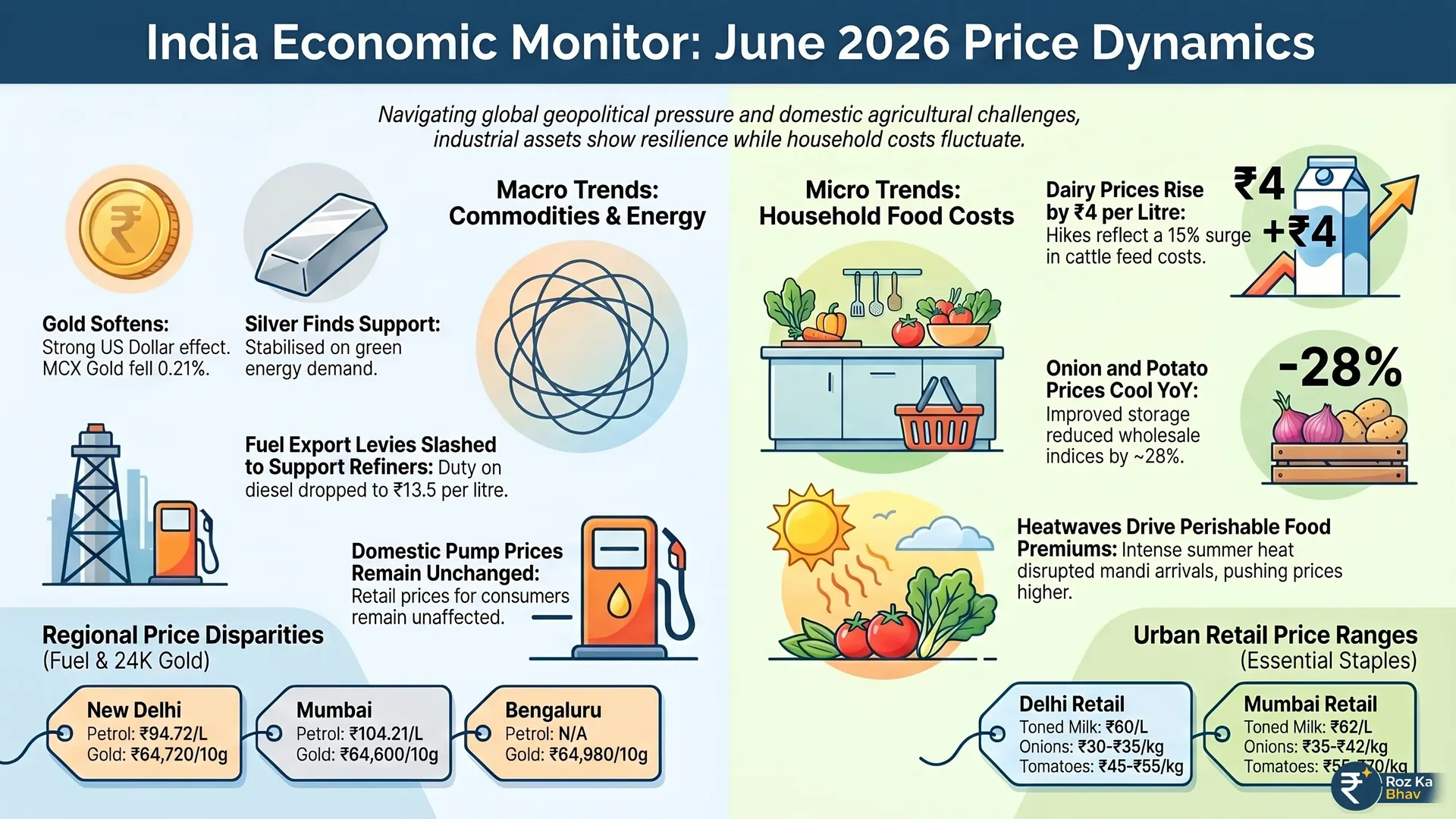
1. Bullion Market Analysis: Gold and Silver Under Pressure
In early domestic trade on the Multi Commodity Exchange (MCX), gold futures for June delivery opened visibly lower, dropping roughly 0.21% to sit at ₹159,272 per 10 grams. This downward pressure follows a choppy extended session where global spot gold hovered around $4,534 per ounce. The yellow metal battles a formidable combination of macroeconomic headwinds; chief among these is a strengthening US Dollar Index (DXY), which has rebounded on the back of persistent, hawkish messaging from US Federal Reserve officials. Central bankers continue to signal a prolonged pause on interest rate cuts, maintaining a high opportunity cost for non-yielding assets.
Furthermore, crude oil benchmark prices remaining sticky above the $100 per barrel mark for three consecutive months has stoked mixed global reactions. While energy-driven inflation typically acts as an ultimate fundamental trigger for safe-haven gold accumulation, in the short term, it has forced defensive positioning into cash and short-term sovereign yield instruments. Domestically, physical gold buyers look closely at structural parameters, particularly as wedding season demand tapers off into the monsoon transition.
Conversely, MCX Silver futures for July delivery managed to stabilize around the ₹2,73,328 per kilogram threshold, highlighting a distinct divergence between the two primary precious metals. Analysts note that silver finds pockets of support from industrial manufacturing buyers who are front-loading stock in anticipation of advanced green energy infrastructure rollouts in East Asia. Technical charting patterns suggest immediate support for MCX Gold at ₹1,57,500, with an upside resistance ceiling capped at ₹1,61,200 for the immediate fortnight.
Metropolitan Bullion Price Breakdowns
In physical spot markets, localized tax variations, octroi, and regional transport premiums have created minor price disparities across jewelry hubs in India:
- Delhi: Retail 24K gold is trading securely at ₹64,720 per 10 grams. Institutional physical demand remains steady despite high initial spot inputs.
- Mumbai: The financial capital presents a slight discount to northern markets, with 24K physical gold priced at ₹64,600 per 10 grams. Bullion desks report measured, volume-based liquidation from retail participants.
- Chennai: Consistently commanding a minor premium due to elevated physical retail affinity, 24K gold stands at ₹64,890 per 10 grams today.
- Bengaluru: The technology hub clocks a retail 24K gold spot rate of ₹64,980 per 10 grams, fueled by localized tech-wealth allocations into physical sovereign bullion bars.
Note: Data based on 2026-06-01.
| City Hub | 22K Gold Price (Per 10g) | 24K Gold Price (Per 10g) | 18K Gold Price (Per 10g) | Silver 99.9% Purity (Per kg) |
|---|---|---|---|---|
| Delhi NCR | ₹59,540 | ₹64,720 | ₹48,540 | ₹2,73,500 |
| Mumbai | ₹59,410 | ₹64,600 | ₹48,440 | ₹2,73,100 |
| Chennai | ₹59,680 | ₹64,890 | ₹48,660 | ₹2,74,200 |
| Bengaluru | ₹59,720 | ₹64,980 | ₹48,700 | ₹2,73,900 |
2. Energy Watch: Fuel Levies Slashed as Domestic Retail Prices Hold Stable
Energy policy took center stage this morning as the Central Government officially implemented its latest fortnightly revision of petroleum export levies. Following an official Ministry of Finance notification, the Special Additional Excise Duty (SAED) on exported petroleum products has been visibly reduced. The export duty on petrol has dropped to ₹1.5 per litre, down from the previous ₹3 per litre, while diesel export levies were dialed back to ₹13.5 per litre. Aviation Turbine Fuel (ATF) exports saw their specific operational tariffs scaled back to ₹9.5 per litre.
These adjustments reflect changing dynamics in international crack spreads. Initially introduced in March 2026 to counter extreme supply volatilities caused by direct geopolitical conflict in West Asia, these levies serve as a critical fiscal tool; they prevent private refiners from starving the domestic market in favor of chasing lucrative international export margins. By reducing these export duties, the government acknowledges a mild cooling in the gross margins available to global refiners, even though crude prices themselves remain stubbornly locked high due to OPEC+ production discipline.
Crucially for domestic consumers, the Ministry has reiterated that there is absolutely no change to the domestic excise duty structure for petrol and diesel sold at local retail outlets. While international benchmarks show high volatility, domestic pump prices remain under a strictly managed, de facto pause. This provides an essential anchor of stability for corporate logistics networks and commercial distribution supply chains, preventing any immediate secondary round of transportation-induced price shocks.
City-Specific Retail Pump Configurations
Because state-level Value Added Taxes (VAT) and localized dealer commissions differ fundamentally, the retail price at the pump shows distinct variations across major state capitals:
Note: Data based on 2026-06-01.
| Metropolitan Capital | Petrol Rate (₹/Litre) | Diesel Rate (₹/Litre) | CNG Commercial Rate (₹/kg) | Primary VAT / State Levy Factor |
|---|---|---|---|---|
| New Delhi | ₹94.72 | ₹87.62 | ₹74.50 | Lowest localized municipal cess configuration. |
| Mumbai | ₹104.21 | ₹92.15 | ₹79.70 | Elevated state fuel surcharge mechanisms. |
| Kolkata | ₹103.94 | ₹90.76 | ₹82.00 | High relative transport-mile logistics addition. |
| Chennai | ₹100.75 | ₹92.34 | ₹80.25 | Moderate state sales tax application. |
3. Kitchen Essentials: Fresh Dairy Hikes and Localized Veggie Trends
While energy and luxury bullion sectors deal with macro global crosscurrents, the micro-economy of the Indian kitchen faces immediate structural challenges. Today, June 1, 2026, marks the official rollout of the Kerala Co-operative Milk Marketing Federation’s (Milma) price increase. It has enacted a flat ₹4 per litre hike across all milk variants throughout its rural and urban distribution chains; this regional move follows systematic adjustments seen nationwide, including the historic ₹2 to ₹4 price corrections introduced by Amul (GCMMF) and Mother Dairy.
The core drivers behind these dairy price increases point to persistent input cost pressures. Severe prolonged drought cycles in key milk-producing belts over the past year have impacted fodder yields, driving cattle feed input costs up over 15%. When combined with higher packaging material inputs and elevated regional transport logistics, dairy cooperatives were forced to pass a portion of these costs on to protect procurement payouts for farmers. Industry data shows that up to 80% of these price increases go directly back to rural dairy farmers, offering essential relief to rural economies facing erratic weather patterns.
Simultaneously, the vegetable wholesale and retail ecosystem is flashing mixed signals. According to recent Wholesale Price Index (WPI) trend readouts, general potato and onion indices have cooled from their historic highs last year, down nearly 30% and 26% year-on-year respectively, thanks to improved cold-storage management and targeted government releases. However, seasonal perishable items like tomatoes, leafy greens, and summer gourds command temporary premiums due to intense summer heatwaves disrupting early arrivals in agrarian mandis.
Metropolitan Retail Essential Cost Mapping
The daily cost of essential food items shows a direct correlation with the proximity of urban markets to agricultural production centers:
- Mumbai: Full cream milk sits high at ₹72 – 76 per litre depending on the brand. Perishable vegetable baskets face minor premiums due to extended logistical supply routes entering the city.
- Delhi NCR: Mother Dairy token milk remains anchored at ₹58 per litre, while packaged full cream options hold at ₹72 per litre. Azadpur Mandi arrivals have stabilized baseline potato and onion retail ranges at an affordable ₹25 – 35 per kilogram.
- Bengaluru: Driven by strong local cooperative networks, base toned milk rates are well-defended, though retail organic vegetable counters in urban pockets show a notable 12% price premium.
Note: Data based on 2026-06-01.
| Essential Commodity Component | Delhi NCR Range | Mumbai Metropolitan | Bengaluru Urban | Kolkata Retail |
|---|---|---|---|---|
| Standard Toned Milk (Per Litre) | ₹60 | ₹62 | ₹58 | ₹61 |
| Full Cream Premium Milk (Per Litre) | ₹72 | ₹74 | ₹72 | ₹73 |
| Onions (Retail Grade per kg) | ₹30 – ₹35 | ₹35 – ₹42 | ₹32 – ₹38 | ₹38 – ₹45 |
| Potatoes (Cold Storage per kg) | ₹22 – ₹28 | ₹28 – ₹34 | ₹30 – ₹36 | ₹26 – ₹32 |
| Tomatoes (Hybrid Variety per kg) | ₹45 – ₹55 | ₹55 – ₹70 | ₹40 – ₹50 | ₹60 – ₹75 |
4. Frequently Asked Questions (FAQs)
Q1: Why did the government reduce fuel export duties if global oil prices are still above $100/barrel?
Answer: Fortnightly export duty revisions are directly linked to international refining margins, known as crack spreads, rather than the raw cost of crude oil alone. As global refining margins eased slightly over the past two weeks, the government reduced the export levy on petrol and diesel to keep domestic refining operations economically viable, ensuring they do not over-export fuel at the expense of domestic fuel pumps.
Q2: Will the recent cuts in fuel export duties bring down retail petrol and diesel prices at local pumps?
Answer: No, retail prices will not see an immediate impact. The Central Government explicitly clarified that domestic excise duties and retail tax structures remain unchanged. The export levy change only applies to petroleum products being shipped outside India by domestic refining corporations.
Q3: What is causing the widespread increase in milk prices by major brands like Amul, Mother Dairy, and Milma?
Answer: The primary drivers are structural input costs. Severe climate conditions and localized droughts have pushed cattle feed and fodder costs up by over 15%. Additionally, dairy cooperatives face higher procurement expenses, transport fuel costs, and packaging overheads, which must be partially passed on to protect farmer payouts.
Q4: Why is MCX gold trading lower despite high global inflation concerns?
Answer: Gold faces immediate pressure from a strengthening US Dollar Index (DXY) and hawkish messaging from the US Federal Reserve. Because the Fed signals that interest rates will remain elevated for longer, institutional investors lean toward short-term yield-bearing assets, capping the immediate upside for non-yielding bullion.
Source & Price Verification – Financial Markets
- Gold & Silver Prices: Data referenced from IBJA, MCX India, and international benchmarks.
- Petrol & Diesel Rates: Daily retail prices sourced from Indian Oil, HPCL, and BPCL.
- Commodity Market Data: Verified using MCX, NCDEX, and government statistical releases.
- Verification Process: Prices are cross-checked with at least two independent official or exchange-based sources before publication.
- Disclaimer: Market prices are indicative and may vary by city, tax structure, or intraday volatility.
Note: Prices are updated daily and cross-checked before publishing. If you notice any discrepancy, please email us at [email protected].
