

India’s Economy Braces for Volatility as Geopolitical Winds Shift
As the sun rose over the financial hubs of Mumbai and Delhi this morning, traders were focused on global shifts as much as local tickers. It is a peculiar time for the Indian consumer. On one hand, the “glitter” of gold is becoming more accessible for middle-class families following a massive price correction; on the other, the cost of a morning cup of chai and evening meals is rising noticeably.
The current reality is a significant tug-of-war between domestic resilience and global anxiety. While the US-Iran conflict has sent ripples through the energy and bullion sectors, the Reserve Bank of India (RBI) is maintaining a neutral stance with a repo rate of 5.25%. It is a delicate balancing act the Sensex and Nifty showed signs of bargain hunting late last week, yet sentiment remains cautious as we enter the final week of March.
Bullion Market: The Sharp Gold Price Correction
Energy Watch: Fuel Rates and Global Crude Pressures
Kitchen Essentials: Rising Dairy and Vegetable Costs
Market FAQ: Your Questions Answered
Bullion Market: The Sharp Gold Price Correction
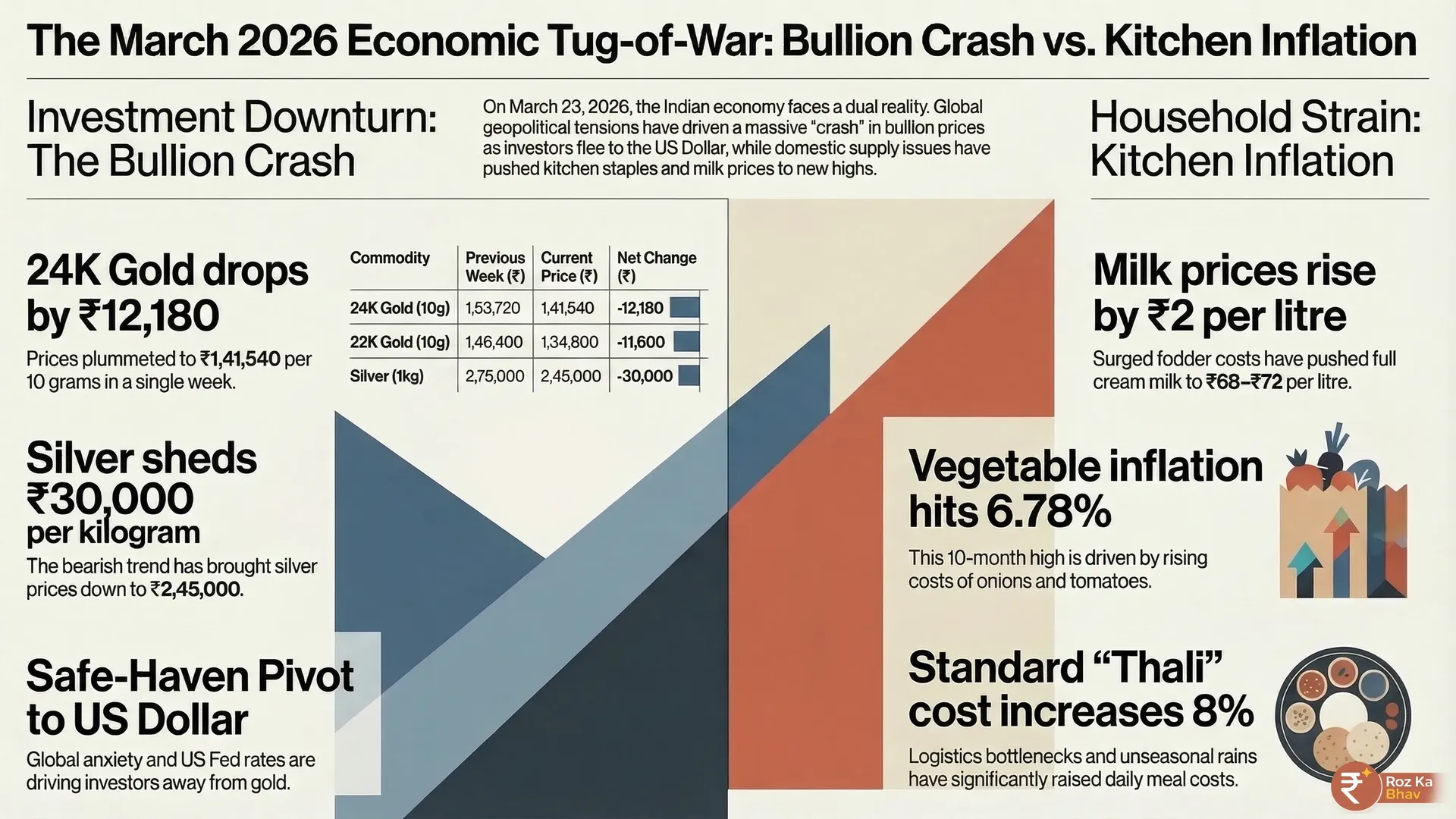
For those waiting for a “dip” to buy gold, the current market offers a significant canyon. Market tracking shows that 24-karat gold has experienced one of its sharpest weekly declines in recent history. Just seven days ago, gold was flirting with record highs; today, the narrative has shifted the price of 24k gold has dropped from roughly ₹15,966 per gram on March 15 to approximately ₹14,597 today.
This shift is driven by ongoing tensions in West Asia combined with the US Federal Reserve’s decision to maintain interest rates between 3.5% and 3.75% — which has pushed investors toward the US Dollar. As the dollar strengthens, gold typically takes a backseat in a classic “risk-off” move. Silver followed a similar downward path, shedding nearly ₹30,000 per kilogram in just one week.
Note: Data based on 2026-03-23.
| Commodity | Price (March 23, 2026) | Price (One Week Ago) | Net Change |
|---|---|---|---|
| Gold (24K per 10g) | ₹1,41,540 | ₹1,53,720 | – ₹12,180 |
| Gold (22K per 10g) | ₹1,34,800 | ₹1,46,400 | – ₹11,600 |
| Silver (per 1kg) | ₹2,45,000 | ₹2,75,000 | – ₹30,000 |
Latest City-Wise Gold Rates
Prices vary across the country due to local taxes and demand. In Mumbai, the 22k gold rate is hovering around ₹13,835 per gram at major outlets like Tanishq and Malabar Gold, while Chennai remains slightly higher due to local levies. You can find more granular data on retail shifts via the latest updates at GoodReturns.
Energy Watch: Fuel Rates and Global Crude Pressures
While gold prices fall, fuel pumps remain relatively still. Petrol and diesel prices in India have stayed unchanged for the past few days, providing a temporary relief for commuters. However, the international backdrop remains volatile Brent crude is currently trading around $107 per barrel. Prices eased slightly after hitting $119 last week, following signals that Iranian energy infrastructure may not be targeted immediately.
This situation provides a reprieve; however, with the Indian crude basket averaging over $101 per barrel this month, pressure on Oil Marketing Companies (OMCs) is mounting. The government is currently absorbing these costs to stabilize inflation but if crude remains above $105, a price revision may occur after current state elections conclude.
Note: Data based on 2026-03-23.
| City | Petrol (per Litre) | Diesel (per Litre) | CNG (per Kg) |
|---|---|---|---|
| New Delhi | ₹94.77 | ₹87.67 | ₹77.09 |
| Mumbai | ₹103.54 | ₹90.03 | ₹77.00 |
| Bengaluru | ₹102.96 | ₹90.99 | ₹90.10 |
| Hyderabad | ₹107.50 | ₹95.70 | ₹96.00 |
CNG prices have shown a slight divergence in Noida, prices are significantly higher at ₹85.70 compared to Delhi’s ₹77.09. This regional disparity continues to affect cross-border commuters who seek savings in the capital. For a full state-wise breakdown, CarDekho’s fuel tracker remains the standard for live data.
Kitchen Essentials: Rising Dairy and Vegetable Costs
The cost of living in Indian metros is being impacted by rising prices for basic necessities. Many consumers have noticed their milk bills increasing major brands like Amul, Mother Dairy, and Gokul raised prices by ₹2 per litre earlier this month, citing higher procurement costs and surging fodder prices.
Vegetable costs are also contributing to the pinch. Wholesale inflation for food articles rose to 2.19% in February, and early March data suggests the trend is accelerating. Potato and onion prices staples of the Indian kitchen are facing upward pressure due to unseasonal rains and logistics bottlenecks. Based on local mandi reports, the cost of a standard “thali” has increased by approximately 8% compared to last year.
Note: Data based on 2026-03-23.
| Item | Average Price (Today) | Trend |
|---|---|---|
| Milk (Full Cream/L) | ₹68 – ₹72 | Increasing |
| Potatoes (per Kg) | ₹25 – ₹35 | Stable to High |
| Onions (per Kg) | ₹35 – ₹50 | Volatile |
| Tomato (per Kg) | ₹40 – ₹60 | Seasonal Hike |
According to reports from Hindustan Times, the dairy hike is partially linked to increased exports of Indian milk powder, which has tightened the domestic supply. While beneficial for the trade balance, it presents challenges for households managing daily grocery expenses.
Frequently Asked Questions
1. Why did gold prices fall in March 2026?
The primary drivers are the strengthening US Dollar and a shift toward liquid assets amid the US-Iran conflict. Additionally, sustained interest rates from the US Fed have made non-yielding assets like gold less attractive to investors.
2. Will petrol and diesel prices increase in India soon?
While rates are currently stable, Brent crude at $107 per barrel pressures Indian OMCs. Many analysts anticipate a hike of ₹2 – ₹3 per litre if global prices do not cool by early April.
3. Is it a good time to invest in the Indian stock market?
The Nifty is testing support near 23,100. While the long-term outlook is supported by a 7.4% GDP forecast, short-term volatility remains due to global tensions. Selective entries in IT and Banking may offer value for long-term investors.
4. Why are milk prices rising despite steady production?
Farmer procurement costs have risen due to expensive fodder. Furthermore, high international demand for Indian milk products has reduced domestic surplus, leading to the ₹2 per litre hike across major brands.
The final week of March is typically a period for tax planning and financial settling. This year, it is also a time for close price-watching. Whether you are hedging with gold or managing monthly grocery bills, staying informed is the best defense against market volatility.
Source & Price Verification – Financial Markets
- Gold & Silver Prices: Data referenced from IBJA, MCX India, and international benchmarks.
- Petrol & Diesel Rates: Daily retail prices sourced from Indian Oil, HPCL, and BPCL.
- Commodity Market Data: Verified using MCX, NCDEX, and government statistical releases.
- Verification Process: Prices are cross-checked with at least two independent official or exchange-based sources before publication.
- Disclaimer: Market prices are indicative and may vary by city, tax structure, or intraday volatility.
Note: Prices are updated daily and cross-checked before publishing. If you notice any discrepancy, please email us at [email protected].