

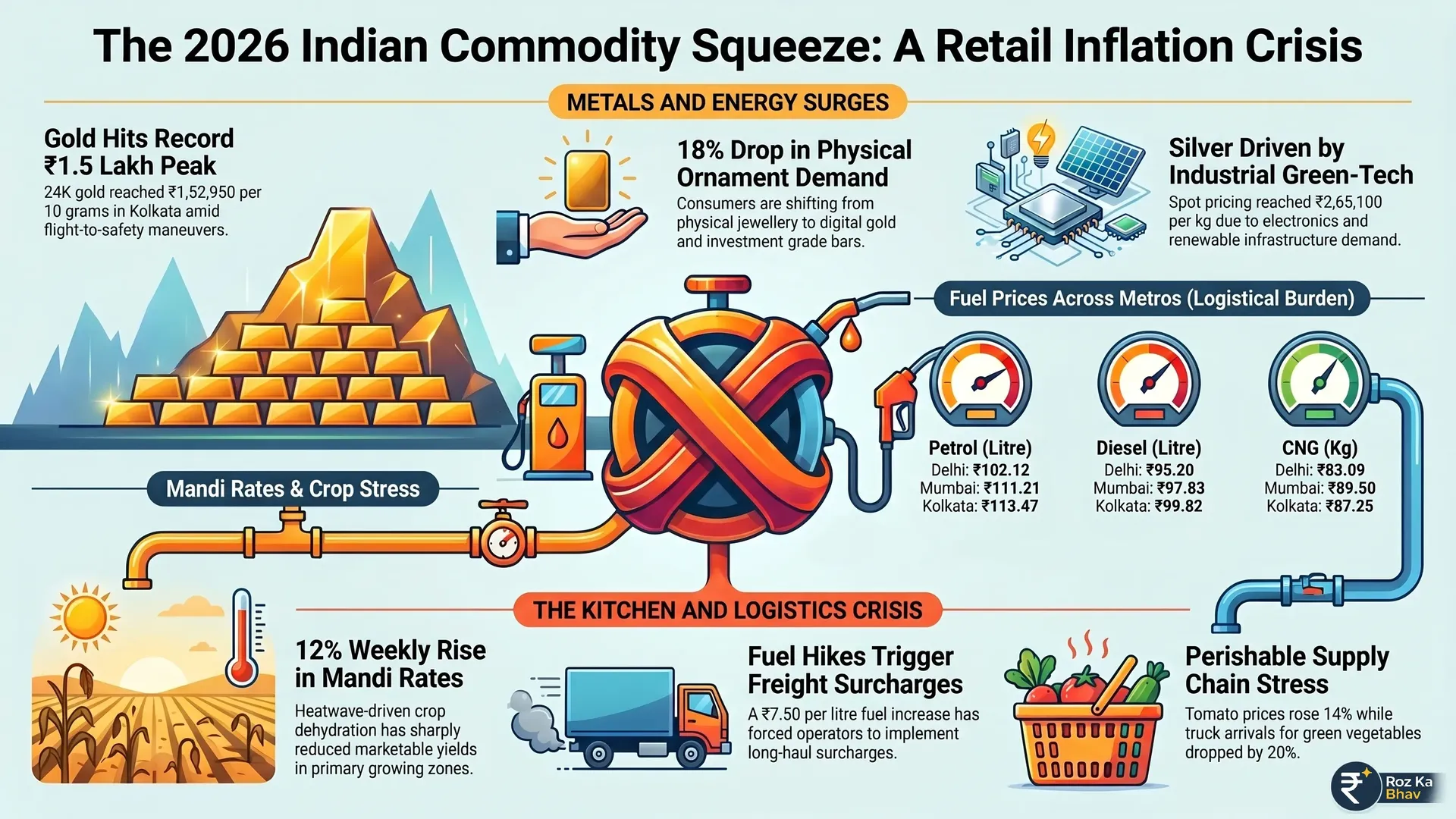
Quick Summary: Today, May 30, 2026, the Indian retail landscape faces a multi-pronged commodity squeeze. Retail fuel prices remain at multi-year highs following consecutive updates; petrol is hovering at ₹111.21/litre in Mumbai and ₹102.12/litre in Delhi. Concurrently, international safe-haven dynamics have propelled 24K gold past ₹15,200 per gram across major bullion desks, while industrial silver trends higher at ₹2,63,966 per kg. Compounding urban household pressures, an intense summer heatwave across northwest and central India has blocked fresh vegetable and dairy supply lines, raising retail mandi rates by 12% week-on-week.
The retail marketplace across urban India is confronting intricate economic crosscurrents today. Macroeconomic structural pressures, driven heavily by persistent geopolitical friction in West Asia and local climate stress, are filtering directly down to the consumer wallet. Over the past fortnight, state-run Oil Marketing Companies (OMCs) broke a long period of price stability to implement multiple fuel revisions; this shift has pushed transport logistics and daily commutes to historical highs. Meanwhile, standard market portfolios are experiencing notable volatility: bullion prices have seen dramatic daily shifts as institutional capital seeks safety against global economic uncertainties. On the home front, basic sustenance has become more expensive; mandi arrivals for critical summer vegetables have dwindled under severe heatwaves, presenting immediate challenges to the Reserve Bank of India’s (RBI) near-term retail inflation targets.
Table of Contents
1. Today’s Gold Rate and Silver Price Trends in India
India’s physical bullion markets continue to show substantial price elevation as global macroeconomic risks influence asset allocations. Today, precious metal desks report 24-carat pure gold changing hands at approximately ₹15,278 per gram in the national capital, reflecting minor consolidative softening from the historical peaks recorded earlier in May. Market analysts on Dalal Street emphasize that the broad trajectory remains firmly bullish, driven by institutional flight-to-safety maneuvers, central bank allocations, and currency alignment adjustments. While peak marriage seasonal physical demand has paused for the summer, retail investment via digital gold platforms and sovereign tranches continues to find support at these higher levels.
Silver has simultaneously logged dramatic moves. Industrial demand across renewable infrastructure alongside classic ornamental fabrication has pulled local spot pricing to an unprecedented ₹2,63,966 per kilogram, according to metrics tracked by the India Bullion and Jewellers Association (IBJA). Experts highlight that silver’s dual character serving as an essential industrial input for modern electronics and a cost-effective alternative store of wealth has attracted significant retail speculative interest. The sharp compression of global mine supply versus expanding green-tech industrial applications suggests that the gold-to-silver ratio is poised for further tight realignments in the upcoming quarters.
— Senior Commodity Strategist, Dalal Street Advisory
Note: Data based on 2026-05-30.
| Bullion Category (Purity / Weight) | Mumbai Spot (₹) | Delhi Spot (₹) | Chennai Spot (₹) | Kolkata Spot (₹) |
|---|---|---|---|---|
| 24K Gold (per 10 Grams) | 1,52,460 | 1,52,780 | 1,52,460 | 1,52,950 |
| 22K Gold (per 10 Grams) | 1,44,500 | 1,45,500 | 1,44,500 | 1,44,950 |
| 18K Gold (per 10 Grams) | 1,18,310 | 1,18,310 | 1,17,900 | 1,18,500 |
| Industrial Silver (per 1 Kilogram) | 2,63,966 | 2,64,500 | 2,65,100 | 2,63,966 |
Metropolitan Regional Bullion Breakdown
In New Delhi and the broader National Capital Region (NCR), 24K gold prices are maintaining a subtle premium, closing near ₹15,278 per gram due to robust local institutional wealth placement. Down south in Chennai, physical trade premiums are holding firm because of structural wedding asset traditions, even amid elevated nominal prices. Meanwhile, Mumbai’s Zaveri Bazar has observed a clear pivot toward institutional derivative clearing and digital gold contracts; retail footfall for physical ornaments has declined by 18% compared to last spring, replaced by a preference for lighter, investment-grade bullion bars. In Kolkata, localized retail buying remains selective, focused on sovereign coins and certified hallmarked offerings.
2. Petrol Price, Diesel Rates, and CNG Supply Dynamics
The domestic transport network is absorbing significant cost adjustments as state-run oil companies pass through higher international refining margins. Following a sequence of upward adjustments over the past few weeks, retail fuel distribution stations have kept prices steady for today’s morning cycle. However, the cumulative increase of nearly ₹7.50 per litre over the past month has altered operational assumptions for fleet operators and urban commuters alike. In Delhi, retail petrol stands at ₹102.12 per litre, while diesel is holding at ₹95.20 per litre. Financial hubs like Mumbai continue to experience the highest structural tax impact, with petrol retailing at ₹111.21 per litre.
Compounding this distribution cost pressure, Compressed Natural Gas (CNG) networks have registered consecutive price hikes. In the Delhi-NCR perimeter, natural gas prices climbed by ₹2 per kilogram earlier this week to settle at ₹83.09 per kg. City gas distribution companies cite rising import procurement expenses for Liquefied Natural Gas (LNG) and a restricted allocation of domestic pool gas as primary drivers for the revision. This combined energy price increase has begun pushing freight operators to implement surcharges on long-haul routes, threatening secondary inflationary impacts on retail manufacturing and FMCG supply chains.
Note: Data based on 2026-05-30.
| Metropolitan City | Petrol Rate (₹/Litre) | Diesel Rate (₹/Litre) | CNG Rate (₹/Kg) | Last Revision Impact |
|---|---|---|---|---|
| Mumbai | 111.21 | 97.83 | 89.50 | + ₹2.61 / Litre Average Change |
| Delhi | 102.12 | 95.20 | 83.09 | + ₹2.71 / Litre Average Change |
| Kolkata | 113.47 | 99.82 | 87.25 | + ₹2.65 / Litre Average Change |
| Chennai | 107.87 | 99.66 | 88.00 | + ₹2.60 / Litre Average Change |
| Bengaluru | 110.93 | 98.80 | 86.50 | + ₹2.55 / Litre Average Change |
City Logistics and Public Transport Outlook
The transport economy in cities like Mumbai, Bengaluru, and Kolkata is responding quickly to these fuel adjustments. In Bengaluru, several tech-corridor transport associations have formally petitioned for a structural review of auto-rickshaw and ride-hailing baseline tariffs. In Kolkata, private bus syndicates warn that multiple routes could become unviable without immediate state fuel subsidies or fare restructuring, as diesel sits just short of the ₹100 threshold. In Delhi-NCR, auto and taxi unions have stated that the ₹2/kg increase in CNG has removed the operational cost advantage of green fleets, prompting demands for unified retail fuel pricing guidelines under a single national framework.
3. Kitchen Inflation: Vegetable Rates & Dairy Prices
The weekly cost of essential foods has risen noticeably as extreme summer temperatures impact agricultural logistics. Mandi officials from Azadpur in Delhi and Vashi in Navi Mumbai report a sharp drop in fresh crop arrivals from regional farming clusters. Essential vegetables, including tomatoes, onions, and potatoes, have registered double-digit retail price gains over the past week. Crop dehydration and heatwave damage in primary growing zones across Maharashtra, Madhya Pradesh, and Uttar Pradesh have reduced marketable yields, driving up wholesale procurement rates.
The dairy sector is experiencing similar, although less volatile, upward cost pressures. Cooperative distribution networks note that extreme summer conditions have disrupted fodder collection and lowered milk yields across major cattle belts. While leading cooperatives like Amul and Mother Dairy have maintained steady consumer pricing over the last few weeks, procurement costs at the farm-gate level are climbing. Market observers suggest that if these climate conditions persist into June, processors may implement a marginal retail adjustment to cover rising cold-chain storage and fuel transport costs.
Note: Data based on 2026-05-30.
| Essential Food Commodity | Wholesale Mandi Avg (₹/Quintal) | Retail Urban Avg (₹/Kg or Litre) | Weekly Price Trend | Primary Driver |
|---|---|---|---|---|
| Tomatoes (Hybrid Variety) | 4,200 | 55 – 70 | Upward (+14%) | Heatwave-driven harvest damage |
| Onions (Nashik Quality) | 2,800 | 40 – 50 | Stable to Marginal High | Sufficient cold-storage inventory |
| Potatoes (Jyoti Variety) | 2,100 | 30 – 38 | Upward (+8%) | Elevated cold-chain transport costs |
| Standard Toned Milk | — | 56 – 58 | Stable | Cooperative buffer management |
| Full Cream Premium Milk | — | 68 – 72 | Firm | Rising dairy processing costs |
Regional Mandi Updates: North vs. South India
In northern distribution zones, local supply pipelines for green vegetables like okra, gourds, and coriander have experienced significant heat stress, leading to a 20% drop in daily truck arrivals. Retail outlets in Delhi are relying heavily on cold-storage varieties and long-distance transport from cooler hilly belts, which adds a premium to final consumer prices. In southern consumption hubs like Chennai and Hyderabad, Vegetable Prices are relatively more stable due to steady arrivals from peripheral irrigation networks, though high transportation costs keep retail shelf prices firm. For dairy distribution, western cooperatives report steady output, but urban distribution chains are spending more on refrigeration logistics to prevent transit spoilage during peak daylight hours.
4. Frequently Asked Questions (FAQ)
Source & Price Verification – Financial Markets
- Gold & Silver Prices: Data referenced from IBJA, MCX India, and international benchmarks.
- Petrol & Diesel Rates: Daily retail prices sourced from Indian Oil, HPCL, and BPCL.
- Commodity Market Data: Verified using MCX, NCDEX, and government statistical releases.
- Verification Process: Prices are cross-checked with at least two independent official or exchange-based sources before publication.
- Disclaimer: Market prices are indicative and may vary by city, tax structure, or intraday volatility.
Note: Prices are updated daily and cross-checked before publishing. If you notice any discrepancy, please email us at [email protected].
