

Quick Summary: Indian commodity markets are experiencing a dynamic shift today. Bullion prices are stabilizing following hawkish signals from global central banks, while domestic gold hovers near critical support levels. Simultaneously, crude oil fluctuations keep local petrol and diesel rates steady under national oil marketing companies’ freeze. In retail markets, kitchen essentials face seasonal pressures: Vegetable Prices remain elevated in metropolitan areas due to uneven monsoon distribution, whereas dairy prices exhibit resilience on steady institutional procurement costs.
Today’s domestic market narrative is defined by a complex intersection of macroeconomics, geopolitical standoffs, and localized seasonal constraints. As Indian households navigate a stickier inflationary landscape, commodities are reflecting rapid changes. From the glinting trading floors of Zaveri Bazaar to the bustling wholesale lanes of Azadpur Mandi, macro indicators are directly transforming consumer purchasing power and corporate margins alike.
Table of Contents
1. Bullion Market: Gold and Silver Prices in India
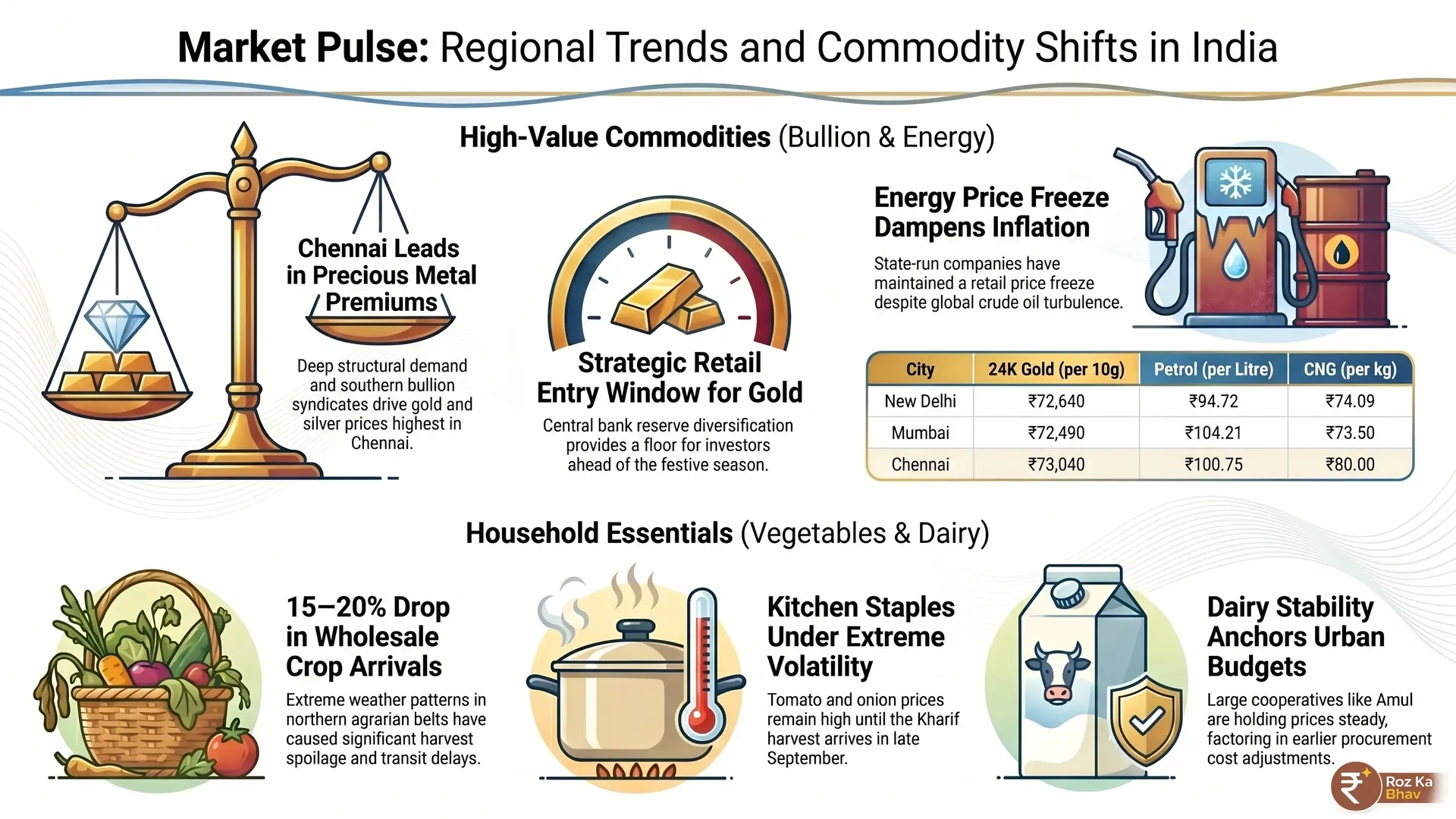
The domestic bullion market is witnessing a phase of intense consolidation; precious metals are reacting sharply to shifting expectations surrounding international interest rate cycles. As the US Federal Reserve maintains a cautious posture on monetary easing, the benchmark spot gold price has faced resistance on the global stage, translating into a tightly bound trading range on the Multi Commodity Exchange (MCX) in India.
Market analysts note that despite these near-term headwinds, institutional appetite for gold as a systemic hedge remains exceptionally robust. The Reserve Bank of India (RBI) – along with other emerging market central banks has continued its strategic diversification into gold reserves, providing a solid floor under domestic prices. For retail investors, this means that any significant dip under the current psychological thresholds could represent a strategic accumulation window ahead of the upcoming festive and marriage season.
Silver has continued to showcase higher volatility compared to its yellow counterpart. Driven by dual impulses both as a monetary store of value and an industrial asset crucial for green technologies, solar photovoltaics, and electric vehicle components silver prices are testing crucial support levels. Supply chain constraints across major global mines have kept physical stockpiles low, preventing a deeper correction in industrial silver rates.
Note: Data based on 2026-06-20.
| City | 22K Gold (per 10g) | 24K Gold (per 10g) | Silver (per 1kg) |
|---|---|---|---|
| Mumbai | ₹66,450 | ₹72,490 | ₹88,500 |
| Delhi | ₹66,600 | ₹72,640 | ₹88,500 |
| Chennai | ₹66,950 | ₹73,040 | ₹93,000 |
| Kolkata | ₹66,450 | ₹72,490 | ₹88,500 |
| Bengaluru | ₹66,500 | ₹72,550 | ₹89,200 |
City-Specific Gold and Silver Rates Breakdown
Mumbai & Kolkata: Traditionally aligned due to similar logistical and supply-line linkages from major refining hubs, retail gold prices in these financial and cultural centers are trading uniformly. Local jewelers report steady physical demand for lightweight gold coins and bars; this trends indicates a clear consumer preference for investment-grade bullion over high-premium jewelry items.
Delhi: The National Capital Region is displaying its usual slight premium over the western markets, largely attributed to regional transshipment costs and localized retail markups. Physical delivery volumes at regional vaults remain steady, though buyers are exhibiting extreme price sensitivity near the ₹73,000 per 10 grams mark for 24K pure gold.
Chennai: South India’s preeminent bullion hub continues to trade at a noticeable premium. Chennai’s structurally distinct appetite for physical silver has pushed local silver rates to ₹93,000 per kilogram, significantly higher than northern and western pricing. This divergence highlights strong regional demand and higher localized premiums charged by Southern bullion syndicates.
2. Energy Watch: Petrol, Diesel, and CNG Rates Today
The energy complex remains a critical pivot for India’s macro stability. State-run Oil Marketing Companies (OMCs) like Indian Oil Corporation (IOCL), Bharat Petroleum (BPCL), and Hindustan Petroleum (HPCL) have maintained a steady hand on retail pump prices today. This retail price freeze persists despite substantial turbulence in Brent crude futures, which are fluctuating due to geopolitical tensions in the Middle East and voluntary production adjustments from the OPEC+ alliance.
While international crude dynamics hover in a delicate balance, domestic fuel pricing continues to act as a primary transmission channel for broader inflationary pressures. Retail logistics providers and heavy freight operators are adjusting to these prolonged high baselines; the steady pricing offers a breather for structural supply chains, preventing further spikes in secondary transportation costs for basic consumer goods.
Note: Data based on 2026-06-20.
| Metropolitan City | Petrol (per Litre) | Diesel (per Litre) | CNG (per Kg) |
|---|---|---|---|
| New Delhi | ₹94.72 | ₹87.62 | ₹74.09 |
| Mumbai | ₹104.21 | ₹92.15 | ₹73.50 |
| Kolkata | ₹103.94 | ₹90.76 | ₹87.50 |
| Chennai | ₹100.75 | ₹92.34 | ₹80.00 |
Regional Fuel Price Variations Explained
The wide dispersion in fuel rates across state lines is directly tied to the cascading impact of local Value Added Tax (VAT) and freight surcharges. For example, vehicle owners in Mumbai continue to shoulder some of the highest fuel expenses in the country, with petrol trading significantly above the ₹100 threshold; this layout contrasts starkly with New Delhi, where lower state-level fiscal levies keep retail rates comparatively subdued.
Meanwhile, the market for Compressed Natural Gas (CNG) is witnessing expanding infrastructure adoption. Public transport fleets and private commuters are progressively switching to gas-powered powertrains to escape high liquid fuel outlays. However, regional pricing for natural gas remains highly fragmented, with Kolkata exhibiting steep costs due to logistical bottlenecks in eastern pipeline connectivity compared to the well-established Western gas grids.
3. Kitchen Essentials: Vegetable and Dairy Price Trends
The most immediate pressure on urban Indian household balance sheets is originating right inside the kitchen. The critical vegetable segment is undergoing substantial price volatility; this escalation is driven by seasonal supply variations exacerbated by an uneven monsoon distribution across central and northern agrarian belts. Excess heat waves early in the season, followed by localized deluge conditions, have disrupted harvest timelines and caused significant spoilage during transit.
Staples such as tomatoes, onions, and potatoes collectively referred to as the TOP crop complex are seeing heightened price pressures at prominent retail outlets. Wholesalers at agricultural produce market committees (APMCs) indicate that incoming crop shipments from major rural supply pockets like Nashik, Indore, and parts of Karnataka have dropped by roughly 15 to 20 percent over the past two weeks, creating an immediate supply-demand mismatch in consumption markets.
Note: Data based on 2026-06-20.
| Commodity / Item | Delhi NCR (Avg) | Mumbai Retail | Bengaluru Retail |
|---|---|---|---|
| Tomatoes (per Kg) | ₹60 – ₹75 | ₹65 – ₹80 | ₹55 – ₹70 |
| Onions (per Kg) | ₹45 – ₹55 | ₹50 – ₹62 | ₹42 – ₹52 |
| Potatoes (per Kg) | ₹30 – ₹38 | ₹35 – ₹42 | ₹32 – ₹40 |
| Standard Milk (per Litre) | ₹56 – ₹58 | ₹57 – ₹60 | ₹54 – ₹56 |
Evaluating the Food Inflation Landscape
The dairy sector, a crucial source of daily protein for millions, offers a more stable outlook than the volatile vegetable sector. Leading cooperatives like Amul and Mother Dairy have held prices steady following adjustments made earlier in the year to counter rising fodder and processing costs. Analysts suggest that unless cattle feed costs experience another upward breakout, fluid milk prices should remain anchor-steady through the current quarter.
Conversely, green vegetables such as coriander, ladyfinger, and cauliflowers are commanding steep premiums in major cities. In Mumbai, severe rain-induced disruptions at the Vashi APMC have driven up distribution overheads, forcing neighborhood vendors to pass these costs directly onto buyers. Government interventions, including open market sales of buffer stocks of onions and pulses, are currently serving as vital backstops to prevent unbridled food inflation from derailing broader economic momentum.
4. Frequently Asked Questions (FAQs)
Q1: Why do gold rates differ significantly between Mumbai and Chennai?
Ans: Gold price differentials between Indian cities are driven by variations in local jewelry association policies, differing state-level transportation surcharges, and localized demand dynamics. Chennai often exhibits higher premiums because of structural retail demand for physical bullion and distinct local market structures that differ from the import-centric Mumbai hubs.
Q2: Will fuel prices decrease in India anytime soon given global crude oil stabilization?
Ans: While global crude oil prices have settled into a steadier trading band, domestic petrol and diesel rate cuts are contingent upon policy decisions by state-run Oil Marketing Companies (OMCs) and potential revisions to central excise or state VAT structures. OMCs are currently using stable crude periods to recoup past under-recoveries and balance operational margins.
Q3: When can consumers expect vegetable prices to normalize in metropolitan areas?
Ans: Agricultural analysts project that retail vegetable prices will begin to stabilize once the main Kharif harvest arrivals start entering wholesale mandis. This normalization typically begins around late September or early October, provided the remaining monsoon phases distribute evenly across key agricultural regions.
Q4: Are dairy prices expected to rise further before the end of the year?
Ans: Current projections suggest dairy prices will remain stable over the medium term. Major cooperative dairies have already factored in historical increases in procurement and logistical expenses. Barring any sudden spikes in animal disease outbreaks or severe fodder scarcities, retail milk rates are poised for an extended period of pricing stability.
Source & Price Verification – Financial Markets
- Gold & Silver Prices: Data referenced from IBJA, MCX India, and international benchmarks.
- Petrol & Diesel Rates: Daily retail prices sourced from Indian Oil, HPCL, and BPCL.
- Commodity Market Data: Verified using MCX, NCDEX, and government statistical releases.
- Verification Process: Prices are cross-checked with at least two independent official or exchange-based sources before publication.
- Disclaimer: Market prices are indicative and may vary by city, tax structure, or intraday volatility.
Note: Prices are updated daily and cross-checked before publishing. If you notice any discrepancy, please email us at [email protected].