

Macroeconomic dynamics across the Indian subcontinent are shifting rapidly today as international geopolitics collide directly with local structural bottlenecks. While domestic bullion investors catch their breath following a minor correction in precious metals, commuters and fleet operators continue to absorb steep fuel overheads that remain completely unyielding to the broader global crude oil retreat. What this means for your wallet is an immediate dual reality: easing entry barriers for financial safe-havens, countered by rigid daily operational and basic dietary expenses that refuse to buckle under central bank target mechanisms.
Table of Contents
1. Gold and Silver Rate Today: Indian Bullion Market Breakdown
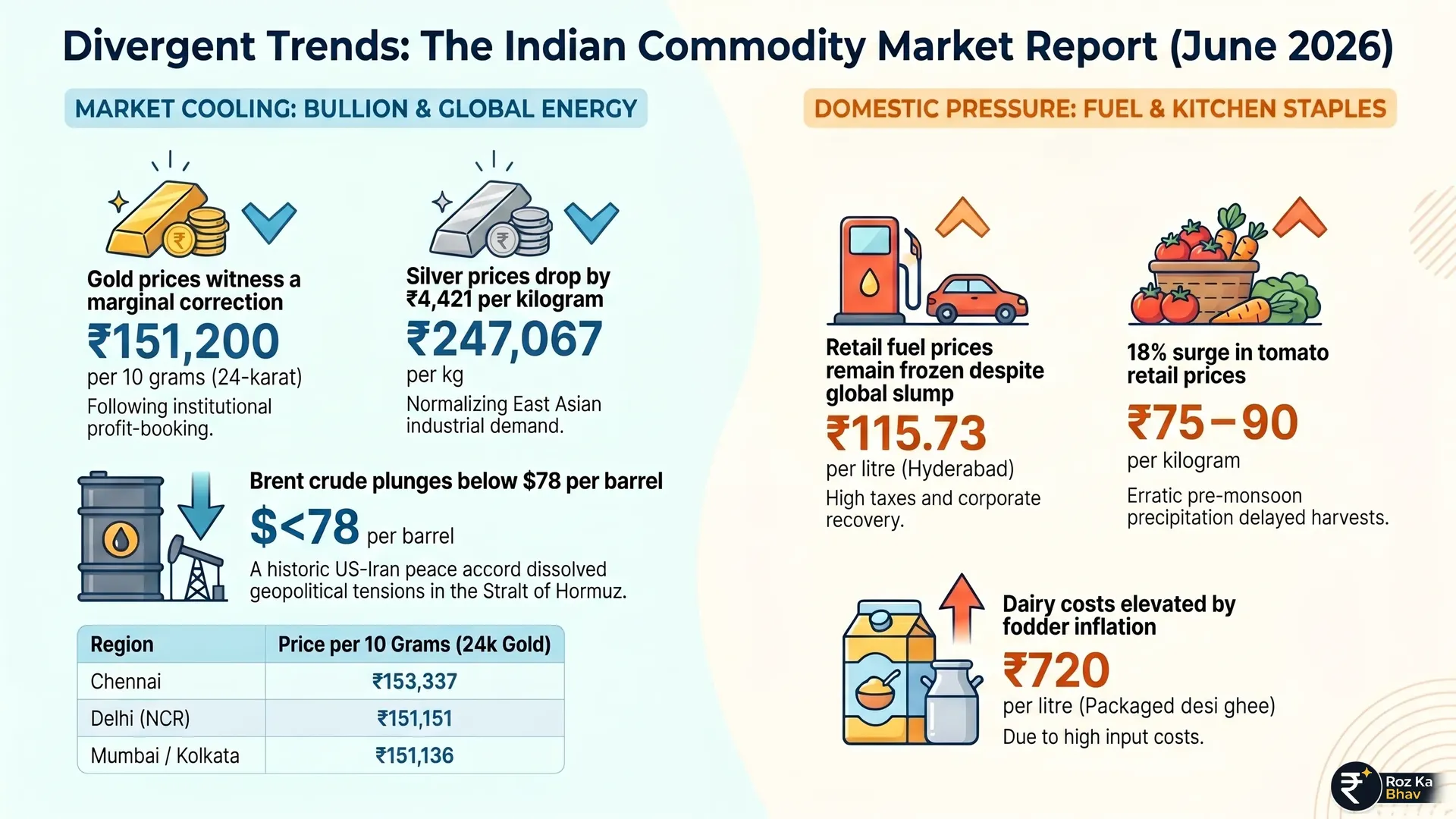
The gold rush that dominated early 2026 has hit an interesting technological and macroeconomic technical resistance level. Market analysts at Dalal Street note that profit-booking from institutional funds has combined with an appreciation cycle for the US Dollar, momentarily stealing the limelight from non-yielding commodities. Today, fine gold (999 purity) marks its spot at ₹151,200 per 10 grams, highlighting a mild drop from early-week peaks. Concurrently, 22-karat gold the baseline standard for traditional Indian jewelry is hovering around ₹138,500, offering retail consumers a slight reprieve before the upcoming festive and wedding seasons resume full-scale momentum.
Silver has felt an even deeper correction today. Industrial demand indicators from East Asia have shown brief periods of normalization, cooling speculative premiums. Indian industrial buyers and retail collectors are currently looking at a silver spot price of ₹247,067 per kilogram, down significantly from recent structural highs that crossed the ₹250,000 threshold earlier in the month. Long-term asset managers maintain that this represents a structural correction rather than a multi-year reversal, as global central banks keep structural liquidities tightly wound.
Note: Data based on 2026-06-18.
| Metal / Purity Type | National Average Price (INR) | Daily Absolute Change | Market Sentiment Status |
|---|---|---|---|
| Fine Gold (24K / 10 Grams) | ₹151,200 | – ₹270 | Mildly Bearish (Short-term) |
| Jewelry Gold (22K / 10 Grams) | ₹138,500 | – ₹250 | Consolidating |
| Standard Gold (18K / 10 Grams) | ₹113,400 | – ₹200 | Stable Volume |
| Industrial Silver (999 Purity / 1 Kg) | ₹247,067 | – ₹4,421 | Correction Phase |
Gold Rates Today in Major Indian Cities
Chennai: True to historical retail structural patterns, Chennai holds the highest consumer premium for physical gold in India today. Due to massive regional retail consumption and high logistical state levies, 24-karat gold commands a steep ₹153,337 per 10 grams, keeping southern retail jewelers on a highly cautious operational path.
Mumbai & Kolkata: The corporate financial capital and the primary eastern trading hub are moving symmetrically today. Physical gold in both Mumbai and Kolkata settles uniformly at ₹151,136 per 10 grams for 24-karat variants, exhibiting strong intraday institutional liquidity and tight physical delivery spreads.
Delhi NCR: In the National Capital Region, standard fine gold prices printed at ₹151,151 per 10 grams. The marginal premium over Mumbai reflects regional transit logistics and local bullion processing overheads, with retail consumer footfall in Chandni Chowk remaining steady despite the broader correction.
2. Petrol and Diesel Prices: Stagnant Pumps Amidst Global Crude Oil Deflation
The global energy framework underwent a paradigm shift this week as the official signing of the historic US-Iran trade and diplomatic accord took place. Geopolitical stress markers across the critical Strait of Hormuz dissipated immediately, sending international benchmark Brent crude plunging down towards the lower bound of $78 per barrel. Yet, back home, State-run Oil Marketing Companies (OMCs) have deliberately extended their freeze on retail pump prices. For the average commuter, the divergence between plummeting global raw energy inputs and unyielding local costs remains a prominent financial point of contention.
According to energy sector reports, domestic downstream players are leveraging this widening spread to fully offset previous multi-quarter under-recoveries. While corporate margins recover, the downstream macroeconomic effect is clear: high logistics overheads remain built into manufacturing and nationwide product distribution channels, preventing secondary retail categories from passing along production discounts to end consumers.
Note: Data based on 2026-06-18.
| Metropolitan City | Petrol Rate (per Litre) | Diesel Rate (per Litre) | Compressed Natural Gas (CNG) |
|---|---|---|---|
| New Delhi | ₹102.12 | ₹95.20 | ₹83.09 / Kg |
| Mumbai | ₹111.18 | ₹97.83 | ₹89.50 / Kg |
| Kolkata | ₹113.51 | ₹99.82 | ₹87.45 / Kg |
| Hyderabad | ₹115.73 | ₹103.82 | ₹93.00 / Kg |
| Bengaluru | ₹110.93 | ₹98.80 | ₹88.20 / Kg |
Fuel Rates Across States and Logistics Impact
The domestic price variance across states highlights the compounding impact of regional Value Added Taxes (VAT). Hyderabad continues to lead the major metros with petrol costing ₹115.73 per litre and diesel fixed at a punishing ₹103.82 per litre. This marks an extensive premium over New Delhi, where localized tax cuts keep petrol pinned down at ₹102.12 per litre.
Logistical operators point out that these geographic discrepancies significantly distort interstate freight transport corridors. Trucking fleets operating out of south Indian manufacturing centers are facing up to an 8% higher fuel operating cost compared to northern logistics networks, adding an unseen structural layer to consumer goods moving across state boundaries.
3. Kitchen Budget Impact: Rising Costs of Daily Vegetables and Dairy
While financial markets dissect bullion price curves, the real battle for inflation management is playing out inside local wholesale agricultural produce markets (APMCs). Erratic pre-monsoon precipitation patterns across primary agrarian belts in Maharashtra, Karnataka, and Uttar Pradesh have structurally impaired harvesting timelines. The disruption has caused sharp spikes in volatile kitchen staples most notably onions, tomatoes, and green chilies forcing family budgets to adapt rapidly to escalating daily procurement fees.
Parallel to the vegetable supply squeeze, the dairy sector is dealing with structural fodder price inflation. Major regional milk cooperatives have implemented localized retail adjustments to sustain dairy supply lines, keeping basic essential nutrition costs highly elevated for urban mid-tier households.
Note: Data based on 2026-06-18.
| Essential Household Food Commodity | Wholesale Unit Index (APMC) | Average Urban Retail Price | Month-on-Month Trend Vector |
|---|---|---|---|
| Hybrid Tomatoes | ₹5,200 / Quintal | ₹75 – ₹90 / Kg | Sharply Increasing (+18%) |
| Nashik Onions (Quality Grade) | ₹3,800 / Quintal | ₹55 – ₹68 / Kg | Moderately Increasing |
| Fresh Toned Milk (Premium Co-ops) | ₹54 / Litre | ₹66 – ₹68 / Litre | Structurally High |
| Desi Ghee (Packaged / 1 Litre) | ₹590 / Litre Bulk | ₹680 – ₹720 / Litre | Steady Expansion |
Agricultural Supply Chain Bottlenecks in Cities
Mumbai Metropolitan Region: The wholesale inflows into Vashi APMC have dropped by roughly 14% over the last ten days. Consequently, local retail vendors across suburban Mumbai are commanding up to ₹90 per kg for grade-A tomatoes, making fresh produce conservation a focal priority for average residential households.
Bengaluru & Hyderabad Tech Belts: Despite proximity to fertile agricultural hinterlands, retail vegetable baskets in these tech corridors have scaled up by 12% across quick-commerce fulfillment applications. Tech-driven logistics platforms are absorbing part of the storage cost, but are passing convenience and transport premiums straight back to consumers.
Frequently Asked Questions Regarding Today’s Commodities Market
Source & Price Verification – Financial Markets
- Gold & Silver Prices: Data referenced from IBJA, MCX India, and international benchmarks.
- Petrol & Diesel Rates: Daily retail prices sourced from Indian Oil, HPCL, and BPCL.
- Commodity Market Data: Verified using MCX, NCDEX, and government statistical releases.
- Verification Process: Prices are cross-checked with at least two independent official or exchange-based sources before publication.
- Disclaimer: Market prices are indicative and may vary by city, tax structure, or intraday volatility.
Note: Prices are updated daily and cross-checked before publishing. If you notice any discrepancy, please email us at [email protected].