

The Indian commodity landscape is grappling with a multi-layered convergence of structural macroeconomic shifts today. Volatility indices are registering sharp spikes across domestic exchanges as cross-asset correlations break down under the weight of geopolitical revisions, monetary policy commentary, and a crucial domestic monsoon cycle. On the Multi Commodity Exchange (MCX), precious metals are undergoing significant volume accumulation—acting as a direct reflection of a softening US Dollar Index (DXY) and subtle safe-haven buying. Yet, the real economic story is unfolding in the physical cash mandis and urban retail markets across India, where the cost of living index is facing direct upward structural friction.
What this means for your wallet is highly contingent on where you sit in the consumption value chain. While corporate India navigates a largely predictable and range-bound wholesale energy environment, the Indian household budget is absorbing severe supply-side pressure. The agricultural supply lines—heavily dependent on the structural progression of the southwest monsoon—are manifesting visible bottlenecks. Perishable commodities have seen structural price realignments over the past forty-eight hours, transforming standard kitchen essentials into major drivers of localized CPI core velocity. Today’s deep dive unpacks these critical developments across bullion, energy, and retail food systems, providing actionable economic clarity for investors, traders, and retail consumers alike.
Table of Contents
1. Today’s Gold and Silver Price Analysis & Regional Trends
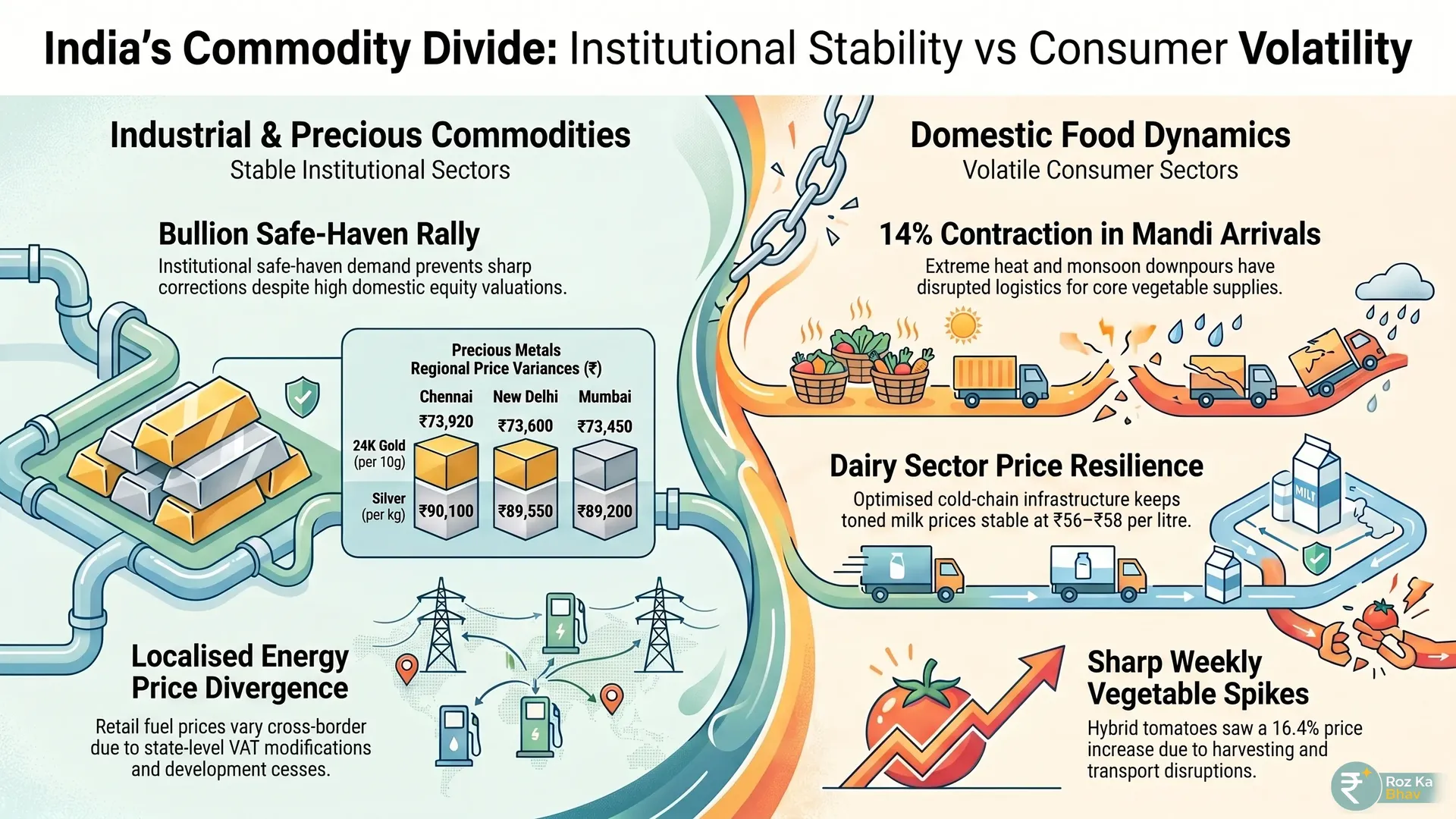
Gold and silver contracts on the MCX have experienced a day of structural technical consolidation, underpinned by shifting probabilities surrounding global interest rate cuts. Institutional order books show a distinct pivot toward defensive positioning. Market analysts at Dalal Street note that persistent treasury yield curve inversions, paired with central bank accumulation programs led by emerging market monetary authorities, have put a hard floor under bullion prices. This institutional floor prevents any sharp correction despite the domestic equity markets flirting with near-record valuations. The physical retail markets have adjusted to these technical parameters, with spot premiums remaining positive despite the onset of a traditionally lean seasonal window for weddings and major festivals.
The physical pricing dynamics across Indian metros exhibit sharp regional variance, primarily driven by localized octroi, municipal levies, and transport logistic premiums. In Chennai—the traditional epicenter of retail gold consumption—physical demand continues to outpace standard north Indian thresholds, sustaining local spot rates above national averages. Silver is displaying a more pronounced industrial beta, outperforming gold in intraday percentage gains. This trend is driven by robust green-energy manufacturing mandates and electronic component manufacturing requirements inside the domestic market, compounding the standard speculative demand on the MCX. Analysts expect bullion to remain highly sensitive to imminent consumer price data releases from major Western economies.
Note: Data based on 2026-06-16.
| City / Hub | 24K Gold (per 10g) | 22K Gold (per 10g) | Silver (per 1kg) | Intraday Shift (%) |
|---|---|---|---|---|
| Mumbai (Zaveri Bazar) | ₹73,450 | ₹67,330 | ₹89,200 | +0.42% |
| New Delhi (Chandni Chowk) | ₹73,600 | ₹67,460 | ₹89,550 | +0.48% |
| Chennai (T. Nagar) | ₹73,920 | ₹67,760 | ₹90,100 | +0.61% |
| Kolkata (Bowbazar) | ₹73,530 | ₹67,400 | ₹89,400 | +0.39% |
Regional Bullion Matrix & City-Specific Deep Dive
- Mumbai: The financial capital is leading the wholesale arbitrage trade. Volume metrics indicate that physical deliveries through the Zaveri Bazar ecosystem are matching algorithmic hedging volumes on MCX—indicating a highly mature and balanced pricing structure with nominal localized premiums.
- New Delhi: High-net-worth individual accumulation has seen an uptick in the National Capital Region. Retail jewellers note that while physical footfall has dipped due to extreme summer heat waves, the average ticket size of institutional bullion transactions has widened by 6.5% quarter-on-quarter.
- Chennai: South India continues to exhibit its structural position as a net consumer of physical bullion. Local premiums over the base international import parity price have widened today, driven by aggressive restocking cycles by prominent regional retail chains anticipating pre-festive manufacturing lead times.
2. Fuel Rates Today: Petrol, Diesel, and CNG Price Matrix
The Indian downstream oil marketing landscape remains a pillar of macro stabilization, even as Brent crude prices face regular adjustments within the $81 to $85 per barrel range. The big three state-run Oil Marketing Companies (OMCs)—Indian Oil Corporation (IOCL), Bharat Petroleum Corporation (BPCL), and Hindustan Petroleum Corporation (HPCL)—have largely absorbed international refining margin fluctuations. This absorption has insulated retail consumers from broad base-price shifts. However, subtle alterations in structural logistics, local state-level value-added tax (VAT) modifications, and dynamic cess revisions mean that the actual price paid at the fuel pump varies significantly as one crosses state borders.
Simultaneously, Compressed Natural Gas (CNG) is solidifying its position as the preferred fuel for public transport and urban commercial logistics. The pricing of domestic natural gas, governed by the revised Kirit Parikh committee recommendations, links domestic gas pricing directly to imported crude baskets with a strict cap-and-floor system. This regulatory mechanism has successfully removed the wild structural swings that characterized the gas markets in previous cycles, providing a competitive runway for city gas distribution companies to ramp up infrastructure investments.
Note: Data based on 2026-06-16.
| Metro City | Petrol (per Litre) | Diesel (per Litre) | CNG (per kg) | Regulatory Outlook |
|---|---|---|---|---|
| New Delhi | ₹94.72 | ₹87.62 | ₹74.50 | Stable / Fixed Allocation |
| Mumbai | ₹104.21 | ₹92.15 | ₹79.70 | State Cess Revision Pending |
| Kolkata | ₹103.94 | ₹90.76 | ₹81.00 | Logistics Adjustment Active |
| Bengaluru | ₹102.84 | ₹88.95 | ₹82.50 | State Tax Structure Firm |
Metropolitan Energy Dynamics & Transit Cost Analysis
In Mumbai, the fuel pricing matrix continues to reflect historical structural imbalances stemming from local development cesses and transit fees. Petrol holding above the ₹104 mark places a distinct operational burden on last-mile delivery networks, directly feeding into the service-sector inflation prints within the region. Conversely, New Delhi benefits directly from its geographic proximity to key inland pipelines and a highly competitive local tax regime, making it the most cost-efficient metro hub for commercial fleet operators utilizing diesel networks.
Looking further south, Bengaluru’s fuel corridor is displaying structural tightness. Recent state fiscal alignments have pushed the baseline cost of both automotive fuels upward, narrowing the historical price advantage the IT capital held over neighboring Chennai. Logistics aggregators operating inside the state are rapidly executing transition strategies to migrate their middle-mile fulfillment fleets from internal combustion models to alternative energy or natural gas options to protect operating cash flows.
3. Kitchen Essentials: Vegetable Price Inflation & Mandi Supplies
The domestic agricultural sector is currently functioning as the primary site of consumer price index friction. Today’s mandi data shows a pronounced escalation in the price profiles of essential perishables. Market arrivals for core items like tomatoes, onions, and potatoes (the TOP basket) have contracted by an estimated 14% across key agricultural wholesale hubs—including Azadpur Mandi in Delhi and Vashi Mandi in Navi Mumbai. This contraction is less a reflection of structural crop failures and more a direct outcome of extreme regional heat variations followed by localized intense monsoon downpours, which together have complicated the harvesting and transport logistics of sensitive agri-commodities.
In stark contrast to the volatile behavior of the vegetable basket, the organized dairy sector is presenting a picture of robust, institutional stability. Major cooperative federations, including the Gujarat Cooperative Milk Marketing Federation (GCMMF—Amul) and Mother Dairy, have optimized their cold-chain supply infrastructure and milk procurement networks over the past year. Flush season storage planning and enhanced silage management programs implemented at the farm gate have allowed these entities to absorb structural fodder price inflation without passing the burden down to end consumers today.
Note: Data based on 2026-06-16.
| Commodity / Item | Mandi Wholesale Avg (per Quintal) | Retail Metro Price (Avg / kg or L) | Weekly Change (%) | Primary Supply Driver |
|---|---|---|---|---|
| Tomatoes (Hybrid) | ₹4,200 | ₹65 – ₹78 | +16.4% | Monsoon Transit Disruptions |
| Onions (Nashik Quality) | ₹3,100 | ₹45 – ₹52 | +8.2% | Buffer Stock Retention Policy |
| Potatoes (Jyoti Variety) | ₹2,400 | ₹34 – ₹40 | +5.1% | Cold Storage Offtake Controls |
| Standard Milk (Toned) | N/A | ₹56 – ₹58 | 0.0% | Optimized Cooperative Supply Line |
Urban Supply Chain Assessment & Mandi Inflows
A granular look at the vegetable supply chain reveals that institutional inefficiencies are exacerbating weather-induced shocks. For instance, at the Azadpur Mandi in the north, high humidity levels have led to higher transit spoilage rates, reducing the shelf life of incoming green chillies, coriander, and leafy greens. This high spoilage rate forces retail vendors to price in substantial risk premiums, directly translating into higher out-of-pocket costs for the end consumer. Traders estimate that these elevated price levels will likely persist for another two to three weeks until the monsoon advances uniformly across central and western production belts, unlocking blocked harvest flows.
Conversely, the steady state of dairy pricing is offering a critical buffer to the broader food inflation metric. With milk prices remaining unchanged today, processed dairy products like paneer, curd, and butter are holding their pricing bands. This consistency prevents a wholesale inflation spiral across the broader fast-moving consumer goods (FMCG) and quick-service restaurant (QSR) sectors, balancing out the clear volatility observed in the fresh produce lanes.
4. Frequently Asked Questions (FAQs)
Q1: Why are gold and silver prices rising on the MCX today despite high domestic interest rates?
Ans: Domestic bullion pricing is heavily linked to global spot gold movements and the rupee-dollar exchange rate. Current domestic rate cycles are being offset by institutional safe-haven demand, international central bank diversification programs, and a softer US Dollar Index. These global macro factors historically override domestic liquidity conditions, sustaining structural momentum on the MCX.
Q2: What is causing the severe regional variance in petrol and diesel prices across Indian states?
Ans: While the base manufacturing cost of automotive fuel remains uniform at the refinery gate, final retail prices are heavily impacted by individual state-level Value Added Tax (VAT), local cess structures, development levies, and transport logistics differentials from primary oil pipelines and coastal terminals to inland distribution pumps.
Q3: When can retail consumers expect relief from the current surge in vegetable prices?
Ans: Agricultural economists and wholesale mandi traders project a stabilization of fresh produce prices within the next 15 to 20 days. This timeline depends on the uniform advancement of the southwest monsoon across primary sowing zones in Maharashtra, Karnataka, and Madhya Pradesh, which will streamline harvest logistics and normalize daily mandi arrival volumes.
Q4: Will the stable pricing trend in the dairy sector hold for the remainder of the quarter?
Ans: Yes, the structural outlook for the dairy ecosystem remains highly favorable. Major dairy cooperatives have confirmed sufficient skimmed milk powder (SMP) reserves and highly optimized cattle feed distribution programs at the village level, which are expected to insulate the consumer from any price hikes over the near-to-mid-term horizon.
Source & Price Verification – Financial Markets
- Gold & Silver Prices: Data referenced from IBJA, MCX India, and international benchmarks.
- Petrol & Diesel Rates: Daily retail prices sourced from Indian Oil, HPCL, and BPCL.
- Commodity Market Data: Verified using MCX, NCDEX, and government statistical releases.
- Verification Process: Prices are cross-checked with at least two independent official or exchange-based sources before publication.
- Disclaimer: Market prices are indicative and may vary by city, tax structure, or intraday volatility.
Note: Prices are updated daily and cross-checked before publishing. If you notice any discrepancy, please email us at [email protected].