

The macroeconomic landscape in India today presents an intricate balance between domestic supply-side realities and overarching global financial variables. As international gold continues to flirt with unprecedented baselines amid multi-nation central bank adjustments and shifting West Asia supply lines, standard consumer choices are undergoing a substantial transformation. On Dalal Street, the domestic focus remains split cleanly between structural agricultural pressures and the fluctuating landing costs of essential raw materials; for everyday retail market participants, these movements carry clear structural implications.
What this means for your wallet is highly sector-dependent. While the structural cost of tech hardware and global investment vehicles tracks highly volatile trends, household daily expenditures are encountering more localized friction points. The interplay of regional climatic variations, infrastructural transportation realities during the active monsoon season, and global currency updates is actively shaping consumer behavior keeping both macroeconomic planners and financial asset managers heavily focused on incoming indicators.
Table of Contents
1. Bullion Market: Gold and Silver Price Deep-Dive
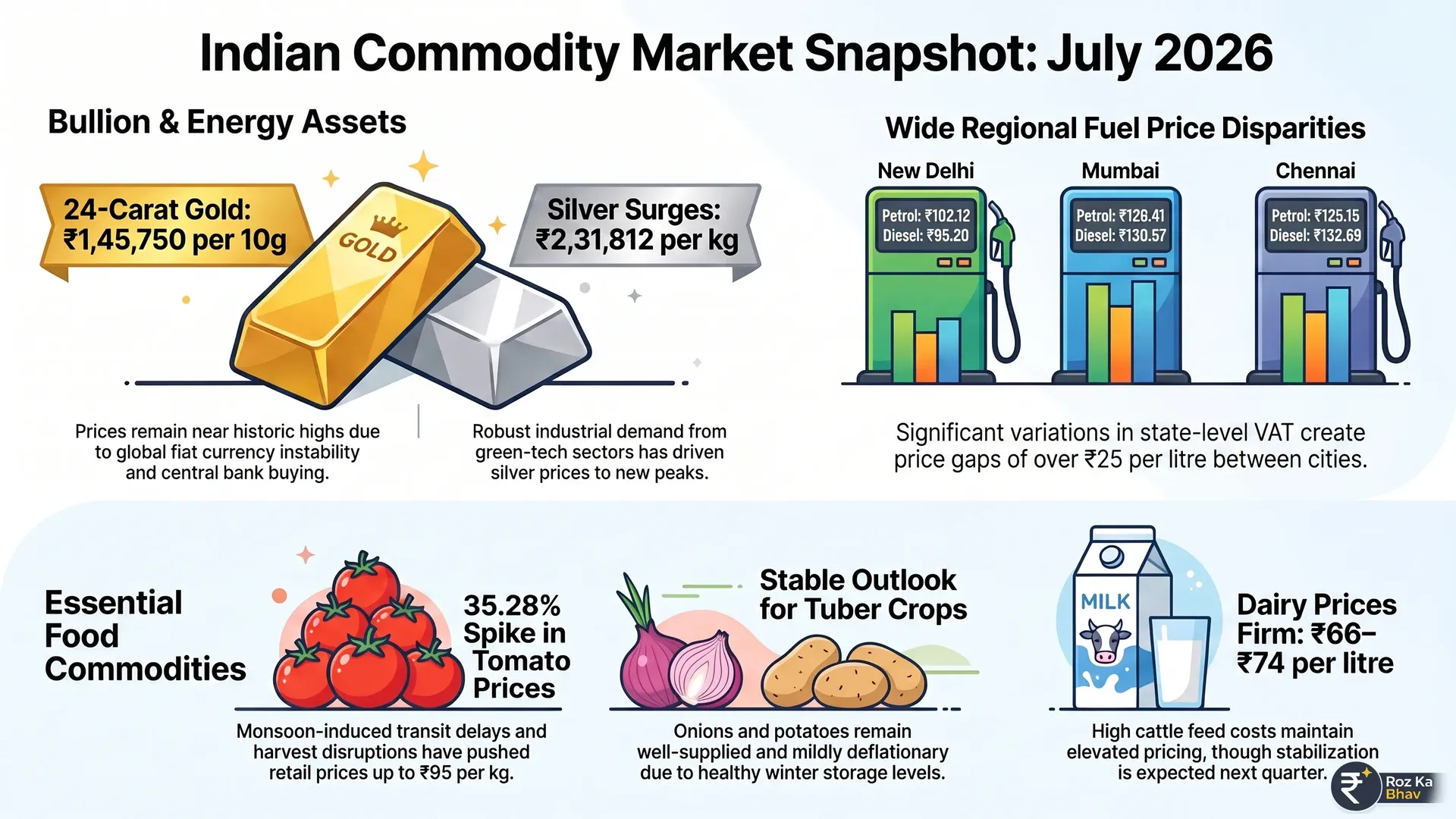
The domestic safe-haven complex continues to witness extraordinary capital reallocation. Analysts across major domestic tracking desks report that systemic concerns over long-term global fiat currency stability, alongside substantial industrial consumption, are keeping precious metals structurally supported. Today, 24-carat gold trades near ₹1,45,750 per 10 grams; this represents minor sequential consolidation after its major leg up earlier in the quarter. This is a substantial rise from historical multi-year support levels, completely shifting long-term hedging approaches for private investors.
Market analysts at Dalal Street note that global central bank accumulation patterns remain the definitive long-term catalyst. Even when spot dollar metrics print momentary strength, the underlying structural demand for physical bars within Asian retail and institutional vaults safeguards the lower price bound. Simultaneously, silver jewellery and industrial-grade bullion products have seen some of the sharpest sequential adjustments on record with retail premium expansions touching near triple-digit annualized baselines in specific industrial manufacturing hubs.
Note: Data based on 2026-07-08.
| Bullion Grade / Type | National Average Price (INR) | Daily Basis Point Change | Primary Market Trend Indicator |
|---|---|---|---|
| 24 Carat Gold (10 Grams) | ₹1,45,750 | -0.08% | Consolidating Near Historic Highs |
| 22 Carat Gold (10 Grams) | ₹1,33,507 | -0.07% | Steady Retail Demand Post-Festive |
| 18 Carat Gold (10 Grams) | ₹1,09,312 | -0.09% | High Domestic Jewelry Volume |
| Silver (Per Kilogram) | ₹2,31,812 | +0.12% | Robust Industrial Green-Tech Pull |
Metro City Breakdown: Bullion Realignment
- New Delhi: Showroom metrics for fine retail products mirror corporate tracking channels cleanly, with 24K hovering at ₹1,45,750. Capital consumption remains anchored by high institutional wealth protection allocations.
- Mumbai: Zaveri Bazaar operations report steady turnover with wholesale cash pricing arriving right around the ₹1,45,895 mark reflecting deep commercial liquidity and standard coastal delivery premiums.
- Chennai: Consistently demonstrating regional structural premiums, Chennai prints a premium tier with 24K trading slightly higher at ₹1,47,061, driven by high structural retail demand for heavy investment ornaments.
- Kolkata: Eastern regional distribution centers show steady numbers around ₹1,46,916, showing healthy physical allocation metrics despite high structural spot volatility.
2. Energy Watch: Petrol, Diesel, and Alternative Fuel Trends
The transportation sector is enjoying a period of relatively steady baseline metrics as international Brent crude pulls back from its peak levels. Following recent diplomatic and supply adjustments that brought the benchmark closer to the lower $70s per barrel range, domestic public-sector Oil Marketing Companies (OMCs) have kept general retail pricing fixed across standard city pumps. This consistency comes as a welcome relief to logistics and freight networks that faced severe financial pressures during the geopolitical tensions earlier in the year.
Interestingly, structural shifts among private fuel retail participants are starting to disrupt traditional public-sector distribution models. Major private networks have introduced strategic rollbacks in regional sectors following refinery operational normalizations. However, State-Run OMCs, which direct over 90% of retail distribution across India, continue to prioritize long-term fiscal consolidation to offset historic under-recoveries; this means consumers in major tier-1 cities continue to see fixed, uniform pricing.
Note: Data based on 2026-07-08.
| Metropolitan Region | Petrol Price (per Litre) | Diesel Price (per Litre) | CNG/Alternative (per Kg) |
|---|---|---|---|
| New Delhi | ₹102.12 | ₹95.20 | ₹79.50 |
| Mumbai | ₹128.41 | ₹130.57 | ₹89.20 |
| Kolkata | ₹110.64 | ₹97.02 | N/A |
| Chennai | ₹125.15 | ₹132.69 | ₹87.50 |
Metropolitan Energy Logistics and Regional Realities
Looking at specific regional variations highlights the major role state-level Value Added Taxes (VAT) and internal logistics structures play in retail pricing. In Mumbai and Chennai, local distribution structures and structural coastal tariffs keep premium grades on a different trajectory compared to land-locked transport depots in Northern India.
For instance, commercial transportation networks operating across the Western transport corridor report that highly localized variations in fuel surcharges are pushing long-haul logistics fleets to optimize their refueling stops. This strategy leverages the lower state taxation levels found in adjacent union territories and border-adjacent fuel stations.
3. Kitchen Essentials: Vegetable and Dairy Price Tracker
The domestic food supply network is currently managing standard monsoon supply chain variations. According to provisional updates from the Ministry of Statistics, headline consumer food price indices continue to demonstrate a distinct divergence between various agricultural product lines. While fundamental winter storage tubers like onions and potatoes show healthy availability and stable pricing, highly perishable items remain sensitive to rain-induced logistical delays.
Tomatoes continue to face supply pressures, with localized crop adjustments driving a 35.28% rise in wholesale and retail segments. Field tracking operations reveal that key growing pockets in Karnataka and Maharashtra have experienced uneven early monsoon precipitation; this has caused immediate harvesting and transport delays to secondary city wholesale yards, creating short-term supply mismatches.
Note: Data based on 2026-07-08.
| Agricultural Commodity | Wholesale Baseline (Per Quintal) | Average Retail Range (Per Kg) | Sequential Month Trend Status |
|---|---|---|---|
| Tomatoes (Hybrid Variety) | ₹5,200 – ₹6,500 | ₹75 – ₹95 | Strong Upward Pressure |
| Onions (Nashik Grade) | ₹1,800 – ₹2,400 | ₹30 – ₹40 | Stable / Mild Deflationary |
| Potatoes (Jyoti/Standard) | ₹1,200 – ₹1,650 | ₹22 – ₹28 | Well-Supplied Balance |
| Standard Fresh Dairy (Per Litre) | N/A | ₹66 – ₹74 | Steady / High Fodder Cost |
Metropolitan Essential Cost Breakdown
- New Delhi (Azadpur Mandi): High incoming supply volumes from regional northern farms have stabilized potato and onion metrics. However, high-quality tomatoes and fresh greens face a 12% retail premium due to rain-related transport challenges.
- Mumbai (APMC Vashi): Consistent moisture levels along coastal transit paths mean that terminal markets show elevated green Vegetable Prices. Dairy distribution prices remain fixed but firm at the higher end of the national average.
- Bengaluru (Kalasipalyam): Being close to major southern production centers has helped buffer local tomato retail prices compared to northern cities keeping standard options steady around ₹65 – ₹70 per kg.
- Kolkata (Koley Market): Supply lines from neighboring states remain vital. Leafy greens are seeing standard monsoon cost increases, while dairy prices are holding stable across standard processing cooperatives.
4. Frequently Asked Questions (FAQ)
Q1: Why are domestic gold prices remaining near historic highs despite global financial market volatility?
Answer: Domestic gold prices are supported by continuous physical buying from central banks and global institutional asset reallocation into safe-haven assets. Additionally, local currency adjustments against the US dollar have kept landed import costs high keeping retail prices firm across India.
Q2: Will the drop in international crude oil prices lead to public sector petrol price cuts anytime soon?
Answer: While international crude benchmarks have corrected to the lower $70s, state-run oil marketing companies are currently maintaining retail prices. They are using these steady margins to offset previous losses incurred when crude was trading above $100 per barrel, ensuring long-term fiscal balance.
Q3: What factors are driving the sharp difference between potato and tomato prices in markets right now?
Answer: Potatoes benefit from extensive cold storage reserves and stable historic crop outputs. On the other hand, tomatoes are highly perishable and depend entirely on real-time transit logistics; seasonal monsoon disruptions in key southern and western cultivation hubs have temporarily reduced immediate market arrivals, driving prices up.
Q4: Are dairy and milk prices expected to undergo further structural hikes before the festive season?
Answer: Major dairy cooperatives suggest that while procurement costs remain elevated due to higher cattle feed prices and seasonal transport logistics, prices are likely to stabilize over the next quarter. Broad retail hikes are expected to remain minor and localized rather than uniform across the country.
Source & Price Verification – Financial Markets
- Gold & Silver Prices: Data referenced from IBJA, MCX India, and international benchmarks.
- Petrol & Diesel Rates: Daily retail prices sourced from Indian Oil, HPCL, and BPCL.
- Commodity Market Data: Verified using MCX, NCDEX, and government statistical releases.
- Verification Process: Prices are cross-checked with at least two independent official or exchange-based sources before publication.
- Disclaimer: Market prices are indicative and may vary by city, tax structure, or intraday volatility.
Note: Prices are updated daily and cross-checked before publishing. If you notice any discrepancy, please email us at [email protected].
