

The macroeconomic landscape in India is displaying a fascinating structural dichotomy today, July 6, 2026. On one hand, deep-seated geopolitical anxieties in West Asia and persistent safe-haven rebalancing have driven domestic bullion prices to unprecedented territories. Retail consumers and institutional investors alike are watching the yellow metal breach psychological thresholds daily, calling into question historical allocation theories. Dalal Street strategists note that the underlying velocity of this rally indicates a structural flight to safety rather than mere speculative churn, as persistent global micro-shocks force asset management funds to heavily overweight physical reserves.
On the flip side, the supply-side dynamics of the energy sector are offering a breath of fresh air albeit an uneven one. Thanks to the stabilization of crucial maritime shipping corridors and structural diplomatic steps taken across major producing cartels, international benchmark Brent crude has compressed significantly from its brutal multi-year peak of $126.41 witnessed back in April. Today, crude hovers productively around the $73.24 per barrel mark. This macro-cushion prompted Nayara Energy, India’s largest private fuel retailer, to execute a sweeping price cut across its expansive network of 7,000+ fuel stations, marking the most significant downstream price adjustment the market has seen in over twenty-four months. However, state-owned Oil Marketing Companies (OMCs) continue to exercise caution, highlighting the persistent baggage of historical under-recoveries.
Table of Contents
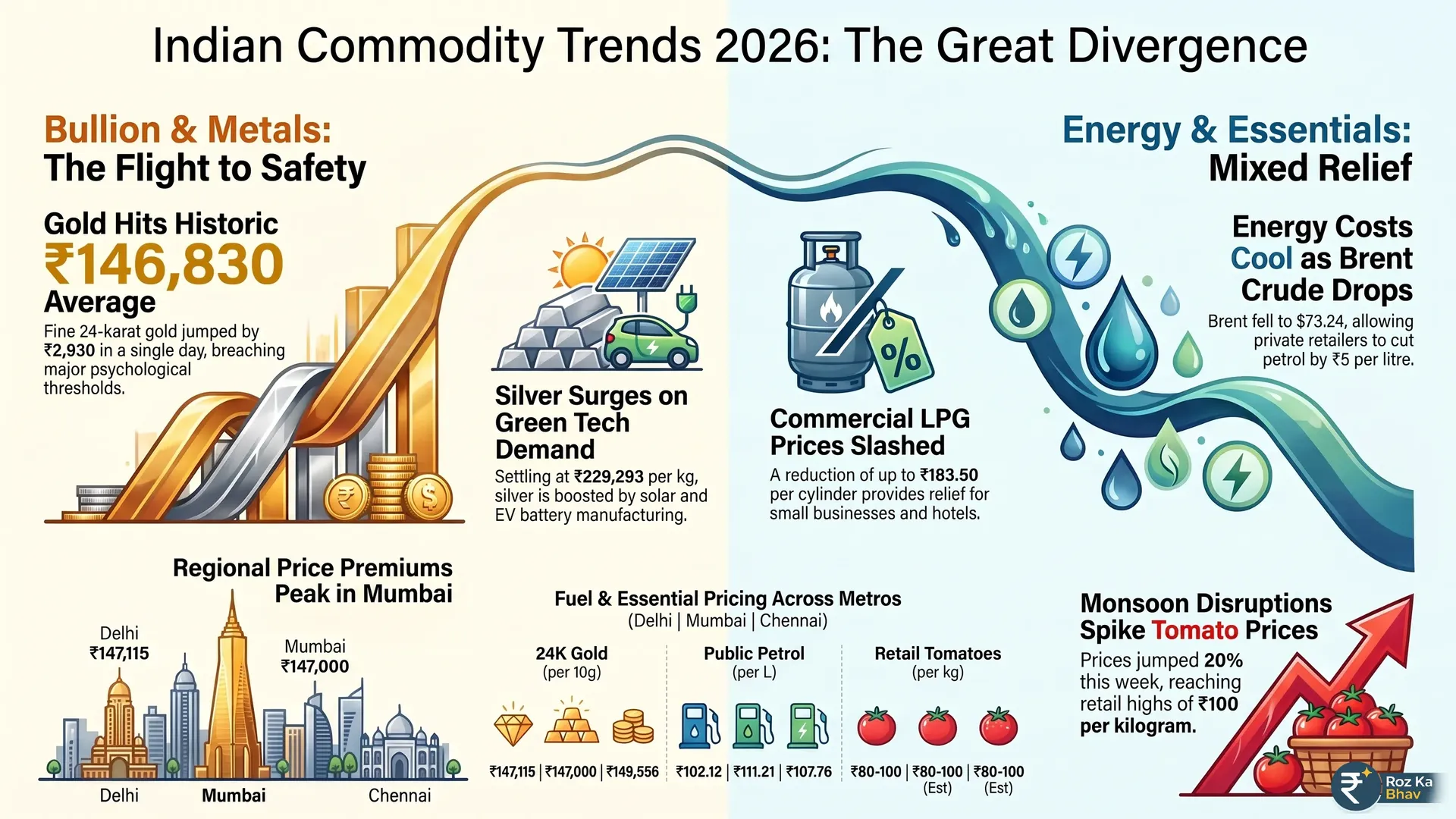
1. Bullion Market Analysis: Gold and Silver Breaking Barriers
The domestic bullion market is operating under highly bullish conditions today. Physical spot gold prices in India extended their remarkable upward momentum into the opening session of the week, with 24-karat gold (99.9% purity) settling at an astronomical national average of ₹1,46,830 per 10 grams. Market analysts at leading Mumbai brokerages describe this environment as an unprecedented structural squeeze. The fundamental catalyst remains multi-layered: although recent diplomatic discussions in the Levant point toward extended ceasefire frameworks, underlying long-term multi-axis instability continues to keep global financial systems on edge.
Simultaneously, silver has become a favorite macro play for institutional funds looking to hedge both monetary depreciation and industrial demand acceleration. Trading at a substantial benchmark rate of ₹2,29,293 per kilogram, silver is benefiting from its dual-class character. While it responds actively to the macro safe-haven drivers propelling gold, it is also experiencing strong tailwinds from the green technology manufacturing sectors across India, particularly solar photovoltaic assembly and regional electric vehicle battery infrastructure projects.
Note: Data based on 2026-07-06.
| Gold Purity Level | Rate per 10 Grams (INR) | Daily Absolute Change | Primary Market Sentiment |
|---|---|---|---|
| 24-Karat Gold (Fine 999) | ₹1,46,830 | + ₹2,930 | Highly Bullish / Aggressive Accumulation |
| 22-Karat Gold (Jewellery 916) | ₹1,34,500 | + ₹2,680 | Moderate / Selective Retail Resistance |
| 18-Karat Gold (Standard) | ₹110,120 | + ₹2,190 | Stable Corporate Gifting Demand |
| 14-Karat Gold (Commercial) | ₹85,600 | + ₹1,710 | Steady Export Manufacturing Volume |
| Silver (999 Purity) | ₹2,29,293 (per kg) | + ₹3,863 | Strong Industrial & Investment Synergy |
City-Specific Bullion Breakdown
Geographic premiums vary structurally due to regional entry taxes and varying local octroi patterns:
- Delhi: The national capital region reflects a premium, with 24K gold trading firmly at ₹1,47,115 per 10 grams, driven by high ceremonial wedding demands.
- Mumbai: Zaveri Bazar indicates a benchmark spot of ₹1,47,000 per 10 grams for 24K, mirroring high liquid trade and import delivery efficiencies.
- Chennai: The southern hub records the highest structural physical premiums, holding spot trades at ₹1,49,556 per 10 grams for 24K, backed by persistent retail jewelry consumption patterns.
- Bengaluru & Hyderabad: Showcasing aligned tech-wealth investments, these cities track tightly at ₹1,47,000 flat per 10 grams for 24K gold.
2. Energy Watch: Decentralized Fuel Pricing & Crude Oil Tailwinds
The massive talking point across India’s energy landscape today is the deep wedge between private downstream retail pricing and state-run enterprise positioning. A major macro-economic shift occurred on July 1 when private fuel retail giant Nayara Energy implemented a direct price cut of ₹5 per litre on petrol and ₹3 per litre on diesel across its network. This aggressive price drop comes directly after their 20-million-ton Vadinar refinery successfully completed its structural turnaround, placing it in a prime position to capitalize on cheaper inbound crude shipments.
What does this mean for your wallet and broader corporate logistics? If you are a commercial transport fleet owner routing logistics through paths serviced by private pumps, your operating expenditure equation shifts to: O_c = Q \times (R_b – \Delta R) where R_b represents the baseline PSU retail rate and \Delta R is the private price rollback. However, state-owned OMCs Indian Oil, Bharat Petroleum, and Hindustan Petroleum which control over 90% of the domestic fuel distribution infrastructure, are maintaining the status quo. Union Petroleum Minister Hardeep Singh Puri stated that retail prices will experience broader drops only when the lower-cost international crude oil shipments fully clear legacy high-cost inventories currently hitting Indian refineries.
Note: Data based on 2026-07-06.
| Metropolitan City | PSU Petrol (₹/Litre) | PSU Diesel (₹/Litre) | Estimated Private Outlet Discount |
|---|---|---|---|
| Delhi | ₹102.12 | ₹95.20 | Petrol: -₹5.00 | Diesel: -₹3.00 |
| Mumbai | ₹111.21 | ₹97.83 | Petrol: -₹5.00 | Diesel: -₹3.00 |
| Kolkata | ₹113.51 | ₹99.82 | Petrol: -₹5.00 | Diesel: -₹3.00 |
| Chennai | ₹107.76 | ₹99.55 | Petrol: -₹5.00 | Diesel: -₹3.00 |
| Bengaluru | ₹111.68 | ₹93.65 | Petrol: -₹5.00 | Diesel: -₹3.00 |
Additionally, commercial operational managers are seeing noticeable relief in thermal overheads. State-owned entities slashed 19-kg commercial LPG cylinders by a significant margin between ₹173 and ₹183.50. This lowers the commercial cylinder price in Delhi down to ₹2,930 from its June high of ₹3,113.50, directly cooling inputs for small businesses, hotels, and casual dining outlets. Domestic cooking cylinders (14.2-kg), however, remain locked under state-subsidized baselines, keeping household budgets protected from direct international gas indexation shocks.
3. Kitchen Essentials: Monsoon Inflation & Grocery Market Impacts
As we advance deeper into the classic monsoon progression window, seasonal logistical friction is affecting agriculture-based supply lines. Daily wholesale tracking out of major agricultural hubs like Azadpur Mandi in Delhi and Vashi Market in Navi Mumbai points to localized logistics logjams. Heavy precipitation across key producing sub-belts in Maharashtra, Karnataka, and Madhya Pradesh has slowed harvesting operations and compromised the immediate transport shelf-life of delicate perishables.
Consequently, tomato prices have jumped 20% over the last seven days, while staple vegetables like onions and potatoes show milder increases due to healthy government buffers. On the dairy side, major processing federations like Amul and Mother Dairy report stable pricing grids today, though they warn that increasing green fodder expenditures across northern milk cooperatives could pressure margins by late Q3.
Note: Data based on 2026-07-06.
| Essential Food Commodity | Wholesale Price Range (₹/Kg) | Retail Price Range (₹/Kg) | Weekly Trend Analysis |
|---|---|---|---|
| Tomatoes (Hybrid Variety) | ₹45 – ₹60 | ₹80 – ₹100 | Sharp Upward Spike (Monsoon Delays) |
| Onions (Nasik Quality) | ₹28 – ₹35 | ₹45 – ₹55 | Steady (Supported by Government Cold Storage) |
| Potatoes (Jyoti Variety) | ₹22 – ₹26 | ₹35 – ₹42 | Flat / Marginal Changes |
| Standard Toned Milk (Litre) | ₹54 – ₹56 | ₹58 – ₹60 | Stable (Fodder Inflation Under Watch) |
Metropolitan Kitchen Impact
The daily financial impact on households depends heavily on their urban location:
- Mumbai & Thane: High local rainfall has pushed the retail basket up by roughly 12% overall, with leafy greens seeing the highest price adjustments.
- Delhi NCR: Supply inflows via Western Dedicated Freight Corridors have kept basic potato and onion prices relatively stable, though high-quality tomatoes remain expensive.
- Bengaluru: Steady arrivals from adjacent rural districts have kept vegetable inflation in check compared to northern cities.
4. Frequently Asked Questions (FAQs)
Source & Price Verification – Financial Markets
- Gold & Silver Prices: Data referenced from IBJA, MCX India, and international benchmarks.
- Petrol & Diesel Rates: Daily retail prices sourced from Indian Oil, HPCL, and BPCL.
- Commodity Market Data: Verified using MCX, NCDEX, and government statistical releases.
- Verification Process: Prices are cross-checked with at least two independent official or exchange-based sources before publication.
- Disclaimer: Market prices are indicative and may vary by city, tax structure, or intraday volatility.
Note: Prices are updated daily and cross-checked before publishing. If you notice any discrepancy, please email us at [email protected].
