

Quick Summary: On July 4, 2026, India’s commodity markets show a stark divergence. Safe-haven bullion extended its historic rally following weak US labor market metrics; driving domestic 24K retail gold up to ₹1,47,010 per 10 grams and silver up to ₹2,50,100 per kg. Conversely, state-run fuel prices remain unchanged; despite international Brent crude hitting a four-month low at $73 per barrel, though private retailer Nayara offered minor relief with an aggressive standalone price cut. Meanwhile, kitchen budgets are feeling the pressure as seasonal monsoon delays trigger an incremental hike in retail Vegetable Prices across metros.
Commodity & Macro Analysis
The Indian macroeconomic landscape is witnessing a fascinating tug-of-war today, July 4, 2026. Domestic commodity spaces are reacting dramatically to a blend of shifting international monetary policies, corporate operational realities; and localized structural bottlenecks. For retail consumers and seasoned investors alike, these market dynamics demand a closer look to separate transient price volatility from major, systemic realignments.
Table of Contents
Bullion Market: Gold & Silver Reach Historic Milestones
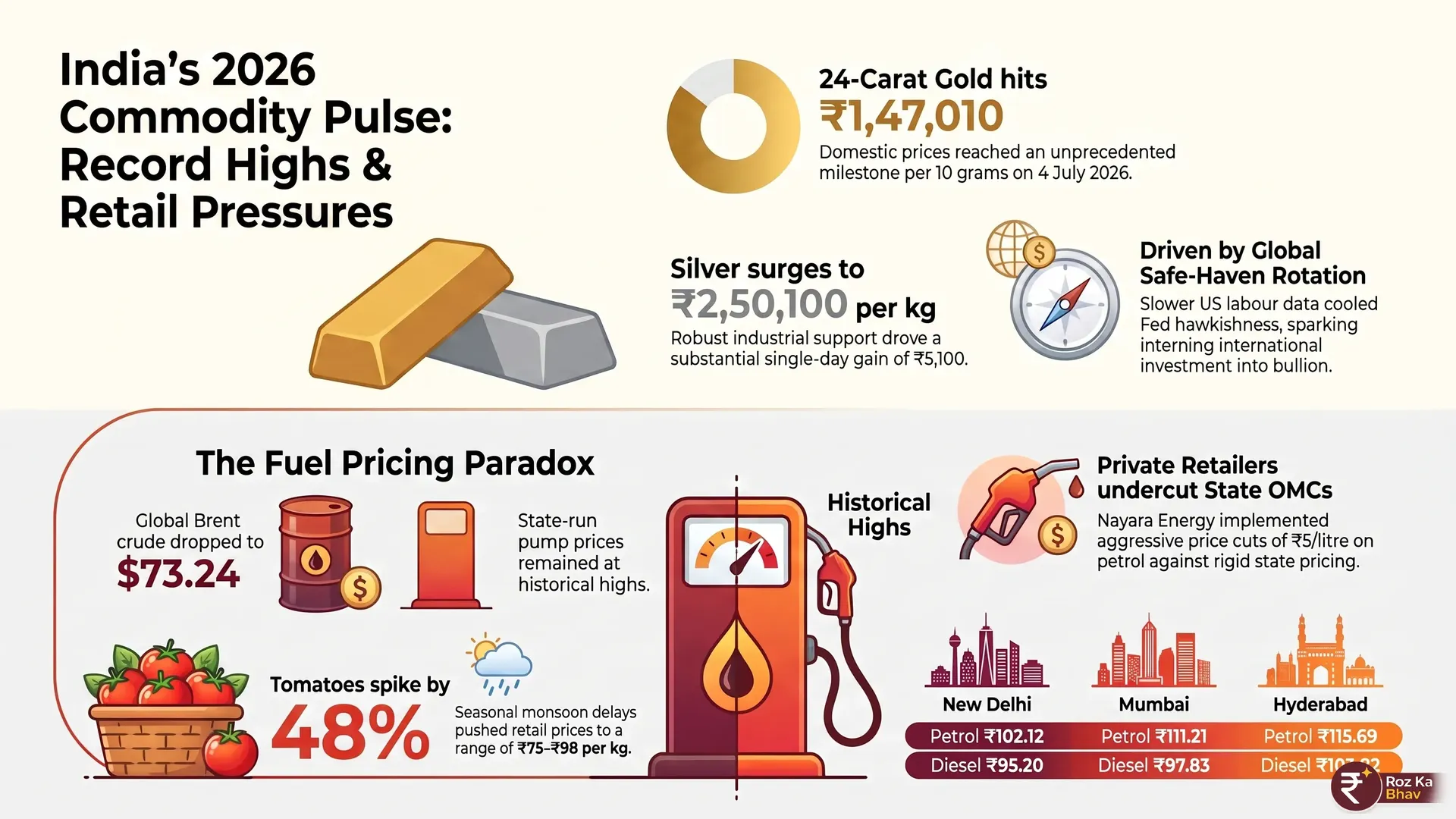
The domestic bullion market has blown past historical ceilings today, continuing its upward trajectory. In retail hubs, 24-carat gold jumped to ₹1,47,010 per 10 grams; highlighting a structural shift in investor sentiment over the last year. Similarly, silver has found its stride, holding firmly at ₹2,50,100 per kilogram. This remarkable rally is a direct product of heavy short-covering on the Multi Commodity Exchange (MCX) and a surge in global Comex spot trading; where gold extended gains past $4,090 per ounce.
Market analysts note that the core catalyst stems from recent economic signals out of the United States. Slower-than-expected jobs data has cooled previous concerns regarding long-term hawkishness from the Federal Reserve; prompting a rotation into safe-haven assets. Locally, the sheer momentum has altered consumer habits ahead of upcoming festive windows. What this means for your wallet is clear: historical cost levels require a systematic, staggered approach to asset accumulation rather than bulk buying, balancing immediate premiums against long-term capital preservation.
Note: Data based on 2026-07-04.
| Metal & Purity Type | National Benchmark Price (per 10g / kg) | Absolute Daily Shift (INR) | Macro Trend & Sentiment |
|---|---|---|---|
| Gold 24K (99.9% Pure) | ₹1,47,010 per 10g | +₹3,230 | Strongly Bullish / Safe-Haven Inflow |
| Gold 22K (91.6% Pure) | ₹1,34,760 per 10g | +₹2,960 | High Domestic Jewelry Demand |
| Gold 18K (75.0% Pure) | ₹1,10,260 per 10g | Steady | Neutral / Alternative Value Tier |
| Silver 999 Fine | ₹2,50,100 per 1kg | +₹5,100 | Highly Volatile / Industrial Support |
City-Specific Bullion Breakdown
- Delhi: Retailers are pricing 24K gold at ₹1,39,440 per 10 grams, showing slight baseline variances owing to local structural levies and transportation costs.
- Mumbai: Zaveri Bazaar reflected deep liquidity pools, stabilizing 22K pure jewelry base rates at ₹1,32,593 per 10 grams, exclusive of local GST and making charges.
- Chennai: Traditionally a high-demand southern hub, Chennai continues to command the highest premiums, pushing retail 22K gold values to ₹1,37,011 per 10 grams.
- Bengaluru: Mirroring national averages closely, 22K standard gold is retailing at ₹1,32,593; while industrial purchasing kept silver consistent with broader MCX guidelines.
Energy Watch: State Pricing Stagnation vs Private Retail Discounts
India’s retail energy ecosystem presents a stark paradox. On the global stage, international benchmark Brent crude futures dropped significantly to a four-month low of $73.24 per barrel; driven by cooling West Asian bottlenecks and structural supply clarity. However, domestic consumers visiting state-run Oil Marketing Companies (OMCs) like Indian Oil (IOCL) or BPCL will find pump prices rigidly stuck at historical highs. In New Delhi, state-run retail petrol holds flat at ₹102.12 per liter, while diesel tracks at ₹95.20 per liter.
In contrast, private enterprise has introduced competitive dynamics into the market. Private retailer Nayara Energy capitalized on lower international input costs following its refinery turnaround; rolling out a standalone price cut of ₹5 per liter on petrol and ₹3 per liter on diesel across its network of over 7,000 stations. This marks the first aggressive retail corporate pricing move in two years. Concurrently, state-run firms reduced the cost of 19-kg commercial LPG cylinders by up to ₹183.50; cutting restaurant overheads, while domestic 14.2-kg household cylinder values remain firmly locked.
Note: Data based on 2026-07-04.
| Metro Location | Standard Petrol (IOCL) | Standard Diesel (IOCL) | 19-kg Commercial LPG |
|---|---|---|---|
| New Delhi | ₹102.12 / L | ₹95.20 / L | ₹2,930.00 |
| Mumbai | ₹111.21 / L | ₹97.83 / L | ₹2,882.50 |
| Kolkata | ₹113.51 / L | ₹99.82 / L | ₹3,044.00 |
| Hyderabad | ₹115.69 / L | ₹103.82 / L | ₹3,148.00 |
Energy Dynamics Across Metro Centers
A closer look at retail fuel reveals clear disparities dictated by state-level Value Added Tax (VAT) structures. In Hyderabad, high state distribution levies keep petrol at a nationwide metropolitan peak of ₹115.69 per liter and diesel above the century mark at ₹103.82 per liter. Conversely, consumers in Delhi benefit from lower regional fuel taxes, keeping standard petrol closer to the baseline. For vehicle owners, finding local private retail pumps can yield small but meaningful savings, though the broader outlook depends entirely on whether state-run corporations match these cuts in the weeks ahead.
Kitchen Essentials: Monsoon Delays and Rising Food Prices
Away from financial exchanges, the daily household budget is facing localized supply chain disruptions. According to consumer inflation metrics from the Ministry of Statistics and Programme Implementation (PIB), food price pressures are showing up in daily staples. Erratic rainfall distribution across central vegetable-producing belts has slowed fresh arrivals at major Agricultural Produce Market Committees (APMCs).
Perishable staples like tomatoes have seen significant price moves, climbing over 48% in annual retail terms; while ginger and leafy greens face similar momentum. On a positive note, cold storage supplies for items like potatoes and peas continue to balance out broader food inflation trends. Meanwhile, the dairy segment has managed to remain steady. Major regional cooperatives have absorbed minor procurement increases; ensuring retail milk and basic dairy products don’t add to the current kitchen budget pressures.
Note: Data based on 2026-07-04.
| Staple Commodity | Average Mandi Range (per kg) | Retail Outflow Range (per kg) | Supply Pipeline Outlook |
|---|---|---|---|
| Tomatoes (Hybrid / Desi) | ₹45 – ₹62 | ₹75 – ₹98 | Tight supply; dependent on fresh southern arrivals |
| Potatoes (Jyoti / Storage) | ₹14 – ₹19 | ₹26 – ₹34 | Stable; well-stocked cold storage inventories |
| Onions (Nashik / Medium) | ₹28 – ₹36 | ₹48 – ₹60 | Balanced; monitored by government buffer reserves |
| Standard Dairy (Toned Milk) | ₹46 / L (Procurement) | ₹56 – ₹58 / L | Steady; healthy cooperative procurement yields |
Mandi Dynamics: Delhi Azadpur vs Mumbai Vashi
In Asia’s largest wholesale hub, the Azadpur Mandi in Delhi, daily truck arrivals for green vegetables dropped by roughly 14% over the past week; creating immediate pressure on retail margins across the National Capital Region (NCR). Over at the Vashi APMC market in Navi Mumbai, traders emphasize that higher transport overheads driven by fixed logistics rates are compounding seasonal price shifts. For the average consumer, these supply variations suggest that food budgets may remain slightly elevated until late-monsoon crop cycles stabilize wholesale supply lines across the country.
Frequently Asked Questions (FAQ)
Source & Price Verification – Financial Markets
- Gold & Silver Prices: Data referenced from IBJA, MCX India, and international benchmarks.
- Petrol & Diesel Rates: Daily retail prices sourced from Indian Oil, HPCL, and BPCL.
- Commodity Market Data: Verified using MCX, NCDEX, and government statistical releases.
- Verification Process: Prices are cross-checked with at least two independent official or exchange-based sources before publication.
- Disclaimer: Market prices are indicative and may vary by city, tax structure, or intraday volatility.
Note: Prices are updated daily and cross-checked before publishing. If you notice any discrepancy, please email us at [email protected].