

Today’s macroeconomic landscape across major Indian urban centers highlights a distinct divergence between globally interlinked bullion trackers and heavily localized food logistics networks. While macro cues from the US Federal Reserve’s restrictive stance have triggered a steep correction in gold futures: wiping over 1.1% off retail baselines within a single session; the domestic household is grappling with multi-speed structural pressures. High fuel input dynamics logged in preceding months continue to diffuse down the line, directly impacting perishable supply routing networks and setting up a challenging quarter for both suburban wallets and monetary policy authorities.
1. Gold and Silver Price Trends: Bullion Market Analysis
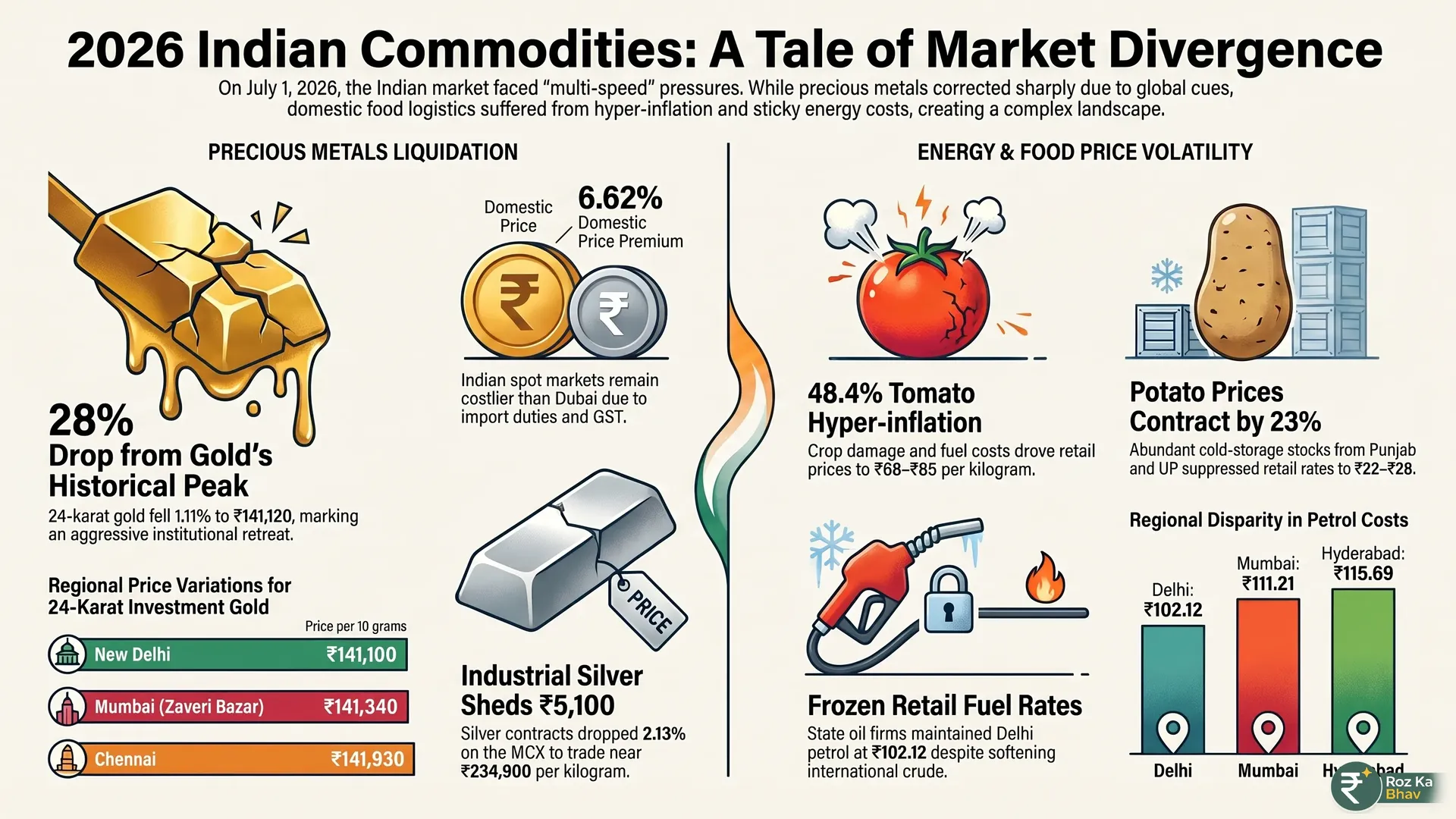
Domestic precious metals experienced aggressive long-unwinding during early morning trade on Wednesday, July 1, 2026. The 24-karat investment grade benchmark plummeted by ₹1,580 per 10 grams to settle at ₹141,120, marking an institutional retreat towards historic eight-month supports. Market analysts at Dalal Street note that this cooling trajectory is a direct translation of firming US Treasury yields and an appreciating greenback, which routinely chips away at the yieldless appeal of physical safe havens. Furthermore, geopolitical premium pricing built up in the prior calendar quarters has steadily unwound, leading to a massive 28% drop from January’s historical peak.
What this means for your wallet is an immediate window of relative affordability if you are looking to hedge long-term portfolios. However, the domestic spot market continues to hold an artificial premium over international transport hubs like Dubai. Currently, 24K retail allocations in India trade roughly 6.62% higher than equivalent off-shore rates, primarily driven by India’s structural import duty framework and internal Goods and Services Tax (GST) mechanisms. The silver market mirrored the selloff, with 999 Fine industrial contracts dropping on the Multi Commodity Exchange (MCX) to trade down near ₹234,900 per kilogram.
Note: Data based on 2026-07-01.
| Metal / Purity | Today’s Rate (INR) | Yesterday’s Rate (INR) | Absolute Change | Percentage Shift |
|---|---|---|---|---|
| Gold 24K (Per 10g) | ₹141,120 | ₹142,700 | -₹1,580 | -1.11% |
| Gold 22K (Per 10g) | ₹129,360 | ₹130,808 | -₹1,448 | -1.11% |
| Gold 18K (Per 10g) | ₹105,840 | ₹107,025 | -₹1,185 | -1.11% |
| Silver 999 Fine (Per 1kg) | ₹234,900 | ₹240,000 | -₹5,100 | -2.13% |
Gold Rates Today in Major Indian Cities
Due to varying octroi frameworks, local transport logistics, and regional jewelry syndication adjustments, clear disparities remain visible across metropolitan centers:
- New Delhi: 24K gold commands ₹141,100 per 10 grams, while retail 22K jewelry metal tracks closely at ₹129,343. Wholesale silver physical deliveries hover around ₹223,730 per kilogram.
- Mumbai: Spot counters settled slightly higher at ₹141,340 for 24K pure bars, indicating sticky physical off-take across Zaveri Bazar.
- Chennai: Consistently maintaining its spot as India’s most expensive physical bullion hub, 24K retail stock here commands ₹141,930, dictated by highly dense cultural demand patterns.
2. Petrol and Diesel Rates: Retail Fuel Price Stability
On the energy front, state-run Oil Marketing Companies (OMCs) – including Indian Oil Corporation (IOC), BPCL, and HPCL have maintained a strict freeze on retail pump rates today. This brings the current baseline streak to more than a full month of flatlining pricing following the modest adjustment back on May 25. In the national capital, petrol continues to retail at ₹102.12 per litre, while high-speed diesel stands fixed at ₹95.20 per litre. Conversely, international crude lines have shown signs of substantial softening, with Brent crude tracking down to near $72.92 per barrel.
Crucially, today marks a major structural turning point in downstream logistics. The Ministry of Petroleum and Natural Gas has officially lifted the temporary supply and distribution restrictions placed on motor spirit and diesel that were initiated during the peak of the West Asia maritime bottlenecks. In response to this stabilization, Nayara Energy, India’s largest private fuel retailer, broke ranks with state firms by implementing a direct price cut of ₹5 per litre on petrol and ₹3 per litre on diesel across its network of over 7,000 retail stations.
Note: Data based on 2026-07-01.
| City / Location | Petrol (INR/Litre) | Diesel (INR/Litre) | OMC Pricing Stance | Last Change Date |
|---|---|---|---|---|
| Delhi NCR | ₹102.12 | ₹95.20 | Unchanged | May 25, 2026 |
| Mumbai | ₹111.21 | ₹97.83 | Unchanged | May 25, 2026 |
| Kolkata | ₹113.51 | ₹99.82 | Unchanged | May 25, 2026 |
| Hyderabad | ₹115.69 | ₹103.82 | Unchanged | May 25, 2026 |
Fuel Prices Today in Metro Cities
While base costs remain managed, individual state levies alter your direct pump outcomes significantly:
- Southern Outliers: Hyderabad features some of the highest state VAT matrices in the country, forcing commercial commuters to bear ₹115.69 for petrol and a premium ₹103.82 for industrial diesel.
- The Commercial Capital: Mumbai consumers continue to pay above the ₹110 psychological ceiling for petrol (standing at ₹111.21), sustaining pressure on logistics providers and app-based aggregators.
3. Vegetable Prices and Food Inflation: Impact on Household Budgets
The retail food sector presents an entirely different macro challenge for the Reserve Bank of India’s inflation targeting framework. The latest provisional Consumer Food Price Index (CFPI) data reveals that food inflation has advanced significantly, climbing towards 4.78%. The single largest stress vector remains the sub-category of everyday kitchen vegetables, led by an extraordinary 48.4% annualized surge in tomato pricing. Unfavorable local climate pockets paired with earlier diesel cost pass-throughs have complicated the distribution chain, triggering sharp variations between farm-gate realization and localized urban mandi baselines.
Conversely, structural buffers are evident across other staple items. Onion prices have transitioned out of steep deflationary tracks but remain relatively subdued, while potato inflation is heavily suppressed, contracting by over 23%. Dairy production lines are experiencing stable summer flash-flushes, allowing major co-operatives like Amul and Mother Dairy to hold retail milk pricing flat, even as fodder inflation ticks moderately upwards.
Note: Data based on 2026-07-01.
| Essential Food Item | Average Retail Base (INR/Kg or L) | YoY Inflation Trend Status | Supply Outlook |
|---|---|---|---|
| Standard Tomatoes | ₹68 – ₹85 | Hyper-Inflationary (+48.4%) | Deficit until next harvest crop arrival |
| Table Potatoes | ₹22 – ₹28 | Deflationary (-23.0%) | Abundant cold-storage stocks available |
| Onions (Medium Grade) | ₹32 – ₹40 | Subdued Deflation (-2.2%) | Regulated release via government buffers |
| Toned Milk (Per Litre) | ₹56 – ₹58 | Stable (Flat) | Adequate structural co-operative reserves |
Retail Mandi Rates and Supply Analysis
Supply chain tracking across regional distribution hubs reveals sharp localized differences:
- Bengaluru & Southern Mandis: Disruption in seasonal arrivals across outer local fringes has caused premium tomato varieties to breach ₹80 per kg at organized retail outlets.
- Delhi Azadpur Mandi: Influx of cold-storage potato stocks from Uttar Pradesh and Punjab has maintained excellent volume depth, depressing local potato prices down to accessible ranges of ₹22 per kg.
4. Frequently Asked Questions (FAQ)
Source & Price Verification – Financial Markets
- Gold & Silver Prices: Data referenced from IBJA, MCX India, and international benchmarks.
- Petrol & Diesel Rates: Daily retail prices sourced from Indian Oil, HPCL, and BPCL.
- Commodity Market Data: Verified using MCX, NCDEX, and government statistical releases.
- Verification Process: Prices are cross-checked with at least two independent official or exchange-based sources before publication.
- Disclaimer: Market prices are indicative and may vary by city, tax structure, or intraday volatility.
Note: Prices are updated daily and cross-checked before publishing. If you notice any discrepancy, please email us at [email protected].