

Bullion Market: Gold & Silver Analysis
Energy Watch: Fuel & Gas Updates
Kitchen Essentials: Veggies & Dairy
Economic Outlook & Analysis
Frequently Asked Questions
Bullion Market Update: Gold Shatters Records on Auspicious Akshaya Tritiya
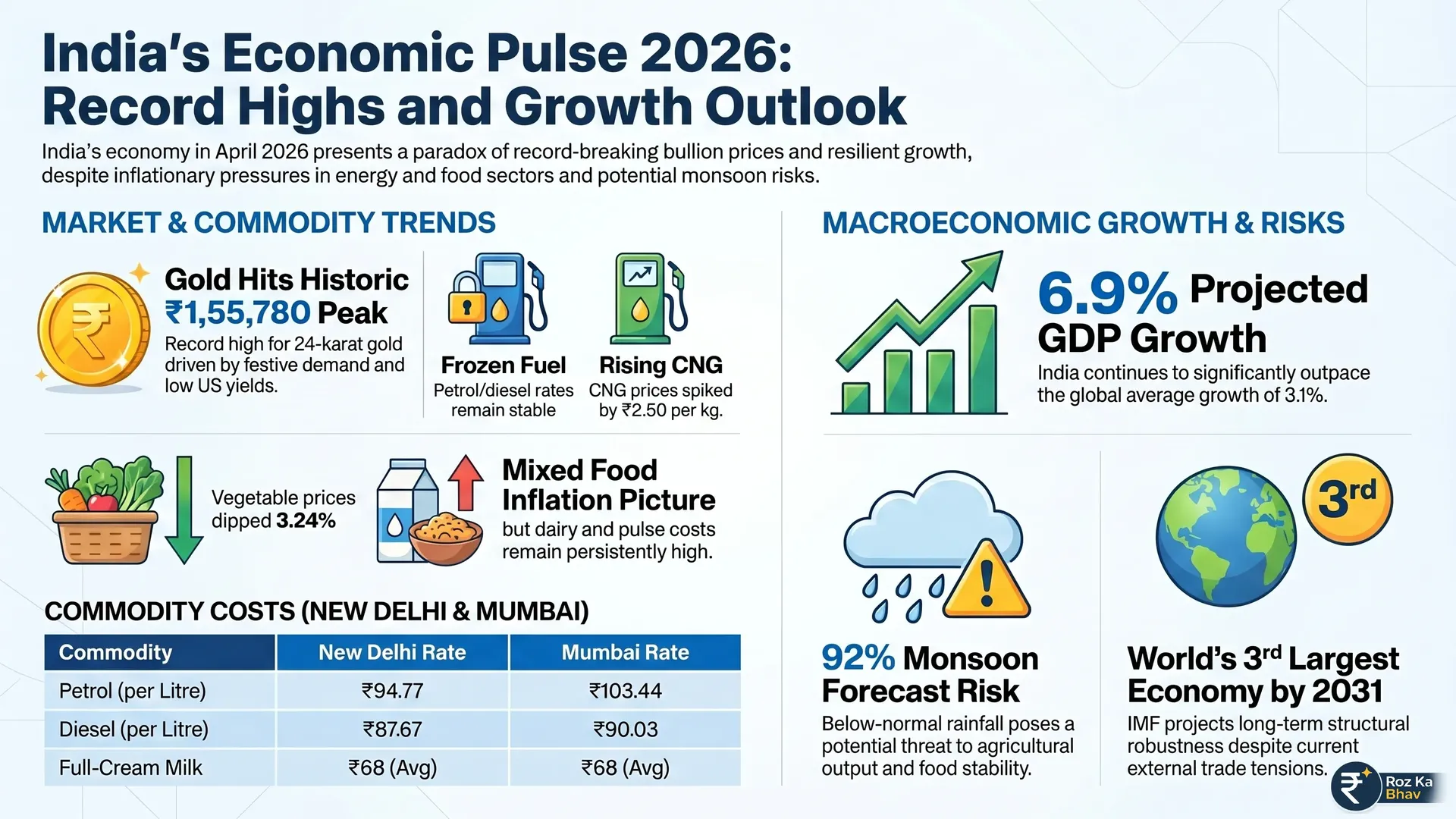
As the sun rose over jewelry hubs from Mumbai’s Zaveri Bazaar to Chennai’s T. Nagar this Sunday, the atmosphere was electric. Today marks Akshaya Tritiya a day many Indians consider the most auspicious for purchasing gold. However, this year, the yellow metal is living up to its name in price as much as in spirit. Looking at the charts, the surge is quite staggering: our market tracking shows that gold has climbed to approximately ₹1,55,780 per 10 grams for 24-karat purity, marking a significant recovery from a brief dip earlier this week.
Why the sudden spike? It is a mix of tradition and global macroeconomics. While local demand is peaking due to the festival, the international backdrop is providing the fuel; a weaker US Dollar currently hovering near a six-week low and a slight dip in US Treasury yields have made gold an attractive safe haven. When the dollar softens, gold typically gets a boost because it becomes cheaper for buyers using other currencies. In India, the sheer volume of festive buying has pushed local premiums even higher.
Silver isn’t sitting quietly either. Following gold’s lead, silver has climbed nearly 4% this month. In many Indian cities, industrial demand for silver, combined with its role as a “poor man’s gold” for festive gifting, has kept the retail price robust. You can see the city-wise variations in the table below, which reflect local octroi and transportation costs.
Note: Data based on 2026-04-19.
| City | 24K Gold (per 10g) | 22K Gold (per 10g) | Silver (per 1kg) |
|---|---|---|---|
| New Delhi | ₹1,55,780 | ₹1,42,800 | ₹98,500 |
| Mumbai | ₹1,55,630 | ₹1,42,650 | ₹98,500 |
| Chennai | ₹1,56,660 | ₹1,43,600 | ₹1,02,000 |
| Bangalore | ₹1,55,780 | ₹1,42,800 | ₹96,000 |
The Global Context: Why Gold?
According to reports from GoodReturns, the recovery in gold prices comes after a period of high volatility. Earlier in the year, fears of a wider Middle East conflict kept inflation expectations elevated. Interestingly, as diplomatic talks between major powers show signs of progress, the risk premium on oil has dropped; however, investors are still flocking to gold as a hedge against currency weakness. It is a bit of a paradox, but then again, markets rarely move in a straight line.
Energy Watch: Petrol and Diesel Hold Steady Amid Crude Volatility
If you visited a petrol pump in Delhi or Mumbai this morning, you likely noticed that the numbers on the display have not moved much. Despite the chaos in global crude markets where Brent crude has seen a nearly 10% decline recently Indian retail prices for petrol and diesel remain largely frozen. It is a strategic move by the government: by keeping prices stable, the administration is trying to prevent a transportation inflation spike from trickling down into the price of daily essentials like bread and milk.
However, it is not all quiet on the energy front. While petrol remains steady, CNG prices have seen minor upward revisions in certain districts. Torrent Gas recently hiked CNG prices by roughly ₹2.50 in some regions, citing higher procurement costs. For the thousands of cab drivers and commuters who switched to CNG to save money, this is a small but painful pinch to the monthly budget.
Note: Data based on 2026-04-19.
| City | Petrol (per Litre) | Diesel (per Litre) | CNG (per Kg) |
|---|---|---|---|
| New Delhi | ₹94.77 | ₹87.67 | ₹77.09 |
| Mumbai | ₹103.44 | ₹90.03 | ₹80.50 |
| Kolkata | ₹105.41 | ₹92.02 | ₹93.50 |
| Chennai | ₹100.85 | ₹92.49 | ₹91.50 |
The reality is that Oil Marketing Companies (OMCs) are absorbing significant losses to keep these retail prices flat. As reported by TV9 Hindi, this freeze is a deliberate policy tool. There is talk of a potential price cut if crude stays below $80 per barrel for an extended period; however, with the West Asia situation still resembling a powder keg, no one is holding their breath. For now, what you see at the pump is what you will get for the foreseeable future.
Kitchen Essentials: Vegetable Prices Cool While Dairy Costs Stay High
The thali economics of India is perhaps the most sensitive barometer of public sentiment. This morning at the Azadpur Mandi in Delhi, traders noted a slight easing in the prices of seasonal vegetables. Tomatoes and onions which often behave like volatile stocks have stabilized as new harvests from Maharashtra and Karnataka hit the markets. Our tracking indicates that vegetable inflation has dipped by about 3.24% month-on-month; this is a welcome relief for the average household.
But here is the catch: while veggies are cheaper, dairy and pulses are playing hardball. milk prices have remained sticky due to rising fodder costs and a general increase in processing expenses. Most major cooperatives have held their prices steady this month, but there is no sign of a reduction. If you are a heavy consumer of dairy, your bill is not going down anytime soon.
Current Retail Price Trends
- Onions: Trading at ₹30 – ₹40 per kg in most metros, down from last month’s highs.
- Tomatoes: Stabilized at ₹25 – ₹35 per kg thanks to improved supply chains.
- Milk (Full Cream): Hovering around ₹66 – ₹68 per litre.
- Pulses (Arhar Dal): Remains a concern, with prices up 4% year-on-year due to lower acreage in certain belts.
Economic Outlook: The Fastest Growing Economy Navigates Uncertainty
Stepping back from the price of gold and onions, the bigger picture for India remains surprisingly resilient. According to the latest Asian Development Bank (ADB) report, India’s GDP growth is projected at 6.9% for FY2026. While this is a slight moderation from the 7.6% seen last year, in a world where the UK is struggling at 0.8% and the global average is around 3.1%, India remains the bright spot.
The moderation is mostly due to external factors: the conflict in West Asia has not just affected oil; it has created volatile trade and financial conditions that weigh on Indian exports. Meanwhile, the IMF recently noted that while India slipped to the sixth-largest economy in nominal terms temporarily, it is on a rock-solid path to claim the third spot by 2031. For investors, this means that while the short-term market might be choppy, the long-term structural story of India is very much intact.
One interesting aside: the IMD has flagged a below-normal monsoon for 2026 – with rainfall projected at 92% of the long-term average. This is the wildcard. If the rains fail, the current stability in vegetable and food prices could vanish by July; it is something we are watching very closely.
Frequently Asked Questions
Today is Akshaya Tritiya, a major festival where buying gold is considered auspicious. This massive domestic demand, combined with a weakening US dollar and lower global bond yields, has pushed prices to record highs exceeding ₹1.55 lakh per 10 grams.
While global crude oil prices have dropped by nearly 10% recently, Indian OMCs have kept retail prices steady to offset previous losses and manage inflation. A price cut is possible only if international crude stays low consistently for several weeks.
India remains the fastest-growing major economy in the world. With a projected growth of 6.5% to 6.9% for 2026, it is significantly outperforming Western economies like the UK and USA, although global geopolitical tensions remain a risk factor.
Vegetable prices have seen a slight seasonal cooling of about 3.2% this month. However, a below-normal monsoon forecast by the IMD could lead to higher prices later in the year if crop yields are negatively affected.
Disclaimer: The financial information provided in this report is based on market data available as of April 19, 2026. Commodity prices and economic projections are subject to change based on global events and government policies. Always consult with a financial advisor before making significant investment decisions.
Source & Price Verification – Financial Markets
- Gold & Silver Prices: Data referenced from IBJA, MCX India, and international benchmarks.
- Petrol & Diesel Rates: Daily retail prices sourced from Indian Oil, HPCL, and BPCL.
- Commodity Market Data: Verified using MCX, NCDEX, and government statistical releases.
- Verification Process: Prices are cross-checked with at least two independent official or exchange-based sources before publication.
- Disclaimer: Market prices are indicative and may vary by city, tax structure, or intraday volatility.
Note: Prices are updated daily and cross-checked before publishing. If you notice any discrepancy, please email us at [email protected].
