

As the first light hit the busy lanes of Chandni Chowk and Zaveri Bazaar this morning, a mix of relief and caution was evident among traders. For several weeks, Indian consumers have navigated the volatility of the West Asian conflict and its ripple effects on global supply chains. Fortunately, today offers a moment of relative calm. It has been a turbulent period for both the Rupee and retail investors; however, recent data indicates a shift toward a period of managed stability.
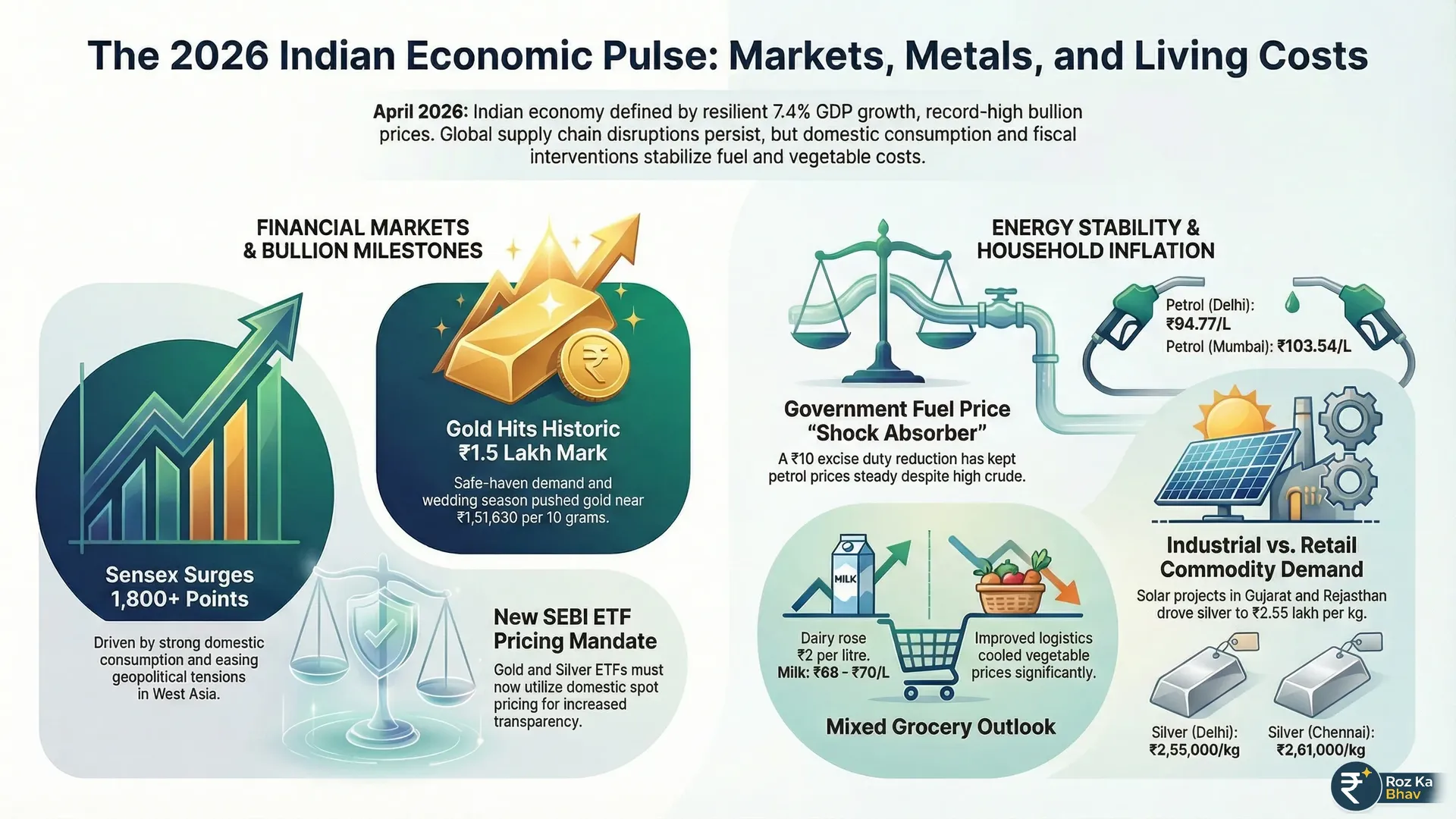
The core story today isn’t just the statistics; it is the sheer resilience of domestic demand. With crude oil lingering near $113 per barrel, the Central Government having slashed excise duty last week has effectively created a vital shock absorber. This intervention has prevented household budgets from spiraling, even as precious metals hit heights that seemed improbable just two years ago. While the Sensex celebrates an 1,899-point surge today; the typical household remains focused on the marginal price shifts in milk and tomatoes.
Quick Links
Bullion Market: Gold and Silver Analysis
Energy Prices: Petrol, Diesel, and CNG
Kitchen Essentials: Vegetable and Dairy Trends
Macro Outlook and RBI Policy
Common Questions (FAQs)
Bullion Market: A New Era for Gold and Silver Prices
Anyone visiting a jewelry showroom recently has likely experienced genuine sticker shock. Gold has entered a significant new phase in the Indian market. Today, 24-carat gold is trading at roughly ₹15,148 per gram in major cities. This is more than a brief spike it represents a major structural shift. According to reports from Business Today, the bullion market is currently processing a weaker dollar and a surge in safe-haven asset demand.
Significantly, today marks the start of a new SEBI mandate. As of April 1, 2026, Indian Gold and Silver ETFs must utilize domestic spot pricing rather than relying on London benchmarks. This move enhances market transparency; the price on your investment dashboard will finally reflect the actual purity and premium of the Indian physical market. Experts suggest this change will drastically reduce the tracking errors that have historically frustrated gold investors.
Note: Data based on 2026-04-01.
| City | 24K Gold (per 10g) | 22K Gold (per 10g) | Silver (per kg) |
|---|---|---|---|
| Delhi | ₹1,51,630 | ₹1,39,000 | ₹2,55,000 |
| Mumbai | ₹1,51,480 | ₹1,38,850 | ₹2,55,000 |
| Chennai | ₹1,50,200 | ₹1,36,700 | ₹2,61,000 |
| Kolkata | ₹1,51,480 | ₹1,38,850 | ₹2,55,000 |
Silver is maintaining a similar pace. Trading at approximately ₹2,55,000 per kilogram, it is now viewed as a vital industrial commodity rather than just an alternative to gold. With the rapid expansion of solar energy projects in Rajasthan and Gujarat, silver demand is currently outrunning supply. For those planning wedding season purchases; waiting for a significant dip may be risky, as prices remain remarkably buoyant.
Energy Watch: Fuel Prices Stabilize Following Excise Cuts
Commuters in Delhi found some consistency today. Petrol holds at ₹94.77 per litre, and Diesel remains at ₹87.67. This stability is notable given that global Brent crude is trading at $113.82 per barrel. The primary reason is the recent ₹10 excise duty reduction. However, it is worth noting that state-run oil marketing companies specifically IOCL and BPCL are currently absorbing these costs to recover earlier losses. While they are not yet passing additional benefits to consumers; they are also refraining from price hikes.
In Mumbai, prices are higher due to local VAT; with petrol reaching ₹103.54. Meanwhile, CNG users in the NCR find prices around ₹77.09 per kg. For domestic piped gas (PNG), rates have stayed flat at ₹47.89 per SCM. The government appears to be prioritizing middle-class financial stability over fiscal deficit targets for the time being.
Note: Data based on 2026-04-01.
| City | Petrol (Regular) | Diesel (Regular) | CNG (per kg) |
|---|---|---|---|
| New Delhi | ₹94.77 | ₹87.67 | ₹77.09 |
| Mumbai | ₹103.54 | ₹90.03 | ₹80.50 |
| Bangalore | ₹102.96 | ₹90.99 | ₹88.95 |
| Kolkata | ₹105.41 | ₹92.02 | ₹93.50 |
Grocery Trends: Vegetable and Dairy Price Movement
Food inflation remains a persistent challenge for daily budgeting. While the headline CPI was reported at 2.75% in January; the “Food and Beverages” segment feels more expensive on the ground. milk prices have climbed steadily over the past year. Major providers like Amul and Mother Dairy point to rising fodder costs as the reason for the recent ₹2 per litre increase in full-cream milk.
Conversely, vegetable markets are seeing some relief. Tomatoes have stabilized between ₹30 and ₹40 per kg in most wholesale hubs. Onions are following suit, staying near the ₹35 mark. However, green leafy vegetables and seasonal gourds are seeing slight increases as the early summer heat begins to affect harvests in Haryana and Uttar Pradesh.
Average Vegetable Rates by City (per KG)
- Tomato: ₹32 (Delhi), ₹38 (Mumbai), ₹28 (Bangalore)
- Onion: ₹34 (Delhi), ₹40 (Mumbai), ₹35 (Chennai)
- Potato: ₹22 (Delhi), ₹25 (Mumbai), ₹24 (Kolkata)
- Milk (Full Cream): ₹68 – ₹70 per litre (Metros)
It is worth noting that logistical improvements have helped significantly. Better refrigerated transport means that even during temperature spikes, spoilage rates are lower than they were five years ago. Prices aren’t necessarily low, but they have become more predictable.
Macro Outlook: RBI Policy and GDP Projections
The Reserve Bank of India (RBI) maintains a watchful “neutral” stance. In the most recent Monetary Policy Committee (MPC) meeting, the repo rate was held at 5.25%. This decision aims to support a projected 7.4% GDP growth for the 2026 fiscal year. Despite global headwinds; India’s internal consumption remains a pillar of strength. According to The Hindu, today’s equity market rally reflects strong investor confidence in India’s macroeconomic stability.
However, analysts at India Ratings and Research suggest caution. If the conflict in West Asia continues; the current account deficit could expand. Historically, a $10 rise in crude prices exerts significant pressure on the Rupee. For now, the currency remains steady; yet global energy volatility remains the primary risk factor for domestic portfolios.
Frequently Asked Questions
1. Why are gold prices reaching record highs in India?
Gold prices are climbing due to geopolitical tensions in West Asia, a weakening US Dollar, and high domestic demand for the wedding season. The move to domestic spot pricing for ETFs has also aligned local prices more closely with physical market rates.
2. Will fuel prices drop further after the recent excise duty cut?
Further cuts are unlikely in the short term. While the government reduced excise duty by ₹10; oil companies are using that margin to cover the costs of expensive crude imports (currently over $110/barrel). Prices at the pump will likely remain stable unless global crude drops significantly.
3. Why is petrol more expensive in Mumbai than in Delhi?
Fuel costs vary by state due to differing Value Added Tax (VAT) rates and transportation charges. Maharashtra typically applies a higher VAT than Delhi; resulting in the price gap of nearly ₹9 per litre.
4. Is silver a viable investment right now?
With new SEBI pricing transparency, Silver ETFs are more attractive. High industrial demand for green energy technology makes silver a strong long-term prospect; though it generally exhibits higher price volatility than gold.
Source & Price Verification – Financial Markets
- Gold & Silver Prices: Data referenced from IBJA, MCX India, and international benchmarks.
- Petrol & Diesel Rates: Daily retail prices sourced from Indian Oil, HPCL, and BPCL.
- Commodity Market Data: Verified using MCX, NCDEX, and government statistical releases.
- Verification Process: Prices are cross-checked with at least two independent official or exchange-based sources before publication.
- Disclaimer: Market prices are indicative and may vary by city, tax structure, or intraday volatility.
Note: Prices are updated daily and cross-checked before publishing. If you notice any discrepancy, please email us at [email protected].