

As the sun rose over the bustling markets of Chandni Chowk and Zaveri Bazaar this morning, the atmosphere was thick with more than the usual humidity. There is a palpable sense of unease among retail buyers; honestly, it is hard to blame them. For anyone planning to purchase jewelry for the upcoming wedding season, the numbers flashing on the tickers are nothing short of a sticker shock. We have witnessed a massive shift in the last 24 hours that is redefining what expensive looks like in the Indian context.
Global triggers are usually the culprit and today is no different. The de-escalation hopes between Israel and Iran that briefly surfaced yesterday have been replaced by a cautious wait-and-watch mode; this traditionally sends investors scurrying toward the safety of bullion. Meanwhile, the average Indian household navigates a different kind of pressure: the rising cost of the breakfast table. From milk to essential greens, the cooling inflation hoped for in 2026 seems to be taking its own sweet time to arrive.
Bullion Market: Gold & Silver Price Analysis
Energy Watch: Fuel & CNG Price Trends
Kitchen Essentials: Vegetable & Dairy Costs
Economic Outlook & Expert Financial Views
Market FAQs
Bullion Market: The Record-Breaking Golden Surge
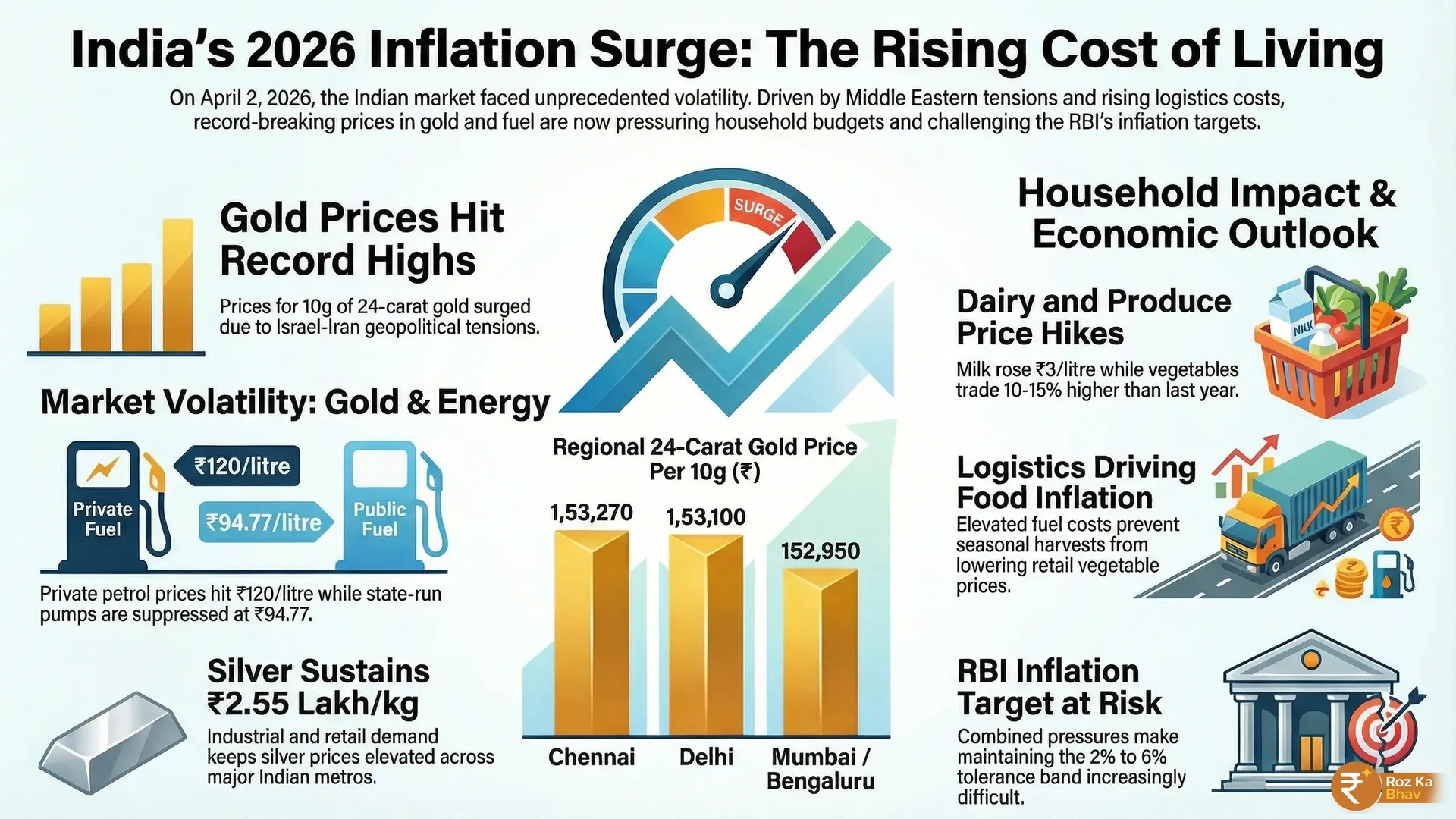
If you bought gold a month ago, you are likely feeling like a genius right now. But for the rest of us? It is getting a bit ridiculous. Our market tracking shows that 24-carat gold has effectively shattered previous resistance levels; it is currently trading near ₹1,53,100 in the national capital. This is not just a small bump it is a continuation of a rally that started with a bang on April 1st, where rates jumped significantly in a single session.
Interestingly, the price gap between cities remains notable. Chennai is currently leading the pack with the highest retail tags; often crossing ₹1,53,270 for the 24K variant. In contrast, Mumbai and Kolkata are seeing slightly more competitive rates though competitive is a relative term when you are paying six figures for a tiny bit of metal. Silver is not lagging far behind either; it is holding firm around the ₹2.55 lakh per kg mark in several southern cities.
City-Wise Gold & Silver Rates (April 2, 2026)
Note: Data based on 2026-04-02.
| City | 24K Gold (per 10g) | 22K Gold (per 10g) | Silver (per 1kg) |
|---|---|---|---|
| Delhi | ₹1,53,100 | ₹14,036 | ₹2,55,100 |
| Mumbai | ₹1,52,950 | ₹14,021 | ₹2,55,100 |
| Chennai | ₹1,53,270 | ₹14,051 | ₹2,65,100 |
| Bengaluru | ₹1,52,950 | ₹14,021 | ₹2,55,100 |
Silver volatility is actually higher than gold right now. It dropped nearly 2% on the MCX in the previous session before stabilizing today. If you are an industrial hedger, this kind of swing is enough to cause a headache. But for the retail investor, the poor man’s gold is starting to look quite elite.
Energy Watch: Shifting Petrol and Diesel Rates
If you pulled up to an Indian Oil or BPCL pump this morning, you likely saw the same prices as yesterday. In Delhi, petrol is holding at ₹94.77 per litre. However, the official price does not tell the whole story. Private players like Nayara and Shell have already started hiking rates to offset the rising cost of Brent crude; which is hovering uncomfortably high due to the West Asia conflict.
For those in Bengaluru, the situation is even more stark. Some reports indicate petrol prices at certain outlets have touched nearly ₹120 per litre for standard variants. It is a fragmented market right now; you might find a ₹5 to ₹7 difference just by driving a few kilometers to a different brand’s station. It is a difficult situation for commuters who are already stretched thin.
Fuel Rates in Metro Cities
Note: Data based on 2026-04-02.
| City | Petrol (per Litre) | Diesel (per Litre) | CNG (per Kg) |
|---|---|---|---|
| New Delhi | ₹94.77 | ₹87.67 | ₹77.09 |
| Mumbai | ₹103.54 | ₹90.03 | ₹80.50 |
| Hyderabad | ₹107.46 | ₹95.70 | ₹97.00 |
| Kolkata | ₹105.41 | ₹92.02 | ₹93.50 |
The government is trying to keep a lid on state-run prices to prevent an inflationary spiral; but with global crude benchmarks edging higher, analysts note that a price correction at PSU pumps might be inevitable after the current round of local elections. For now, the advice is simple: check the price board before you say full tank.
Kitchen Essentials: Dairy and Vegetable Price Hikes
While the headlines focus on gold and oil, the real story for most families is in the kitchen. Starting yesterday, April 1st, milk prices saw a sharp revision. In cities like Indore, the Indore Dugdh Vikreta Sangh announced a ₹3 per litre hike. This is not just a local issue; fodder costs are up across the country, and dairy cooperatives in other states are expected to follow suit soon.
Vegetable Prices are also showing their usual seasonal spring fever. While the arrival of new harvests usually cools things down, logistical disruptions linked to fuel costs have kept prices for tomatoes and onions about 10 – 15% higher than this time last year. Everything is connected: higher diesel prices for trucks eventually lead to a more expensive salad.
Economic Outlook: The 4% Inflation Challenge
The Reserve Bank of India (RBI) is in a tight spot. The government recently retained the 4% retail inflation target for the next five years. On paper, that sounds great. In reality, when gold is at record highs and milk is getting pricier, keeping the Consumer Price Index (CPI) within that 2 – 6% tolerance band is like trying to balance on a tightrope during a storm.
Based on current exchange data, the Rupee is also facing renewed pressure against the Dollar. This makes our imports especially oil and electronics even more expensive. If the global situation does not settle down, we might see the RBI holding interest rates higher for longer; this means your home loan EMIs are not coming down anytime soon. It is a sobering thought, but one that every middle-class investor needs to plan for.
Looking ahead to the rest of the week, watch for the US jobs report and any further statements from the Middle East. Those are the two Goliaths that will dictate whether our markets find some calm or continue this wild ride. For now, diversification is not just a buzzword; it is a survival strategy. Do not put all your eggs or your gold in one basket.
Market Frequently Asked Questions (FAQs)
1. Why are gold prices so high in India today?
Prices are driven by global geopolitical tension in the Middle East and a weaker Rupee. When uncertainty rises, investors buy gold as a safe haven; this drives up the price globally and domestically.
2. Will petrol prices increase at all petrol pumps?
Currently, only private retailers like Shell and Nayara have significantly increased prices. State-run pumps (IOCL, HPCL, BPCL) have kept rates stable; however, this could change if global oil prices stay above $90 a barrel.
3. Why is milk becoming more expensive in April 2026?
The primary reason is the rising cost of cattle fodder and animal maintenance. Milk unions are passing these costs onto consumers to ensure the supply chain remains viable for farmers.
4. Is it a good time to invest in silver?
Silver is currently very volatile. While it has industrial demand, its price swings can be sharp. Analysts suggest a buy-on-dips strategy rather than chasing the current highs.
Source & Price Verification – Financial Markets
- Gold & Silver Prices: Data referenced from IBJA, MCX India, and international benchmarks.
- Petrol & Diesel Rates: Daily retail prices sourced from Indian Oil, HPCL, and BPCL.
- Commodity Market Data: Verified using MCX, NCDEX, and government statistical releases.
- Verification Process: Prices are cross-checked with at least two independent official or exchange-based sources before publication.
- Disclaimer: Market prices are indicative and may vary by city, tax structure, or intraday volatility.
Note: Prices are updated daily and cross-checked before publishing. If you notice any discrepancy, please email us at [email protected].
