

India’s Economic Performance: Resilience Amid Global Volatility
Observing the financial pulse of Mumbai today reveals a sense of cautious optimism. While global markets navigate ongoing tensions in the Middle East, the Indian economy continues to hold its ground. Recent reports from the OECD and Fitch confirm that India remains the world’s fastest-growing major economy.
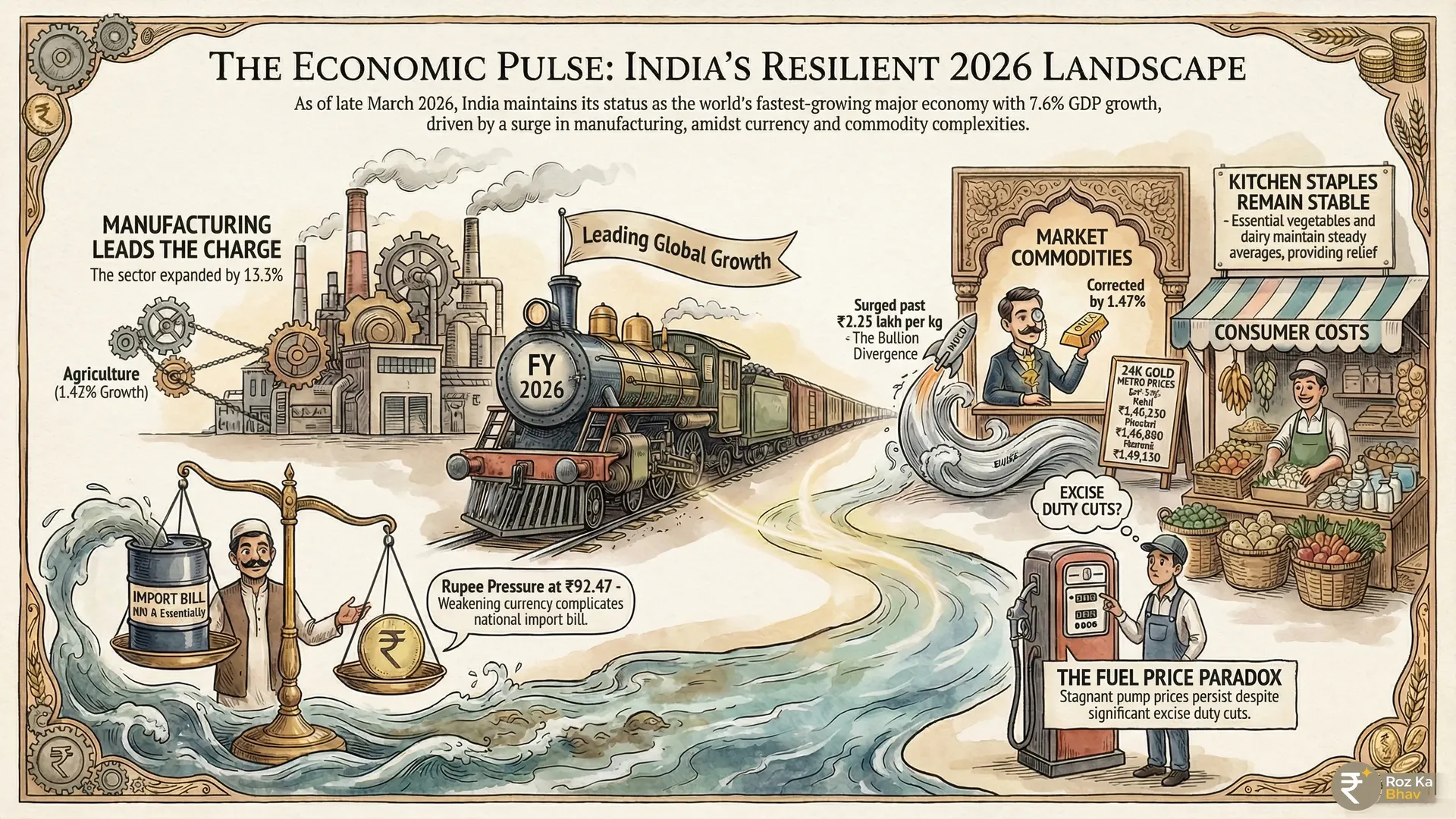
Data points to a resilient 7.6% GDP growth estimate for the current fiscal year. Manufacturing has emerged as a powerhouse growing at 13.3% — while agriculture lags slightly at 1.42%. This difference explains why grocery costs may feel high even as the stock market breaks records. The Reserve Bank of India (RBI) remains committed to a 4% inflation target a challenging goal as the Rupee recently hit ₹92.47 against the dollar.
Bullion Market: Gold Prices See a Minor Correction
For those eyeing gold purchases for the upcoming wedding season, today offers a slight reprieve. After a long rally, gold prices in major cities have finally cooled. In Delhi, 24K gold fell by roughly 1.47%, settling at ₹1,40,330 per 10 grams. While these prices are historically high, the dip provides a welcome breather in a month defined by volatility.
Silver is moving in the opposite direction. On the MCX, silver futures for May 2026 rose by over 2%, surpassing the ₹2.25 lakh per kg mark. It appears industrial demand for silver is now decoupling from gold’s path as a safe-haven asset. Internationally, spot gold is holding near $4,428 per ounce. While the long-term trend remains bullish, these short-term pullbacks often attract retail buyers.
Current Gold & Silver Rates (March 28, 2026)
Note: Data based on 2026-03-28.
| City | 22K Gold (10g) | 24K Gold (10g) | Silver (1kg) |
|---|---|---|---|
| Delhi | ₹1,33,650 | ₹1,40,330 | ₹2,40,000 |
| Mumbai | ₹1,34,650 | ₹1,46,890 | ₹2,41,000 |
| Chennai | ₹1,36,700 | ₹1,49,130 | ₹2,45,000 |
| Bangalore | ₹1,34,650 | ₹1,46,890 | ₹2,40,500 |
For real-time tracking and purity spreads, investors can visit the GoldMeter live dashboard for up-to-the-minute data.
Energy Sector: The Fuel Excise Duty Paradox
Indian fuel prices often behave in unexpected ways. The central government recently made a significant move by cutting excise duty on petrol by ₹10 per liter. While this looks like a win for consumers on paper, visiting an Indian Oil or BPCL station reveals that pump prices have remained largely static.
This lack of movement is due to global crude volatility and a weaker Rupee. Oil marketing companies are utilizing the excise cushion to recover previous losses instead of passing immediate savings to the public. This strategy has kept prices from jumping to ₹150; keeping Delhi at ₹94.77 for petrol while Mumbai stays above ₹100 due to state-level VAT.
Metro City Fuel Price Comparison
Note: Data based on 2026-03-28.
| City | Petrol (per L) | Diesel (per L) | CNG (per kg) |
|---|---|---|---|
| New Delhi | ₹94.77 | ₹87.62 | ₹75.59 |
| Mumbai | ₹103.44 | ₹92.15 | ₹82.00 |
| Kolkata | ₹103.54 | ₹90.76 | ₹85.50 |
| Hyderabad | ₹107.46 | ₹95.65 | ₹89.00 |
Indicative rates from the Indian Oil Corporation show that prices can vary by specific outlet. On a positive note, the partial reopening of the Strait of Hormuz to Indian vessels may help stabilize supply in the near future.
Kitchen Budget: Stability in Vegetables and Dairy
Food inflation is where the average household feels the most impact. Fortunately, the essential trio Potato, Onion, and Tomato is currently showing price stability. Retail prices for potatoes are averaging ₹20.64/kg, with onions at ₹25.26/kg.
The dairy industry is also reaching a point of stabilization. Despite minor regional hikes of ₹1 to ₹2 per liter in Bihar and Andhra Pradesh, the Indian Dairy Association suggests a nationwide price hike is unlikely for the remainder of 2026. This forecast is supported by a better flush season and improved fodder supplies.
Current Retail Prices for Essential Goods
Note: Data based on 2026-03-28.
| Commodity | Avg. Price (All India) | Current Trend |
|---|---|---|
| Milk (per L) | ₹59.39 | Stable |
| Potato (per kg) | ₹20.64 | Steady |
| Onion (per kg) | ₹25.26 | Slight Dip |
| Tomato (per kg) | ₹26.78 | Volatile |
| Atta (per kg) | ₹36.98 | Marginal Rise |
For daily updates, consumers can monitor the Ministry of Consumer Affairs Price Monitoring System to compare local vendor rates with city averages.
Frequently Asked Questions (FAQ)
The correction is linked to a dip in international spot prices and a minor recovery of the Rupee. Many investors are also booking profits following a period of sustained high prices.
While the duty was cut, pump prices remain stable as oil companies offset high import costs. Significant drops at the pump would likely require global crude prices to stay consistently below $75 per barrel.
The Indian Dairy Association forecasts a major hike is unlikely in 2026. With production expected to grow by 2%, current stocks should meet demand without necessitating price hikes.
India remains a global leader with a projected growth of 7.5% to 7.6%. This contrasts with slowing growth in other major markets, driven largely by domestic consumption and infrastructure investment.
Source & Price Verification – Financial Markets
- Gold & Silver Prices: Data referenced from IBJA, MCX India, and international benchmarks.
- Petrol & Diesel Rates: Daily retail prices sourced from Indian Oil, HPCL, and BPCL.
- Commodity Market Data: Verified using MCX, NCDEX, and government statistical releases.
- Verification Process: Prices are cross-checked with at least two independent official or exchange-based sources before publication.
- Disclaimer: Market prices are indicative and may vary by city, tax structure, or intraday volatility.
Note: Prices are updated daily and cross-checked before publishing. If you notice any discrepancy, please email us at [email protected].
