

Indian Economic Landscape: Key Drivers Shifting Today’s Markets
As trading began today across the bustling markets of Chandni Chowk and Mumbai’s financial hubs, a sense of cautious relief emerged among traders. It has been a rollercoaster week, but after the sharp sell-offs seen earlier this month, Indian markets appear to be establishing a new floor. While the global backdrop remains complex, domestic resilience is hard to ignore.
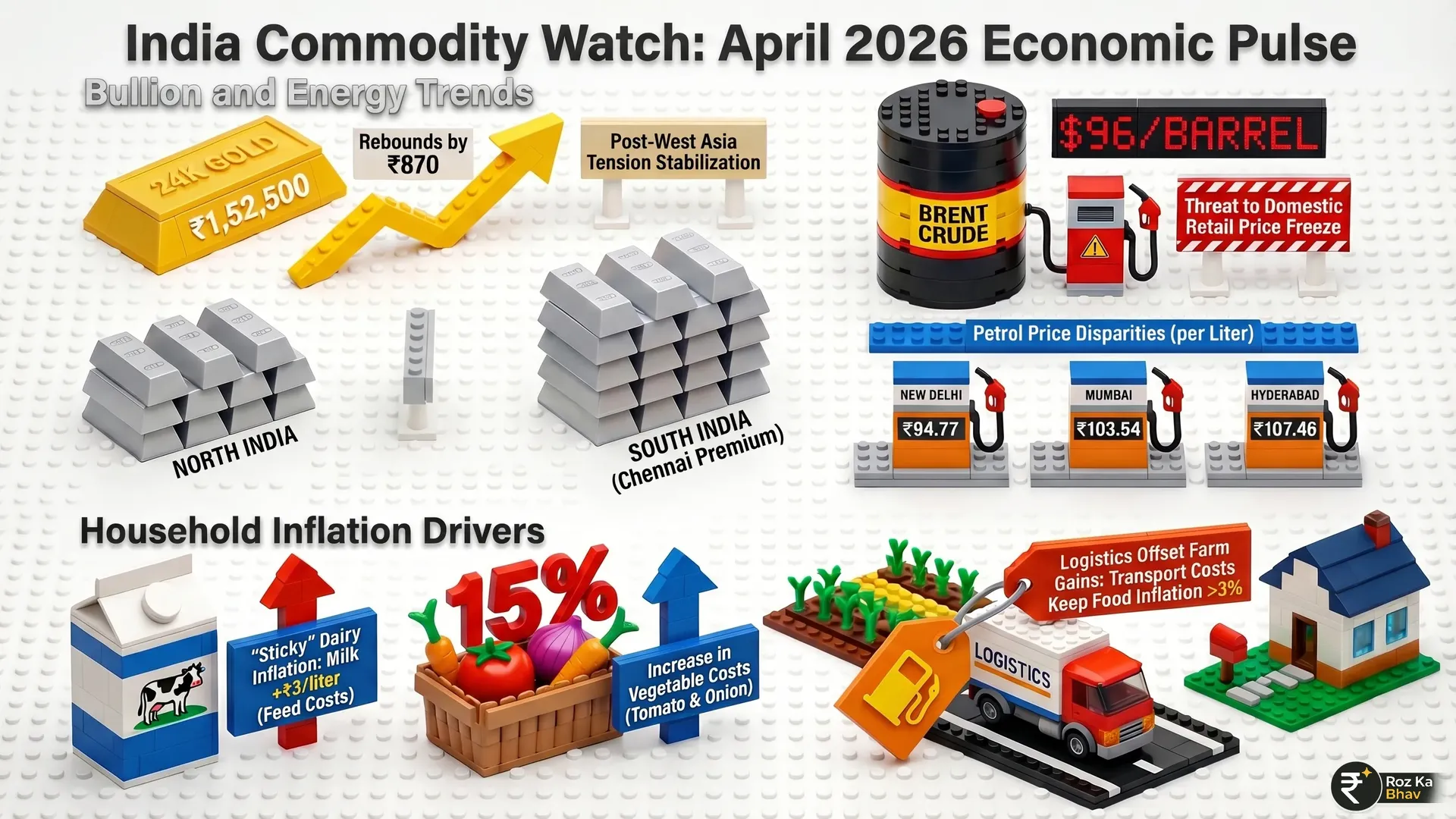
The primary driver for today’s market shift is the relative stabilization of the Indian Rupee against the Dollar, paired with a slight cooling of geopolitical tensions in West Asia. When global uncertainty lingers, gold often finds its feet and that is exactly what we are witnessing. Domestic gold prices gained roughly ₹870 per 10 grams today; a move analysts describe as a corrective rebound rather than a speculative bubble. Investors are not necessarily diving back into the deep end, but they are certainly testing the waters again.
For the average consumer, this translates to a mixed bag. If you are looking to invest in hedges like gold, the entry point is becoming more predictable, though it remains at historic highs. Conversely, for those managing a household, the silent inflation in the kitchen is where the real struggle persists. It is not just the stock tickers the price of a liter of milk is defining the consumer mood today.
Bullion Market: Gold & Silver Analysis
Energy Watch: Fuel & CNG Rates
Kitchen Essentials: Veggie & Dairy Trends
Frequently Asked Questions
Bullion Market Analysis: The Golden Rebound
If you have been tracking gold recently, you might have experienced a bit of whiplash. Just days ago, prices were swinging wildly as global headlines shifted between conflict and diplomacy. Today April 11, 2026 — we are seeing a much more composed market. In Delhi and Mumbai, 24K gold is hovering between the ₹1,52,350 and ₹1,52,500 mark. This represents a recovery, yet we are still looking at prices that would have seemed unthinkable a year ago.
Silver is following a similar trajectory. Often called the poor man’s gold, it is proving quite expensive lately, holding steady at ₹2.60 lakh per kilogram. In southern markets like Chennai and Hyderabad, where demand for physical metal is traditionally higher, prices are even steeper. According to the latest data from
OneIndia’s market tracking, the regional gap is widening; Chennai is trading at a premium of nearly ₹5,000 for silver compared to northern states.
Today’s Gold & Silver Rates by City (April 11, 2026)
Note: Data based on 2026-04-11.
| City | 24K Gold (per 10g) | Silver (per 1kg) | Daily Trend |
|---|---|---|---|
| New Delhi | ₹1,52,500 | ₹2,60,100 | Upward (+₹870) |
| Mumbai | ₹1,52,350 | ₹2,60,100 | Stable Rebound |
| Chennai | ₹1,54,090 | ₹2,65,100 | Premium High |
| Bangalore | ₹1,52,350 | ₹2,60,100 | Steady |
Meanwhile, the demand for 22K gold commonly used in jewelry has seen a parallel rise. In Bangalore and Hyderabad, 22K gold is priced at roughly ₹1,39,660 per 10 grams. Interestingly, despite these record highs, wedding season demand has not evaporated it has simply shifted. Consumers are buying less in weight but more in value; a notable shift in behavior observed throughout this quarter.
Energy Watch: No Relief at the Petrol Pump
Commuters in Delhi found pump prices exactly where they left them this morning. Petrol remains firm at ₹94.77, while diesel is pegged at ₹87.67. This stability is a double-edged sword: it prevents immediate logistics shocks but reflects the high floor set by global crude. With Brent crude flirting with the $96 mark, Indian oil marketing companies remain on edge.
Regional disparities in fuel costs remain significant. If you are driving in Hyderabad, you are paying over ₹107 per liter for petrol nearly a ₹13 difference compared to Delhi. This is not just about local taxes; it reflects the logistical challenge of moving fuel across the subcontinent when transit costs are at an all-time high. CNG prices in the capital remain steady at ₹77.09 per kg, providing a small silver lining for taxi and auto drivers.
Current Fuel Rates in Major Metro Cities
Note: Data based on 2026-04-11.
| Metro City | Petrol (per Litre) | Diesel (per Litre) | CNG (per Kg) |
|---|---|---|---|
| New Delhi | ₹94.77 | ₹87.67 | ₹77.09 |
| Mumbai | ₹103.54 | ₹90.03 | ₹80.50 |
| Kolkata | ₹105.41 | ₹92.02 | ₹93.50 |
| Hyderabad | ₹107.46 | ₹95.70 | ₹97.00 |
Fuel carries a long shadow: even when retail prices stay flat, high diesel costs from the past six months have already baked into the transport costs of cement and produce. Based on current exchange data and reports from the
Petroleum Planning & Analysis Cell, any further escalation in global crude will likely break this period of retail price freezes. We are essentially living on borrowed time at these price points.
Kitchen Essentials: Rising Breakfast Inflation
While headlines focus on gold, the real conversation in Indian households revolves around the grocery bill. Our tracking shows a 1.2% rise in dairy prices over the last month alone. For a family of four, that adds up quickly. milk prices saw a ₹3 hike in several regions earlier this month, driven by a mix of rising cattle feed costs and a structural lag in production.
Vegetable prices are equally pressured. While the spring harvest should technically lower costs, high logistical expenses are keeping tomatoes and onions 10 – 15% higher than this time last year. It is a catch-22: farmers are receiving more for their produce, but transport and middleman costs eat up any potential savings for the urban consumer.
Essential Commodity Price Index (April 2026)
Note: Data based on 2026-04-11.
| Product | Price Range (Retail) | Trend |
|---|---|---|
| Milk (Full Cream/Litre) | ₹68 – ₹74 | Increasing |
| Tomatoes (per Kg) | ₹40 – ₹55 | Volatile |
| Onions (per Kg) | ₹35 – ₹48 | Stable but High |
| Cooking Oil (Sunflower/Litre) | ₹165 – ₹180 | Slightly Up |
In cities like Bangalore, the situation is more stark, with reports suggesting premium milk variants are crossing the ₹80 mark. It is a frustrating reality: you may save on your commute, but you lose that gain at the dining table. Analysts note that the Wholesale Price Index (WPI) for food articles still shows a positive inflation rate of over 3%, as confirmed by recent
PIB data releases. This represents a structural challenge the economy is currently grappling with.
Frequently Asked Questions (FAQs)
Gold is hovering around ₹1.52 lakh due to high global demand, a weaker Rupee, and its traditional role as a safe haven during geopolitical uncertainty in the Middle East.
This is unlikely in the short term. With Brent crude near $96 per barrel, Indian oil companies are operating on thin margins. Any decrease would require a significant drop in international oil prices or a major cut in taxes.
Dairy inflation is driven by higher prices for cattle feed such as maize and soy and increased transportation costs. These production costs are often permanent, making price hikes harder to reverse.
While the Sensex saw a 900-point jump recently, the market remains cautiously optimistic. Diversifying into gold is common now, but analysts suggest watching WPI inflation data before moving into consumer stocks.
Source & Price Verification – Financial Markets
- Gold & Silver Prices: Data referenced from IBJA, MCX India, and international benchmarks.
- Petrol & Diesel Rates: Daily retail prices sourced from Indian Oil, HPCL, and BPCL.
- Commodity Market Data: Verified using MCX, NCDEX, and government statistical releases.
- Verification Process: Prices are cross-checked with at least two independent official or exchange-based sources before publication.
- Disclaimer: Market prices are indicative and may vary by city, tax structure, or intraday volatility.
Note: Prices are updated daily and cross-checked before publishing. If you notice any discrepancy, please email us at [email protected].
