

Current Economic Landscape: Navigating the Post-MPC Reality
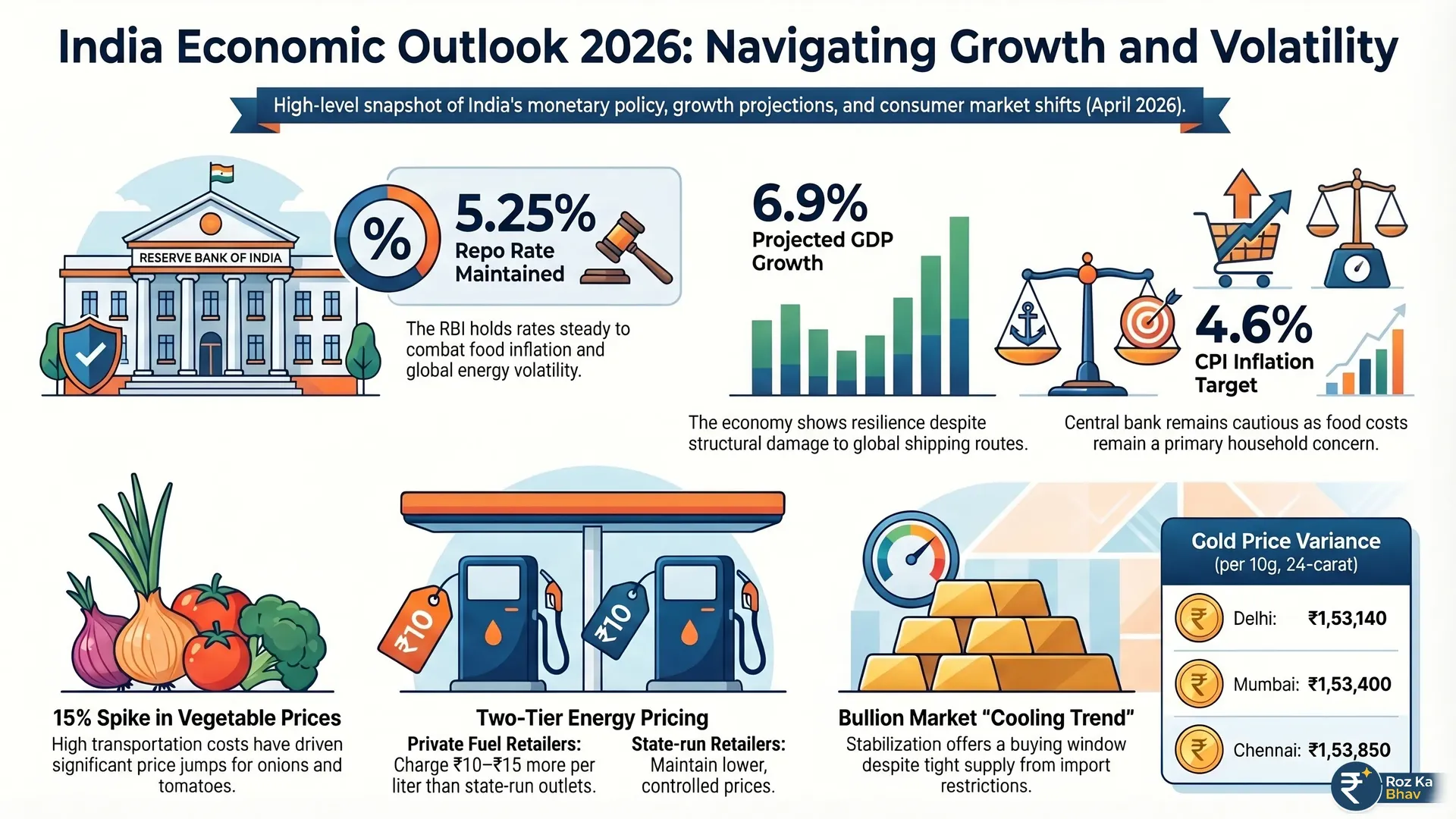
The dust has settled following the Reserve Bank of India’s first monetary policy meeting for the 2026 — 27 fiscal year. For those hoping a rate cut would ease home loan EMIs, the news is a bit disappointing Governor Sanjay Malhotra and the MPC have decided to keep the repo rate steady at 5.25%. This pragmatic move reflects the current climate; although a Middle East ceasefire was recently announced, the “imported inflation” from global energy costs has not fully vanished.
Our tracking indicates that the RBI remains cautious regarding supply-side shocks from the past month. The blockade of the Strait of Hormuz may have ended, but the structural damage to shipping routes continues to impact the Indian crude basket. The central bank’s neutral stance suggests they aren’t ready to declare victory over inflation projecting CPI inflation at 4.6% for the year even if the “kitchen table” reality feels much higher for most families.
1. Bullion Market: Today’s Gold & Silver Trends
2. Energy Watch: Petrol, Diesel, and CNG Updates
3. Kitchen Essentials: Rising Costs of Dairy & Vegetables
4. Frequently Asked Questions
It is not all doom and gloom the economy is still projected to grow by 6.9% this fiscal year a solid rate compared to global peers. However, for residents in Mumbai or Delhi, the growth story is often overshadowed by the rising cost of living. From higher prices at the petrol pump to the increasing cost of a liter of milk, the financial pressure is palpable. Let’s look at the specific data from today’s markets.
Bullion Market Analysis: A Buying Opportunity for Gold?
After weeks of relentless climbing, gold and silver prices have finally hit a plateau. We are seeing a mild decline across major metros today. In Delhi, 24-carat gold is retailing at approximately ₹153,140 per 10 grams, while Chennai leads the charts in the southern markets at ₹153,850.
Silver has also experienced significant volatility. In Mumbai the epicenter of the recent bullion rally silver is trading at roughly ₹2,44,050 per kg. While this figure is staggering compared to last year, it represents a slight softening today. Analysts attribute this correction to a stabilizing US Dollar and easing geopolitical tensions. If you are planning purchases for upcoming festivities, this window may be favorable; however, staggered buying remains the most prudent strategy.
Note: Data based on 2026-04-10.
| City | 24K Gold (per 10g) | Silver (per kg) |
|---|---|---|
| Delhi | ₹1,53,140 | ₹2,43,630 |
| Mumbai | ₹1,53,400 | ₹2,44,050 |
| Chennai | ₹1,53,850 | ₹2,44,760 |
| Bengaluru | ₹1,53,520 | ₹2,44,240 |
Source: NDTV Profit Live Bullion Tracking
Energy Watch: Understanding the Two-Tier Fuel Market
At state-run gas stations in Delhi this morning, petrol was priced at ₹94.77 and diesel at ₹87.67. While prices appear stable on the surface, state-run Oil Marketing Companies (OMCs) are currently absorbing losses to keep rates flat. In contrast, private retailers like Shell or Nayara are charging premiums as high as ₹10 – 15 per liter in certain regions, as they operate on market-linked margins.
Global Brent crude prices are hovering stubbornly near $100 per barrel. Although the ceasefire prevented a spike toward $120, the price floor remains high. This creates a challenge for the government; following previous excise duty cuts, there is limited room for further tax relief within the new fiscal year’s budget goals.
Latest Fuel Rates by City (April 10, 2026)
Note: Data based on 2026-04-10.
| Metro City | Petrol (per Litre) | Diesel (per Litre) |
|---|---|---|
| Delhi | ₹94.77 | ₹87.67 |
| Mumbai | ₹103.54 | ₹90.03 |
| Kolkata | ₹101.45 | ₹89.32 |
| Chennai | ₹100.85 | ₹92.44 |
Kitchen Essentials: Addressing Food Inflation
While gold and petrol dominate the headlines, the primary struggle for many Indian households lies in the dairy and vegetable aisles. milk prices recently surged by about ₹3 per liter in several regions. This is more than a seasonal trend; high fodder costs and rising logistical expenses have forced cooperatives like Amul and Mother Dairy to pass costs to consumers.
Vegetable Prices also remain erratic. While the spring harvest typically cools the market, high transportation costs driven by diesel rates are keeping tomato and onion prices 15% higher than last year. This creates a double whammy: consumers pay more to reach the market and more for the goods they purchase.
Note: Data based on 2026-04-10.
| Product | Avg. Price (Delhi/NCR) | Month-on-Month Change |
|---|---|---|
| Milk (Full Cream, 1L) | ₹72 – ₹74 | +₹3.00 |
| Onion (1kg) | ₹45 – ₹55 | +10% |
| Tomato (1kg) | ₹40 – ₹50 | +12% |
| Potato (1kg) | ₹25 – ₹30 | Stable |
Frequently Asked Questions
This is largely a technical correction. After reaching record highs near ₹1.55 lakh, many investors are booking profits. Additionally, the temporary ceasefire in West Asia has slightly reduced “safe haven” demand, though the long-term outlook remains bullish.
It is unlikely in the short term. Indian state-run OMCs have been absorbing losses for months during peak crude prices. They will likely use this period of relative stability to recover margins rather than passing immediate savings to consumers.
Persistent inflation is the main factor. While core inflation is under control, food inflation specifically in dairy and vegetables remains sticky. The RBI is avoiding a rate cut that could further fuel price increases until CPI numbers show a sustained decline.
Silver currently exhibits more volatility than gold. While demand remains high due to its use in green energy sectors, experts suggest a “buy on dips” approach rather than investing a large sum at once given today’s rates.
Source & Price Verification – Financial Markets
- Gold & Silver Prices: Data referenced from IBJA, MCX India, and international benchmarks.
- Petrol & Diesel Rates: Daily retail prices sourced from Indian Oil, HPCL, and BPCL.
- Commodity Market Data: Verified using MCX, NCDEX, and government statistical releases.
- Verification Process: Prices are cross-checked with at least two independent official or exchange-based sources before publication.
- Disclaimer: Market prices are indicative and may vary by city, tax structure, or intraday volatility.
Note: Prices are updated daily and cross-checked before publishing. If you notice any discrepancy, please email us at [email protected].