

How Today’s Economic Shifts Impact Your Finances
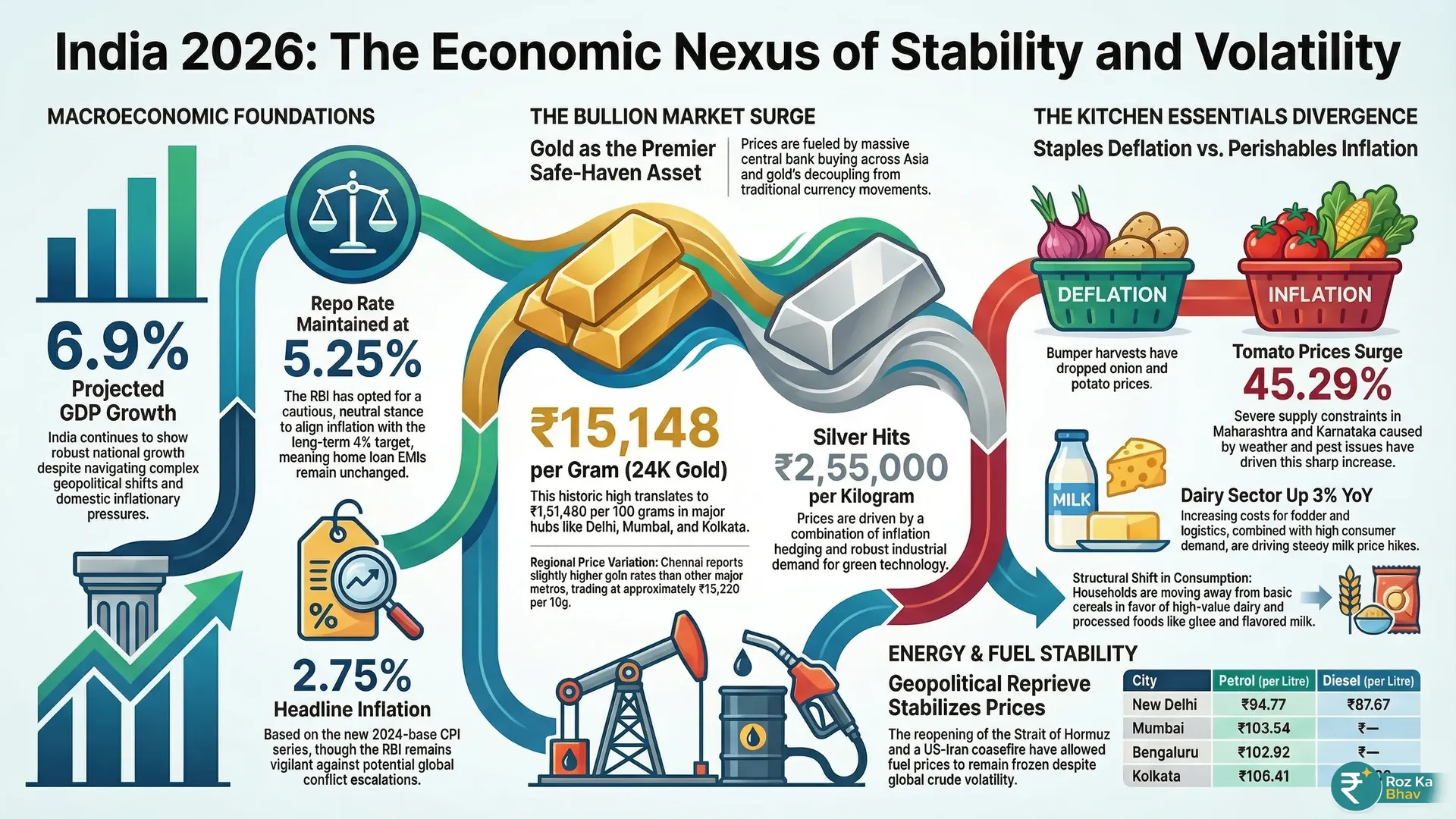
As the trading day begins in Mumbai and Delhi, consumers face a blend of stability and sharp volatility. It is a unique moment for the Indian economy: the Reserve Bank of India (RBI) is maintaining a cautious stance by keeping the repo rate at 5.25%, while household budgets feel the pressure of rising precious metal costs and fluctuating kitchen staples.
The primary driver today is the Hormuz Factor. Following the ceasefire announcement between the US and Iran and the reopening of the Strait of Hormuz global energy markets have started to settle. This provides a vital reprieve for Indian Oil Marketing Companies (OMCs), allowing them to keep petrol and diesel rates frozen. However, West Asian tensions haven’t entirely faded; that lingering uncertainty is precisely what is pushing the bullion market into a frenzy.
Data reflects a structural shift in Indian consumption: spending is moving away from basic cereals toward high-value dairy and processed foods. This trend combined with the RBI’s neutral position suggests that while the economy grows at a projected 6.9%, the road to lower retail prices for the middle class remains challenging. Macro indicators look strong, but the microeconomic level is where most feel the pinch.
Table of Contents
Bullion Market: Gold Prices Reach Record Levels
For those planning investments or jewelry purchases, today’s gold rates are significant. As of April 9, 2026, gold has solidified its role as a safe-haven asset. In Delhi and Mumbai, 24K gold is trading near ₹1,51,480 per 100 grams roughly ₹15,148 per gram. This is a substantial jump from historical averages, and market momentum remains strong.
Silver is also seeing gains, trading at ₹2,55,000 per kilogram. Analysts suggest this surge is driven by industrial demand for green technology and investors hedging against inflation. Interestingly, even with gold’s weight in the new CPI series reduced to 0.6%, its psychological impact on Indian households stays massive.
City-Wise Bullion Rates (April 9, 2026)
Note: Data based on 2026-04-09.
| City | 24K Gold (per 10g) | 22K Gold (per 10g) | Silver (per kg) |
|---|---|---|---|
| Delhi | ₹15,148 | ₹13,885 | ₹2,55,000 |
| Mumbai | ₹15,148 | ₹13,885 | ₹2,55,000 |
| Chennai | ₹15,220 | ₹13,950 | ₹2,58,000 |
| Kolkata | ₹15,148 | ₹13,885 | ₹2,55,000 |
Fuel Prices: Stability Amid Geopolitical Shifts
Commuters have found some relief today. Despite a volatile week for Brent crude, pump prices across India have remained static. This stability follows a ceasefire window in the Middle East that has temporarily secured supply lines through the Strait of Hormuz.
In the national capital, petrol retails at ₹94.77 per litre. Mumbai continues to see higher rates, with petrol priced at ₹103.54. While retail prices are steady today, underlying costs for oil companies remain elevated; prices may be revised once the current two-week negotiation window expires.
Fuel Rates in Major Indian Cities
Note: Data based on 2026-04-09.
| City | Petrol (₹/Litre) | Diesel (₹/Litre) | Status |
|---|---|---|---|
| New Delhi | ₹94.77 | ₹87.67 | Unchanged |
| Mumbai | ₹103.54 | ₹90.03 | Unchanged |
| Kolkata | ₹105.41 | ₹92.02 | Unchanged |
| Bengaluru | ₹102.92 | ₹90.99 | Slight Dip (-0.07) |
For live updates on global energy markets, visit the Business Today Live Fuel Tracker for details on the US-Iran ceasefire impact.
Kitchen Essentials: Tomato Prices Surge While Staples Drop
Local markets are showing a divergence in food costs. Potatoes and onions essential staples have seen year-on-year deflation of over 18% and 28% respectively: a result of effective supply management. However, tomatoes have spiked significantly, with inflation in that category reaching 45%.
Dairy products are also on a gradual climb. As consumer preference shifts toward products like ghee and flavored milk, base milk prices have risen by 3% YoY. This trend is driven by increased fodder and logistics costs reaching the retail level.
Food Inflation Trends (YoY)
Note: Data based on 2026-04-09.
| Item | Price Trend | Inflation Rate (%) |
|---|---|---|
| Potato | Decreasing | -18.46% |
| Onion | Decreasing | -28.20% |
| Tomato | Increasing | +45.29% |
| Milk | Rising | +3.00% |
Economic Outlook: RBI Maintains Repo Rate Stance
RBI Governor Sanjay Malhotra confirmed in the latest MPC briefing that the repo rate will stay at 5.25% until inflation moves toward the 4% target. While the new 2024-base CPI series shows inflation at 2.75%, core pressures in health and education remain above 3%.
For consumers, this means home loan EMIs are unlikely to decrease soon. The RBI’s neutral stance indicates readiness to adjust if global conflicts escalate or if the economy cools. The full RBI MPC April 2026 Policy Statement is available on the Indian Express for detailed GDP projections.
Frequently Asked Questions
1. Why are gold prices so high in India today?
Gold is surging due to global demand and geopolitical uncertainty. Despite the temporary ceasefire, investors are choosing safe-haven assets, pushing prices toward the ₹1.5 lakh per 100g mark.
2. Will petrol prices drop after the Strait of Hormuz reopening?
While the reopening reduces crude oil risk premiums, local prices depend on taxes and exchange rates. A significant drop is unlikely unless global crude stays consistently below $75 – 80.
3. Why are tomato prices rising while onions are cheaper?
Onions and potatoes had a bumper harvest, creating a surplus. Tomatoes are more vulnerable to weather and pests, which has restricted supply from key states like Maharashtra and Karnataka.
4. Is this a good time to apply for a home loan?
With the repo rate at 5.25%, interest rates have stabilized but are not at historic lows. It may be a good time to buy if you find the right property, but immediate rate cuts are not expected.
Source & Price Verification – Financial Markets
- Gold & Silver Prices: Data referenced from IBJA, MCX India, and international benchmarks.
- Petrol & Diesel Rates: Daily retail prices sourced from Indian Oil, HPCL, and BPCL.
- Commodity Market Data: Verified using MCX, NCDEX, and government statistical releases.
- Verification Process: Prices are cross-checked with at least two independent official or exchange-based sources before publication.
- Disclaimer: Market prices are indicative and may vary by city, tax structure, or intraday volatility.
Note: Prices are updated daily and cross-checked before publishing. If you notice any discrepancy, please email us at [email protected].