

Bullion Market Analysis
Energy & Fuel Watch
Kitchen Essentials & Dairy
Analyst Commentary
Frequently Asked Questions
Indian Economy Navigates Geopolitical Headwinds and Agricultural Surplus
As the sun rose over the bustling wholesale markets of Azadpur this morning, the atmosphere felt different. For the first time in months, the frantic bargaining over tomato and onion crates lacked its usual desperation; this is a clear reflection of the broader economic data hitting our desks today. India’s economy is currently a study in contrasts we are witnessing a precious metal fever on one hand and a cooling kitchen stove on the other.
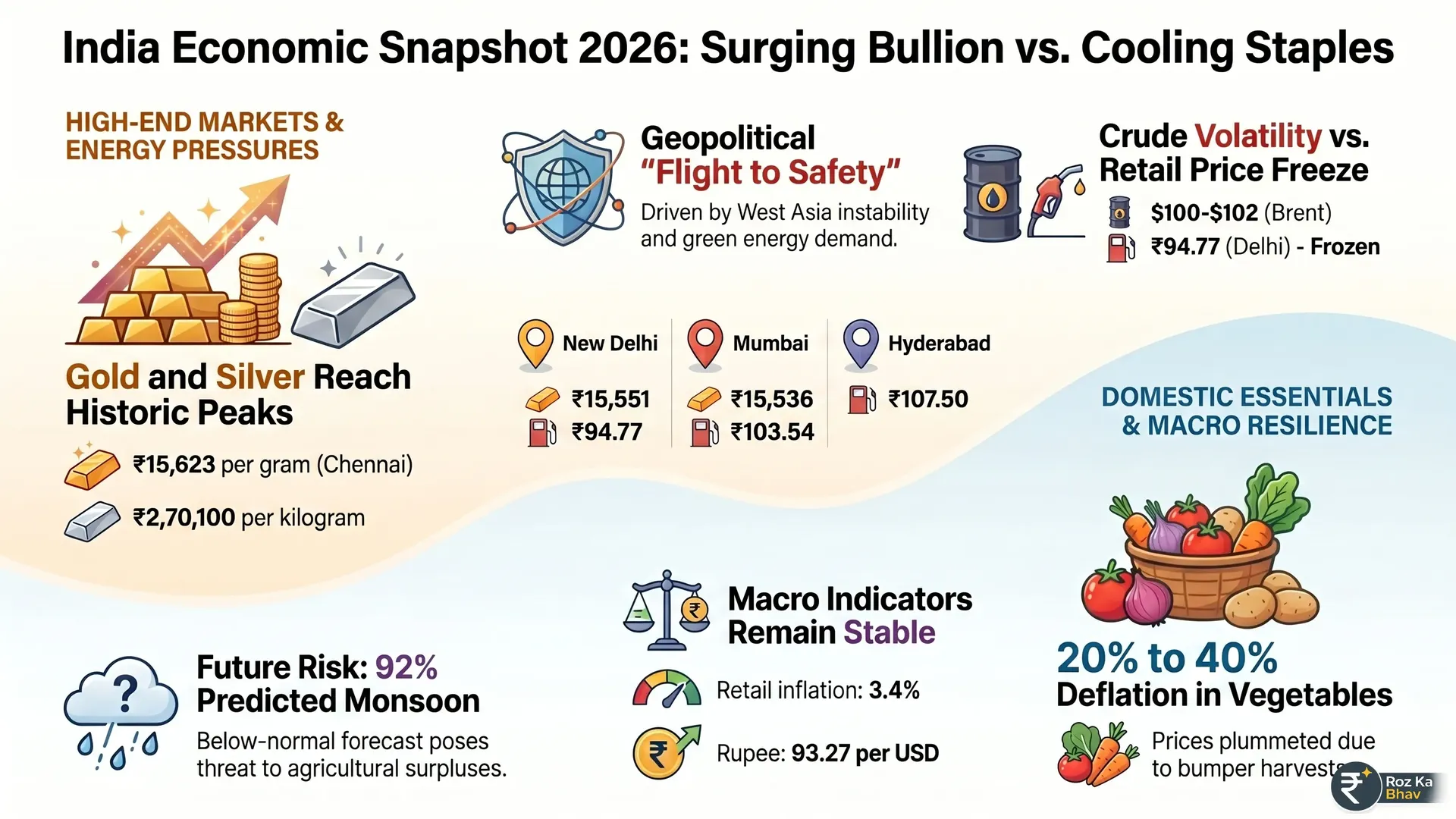
The latest Economic Survey 2025-26 suggests India has managed a remarkable feat recording some of the lowest inflation rates in recent history despite global volatility. However, the shadow of the West Asia conflict looms large. While domestic fuel prices held firm today, the collapse of peace talks has pushed Brent crude toward the $100 mark. This tension is the primary engine behind the surge in gold and silver; investors are dumping riskier assets in favor of the safety of the vault.
What does this mean for the average Indian? It is a mixed bag. Your investment portfolio might be glowing if you hold bullion; however, your travel plans could soon get more expensive if aviation fuel follows the crude spike. Meanwhile, the Rupee has shown resilience appreciating slightly to 93.27 against the US dollar in early trade. This strength is partly due to retreating prices of certain oil blends and a cautious but steady inflow of domestic equity interest.
Bullion Market Update: Gold and Silver Reach Record Levels
If you walked into a jewelry store in Zaveri Bazaar this morning, you likely saw more onlookers than buyers. Gold has officially entered uncharted territory. According to retail market rates, 24-carat gold is trading near ₹15,536 per gram; this is a massive jump that has caught many retail investors off guard. The driver is the classic flight to safety as global uncertainty refuses to simmer down.
Silver is not sitting this one out either. In Mumbai the epicenter of the current metal rally silver is trading at a breathtaking ₹2,70,100 per kilogram. Analysts note that industrial demand for silver in green energy tech is finally merging with its role as a currency hedge; this is creating a perfect storm for price action. Interestingly, the price variance across cities remains narrow though Chennai continues to command a slight premium due to higher local demand and transportation logistics.
Note: Data based on 2026-04-16.
| City | 24K Gold (per gram) | 22K Gold (per gram) | Silver (per kg) |
|---|---|---|---|
| Delhi | ₹15,551 | ₹14,256 | ₹2,55,060 |
| Mumbai | ₹15,536 | ₹14,241 | ₹2,54,890 |
| Chennai | ₹15,623 | ₹14,321 | ₹2,55,600 |
| Kolkata | ₹15,536 | ₹14,241 | ₹2,55,100 |
For those planning a wedding this season, these prices are painful. From an investment perspective, however, the trend remains bullish. The failed talks in West Asia have effectively put a floor under these prices. We do not expect a significant correction unless there is a major breakthrough in international diplomacy. For more detailed city-wise breakdowns, you can visit the latest reporting at Business Today.
Energy Watch: Fuel Prices Steady Amid Global Crude Volatility
Despite the war drums beating in oil-producing regions, Indian OMCs have chosen to keep retail prices unchanged for another day. It is a relief for commuters who were bracing for a hike after Brent crude surged past $102 earlier this week. In the national capital, petrol continues to retail at ₹94.77 per litre while diesel stays at ₹87.67.
However, do not get too comfortable. The blockade of the Strait of Hormuz is more than just a headline; it is a physical bottleneck for the world’s energy supply. While India has diversified its sources, the sheer cost of insurance and shipping for tankers is rising. You might see this reflected first in CNG and commercial LPG prices rather than the petrol at your local pump. In fact, commercial LPG is already holding at a steep ₹2,078 in many regions.
Current City-Wise Fuel Rates (April 16, 2026)
Note: Data based on 2026-04-16.
| City | Petrol (per Litre) | Diesel (per Litre) | CNG (per Kg) |
|---|---|---|---|
| New Delhi | ₹94.77 | ₹87.67 | ₹77.09 |
| Mumbai | ₹103.54 | ₹90.03 | ₹80.50 |
| Bangalore | ₹102.92 | ₹90.99 | ₹88.95 |
| Hyderabad | ₹107.50 | ₹95.70 | ₹97.00 |
The Rupee’s slight appreciation this morning has provided a small cushion for importers. But as any seasoned economist will tell you the lag between global crude spikes and Indian pump prices is usually a matter of weeks, not months. If the Strait of Hormuz remains blocked, we are looking at a very different table by early May. For the most recent updates on the global crude impact, see the detailed analysis on The Sunday Guardian.
Kitchen Essentials: Vegetable Prices Drop as Dairy Remains Firm
The horticultural contraction mentioned in the latest Economic Survey is delivering real results. Prices for potatoes, onions, tomatoes, and garlic have fallen between 20% and 40% in many regions. This is primarily due to a bumper harvest and improved supply chain logistics that have finally reduced the farm-to-fork wastage that plagued markets in 2024.
While vegetables are cheaper, the dairy sector is behaving differently. Milk and dairy products have seen a stable but firm inflation rate of around 2.6%. This is a global trend; the FAO Dairy Price Index recently saw its first increase in months. In India, a seasonal decline in milk supply as we move into hotter months is keeping prices from following the downward trend of the veggie basket.
Retail Market Trends for Essential Commodities
Note: Data based on 2026-04-16.
| Product Category | Price Trend (MoM) | Market Outlook |
|---|---|---|
| Vegetables (Onion/Tomato) | -25% to -40% | Significant Relief |
| Milk & Dairy Products | +2.6% (Stable) | Seasonal Pressure |
| Edible Oils | Moderate Increase | Affected by Global Trade |
| Protein (Meat/Eggs) | Slight Recovery | Stabilizing Demand |
The drop in Vegetable Prices is the main reason the CPI has not exploded. While cereals and pulses see a marginal uptick, the massive cooling in the TOP category Tomato, Onion, and Potato is doing the heavy lifting for the middle-class budget. However, we must keep an eye on the IMD forecast; they are predicting a below-normal monsoon at 92% of the Long Period Average which could change the story by the next planting season.
Economic Outlook: Expert Financial Commentary
Based on current exchange data and the latest prints from the NSO, India’s headline inflation inched up to 3.4% in March. While that is an increase, it remains remarkably benign compared to the 6.7% seen just a few years ago. The government’s decision to reduce basic customs duty on edible oil has also helped moderate price hikes since late 2025.
The primary risk to the Indian economy right now isn’t domestic, notes a senior analyst at ICRA; it is the transmission of global energy shocks into the local food chain. If freight costs continue to rise because of West Asian tensions the relief we see in vegetable prices could be swallowed by transportation costs. We are seeing this play out in the food away from home segment, where restaurant charges are beginning to creep up due to higher commercial LPG costs.
Frequently Asked Questions (FAQ)
1. Why is gold so expensive in India today?
Gold prices are hitting record highs due to global geopolitical instability, specifically the conflict in West Asia. When international markets are volatile, investors buy gold as a safe-haven asset; this drives up the price globally and in India.
2. Will petrol prices increase soon?
While domestic prices are currently stable, there is an upside risk. If Brent crude stays above $100 per barrel for an extended period, OMCs may eventually pass that cost on to consumers.
3. Why are vegetable prices falling while other items are expensive?
India has seen a bumper harvest for horticultural crops like onions and tomatoes this season. This surplus supply in wholesale markets has led to a 20-40% drop in retail prices even as global factors keep electronics or metals expensive.
4. How is the Indian Rupee performing against the Dollar?
The Rupee has been relatively stable trading around 93.27. It is being supported by lower-than-expected oil import bills in certain sectors and a generally weakening US dollar index.
Source & Price Verification – Financial Markets
- Gold & Silver Prices: Data referenced from IBJA, MCX India, and international benchmarks.
- Petrol & Diesel Rates: Daily retail prices sourced from Indian Oil, HPCL, and BPCL.
- Commodity Market Data: Verified using MCX, NCDEX, and government statistical releases.
- Verification Process: Prices are cross-checked with at least two independent official or exchange-based sources before publication.
- Disclaimer: Market prices are indicative and may vary by city, tax structure, or intraday volatility.
Note: Prices are updated daily and cross-checked before publishing. If you notice any discrepancy, please email us at [email protected].