

Navigating the current Indian market environment requires a sharp eye on both macroeconomic global indices and local supply-chain realities. As global trade dynamics shift and domestic consumption patterns evolve, everyday commodities: ranging from the gold in your locker to the milk in your morning tea; continue to experience notable pricing pressures. Financial analysts at Dalal Street and commodity exchanges across Mumbai and Delhi are closely monitoring these trends to forecast mid-term inflation trajectories.
What this means for your wallet is an ongoing need for agile financial planning. Whether you are looking to purchase precious metals for upcoming festive seasons, manage daily fuel commuting expenditures, or balance your monthly grocery bills, staying informed is your greatest asset. Let us break down the numbers across the bullion, energy, and kitchen commodity sectors to provide you with actionable intelligence.
Bullion Market: Gold and Silver Analysis
Precious metals have always held a sacred place in Indian household investments and cultural portfolios. Today, the bullion market is displaying measured stability following a week of high volatility driven by international currency fluctuations and shifting US Federal Reserve rate expectations. Domestic buyers are observing cautious market movements as jewelers prepare for the upcoming wedding and festive buying cycles.
Market analysts note that gold futures on the Multi Commodity Exchange (MCX) are consolidating near crucial support levels. Investors are balancing safe-haven asset accumulation against rising equity market participation. Meanwhile, industrial demand for silver continues to provide strong fundamental backing, preventing any steep correction in silver bullion valuations.
Note: Data based on 2026-07-30.
City-Wise Bullion Breakdown
In major trading hubs like Mumbai and Ahmedabad, gold rates remain competitive due to deep liquidity and high wholesale bullion movement. Conversely, southern markets such as Chennai and Bengaluru report a slight retail premium driven by sustained physical demand for temple jewelry and coin investments. Retail consumers are advised to verify hallmarking standards: specifically HUID numbers: before finalizing any purchases.
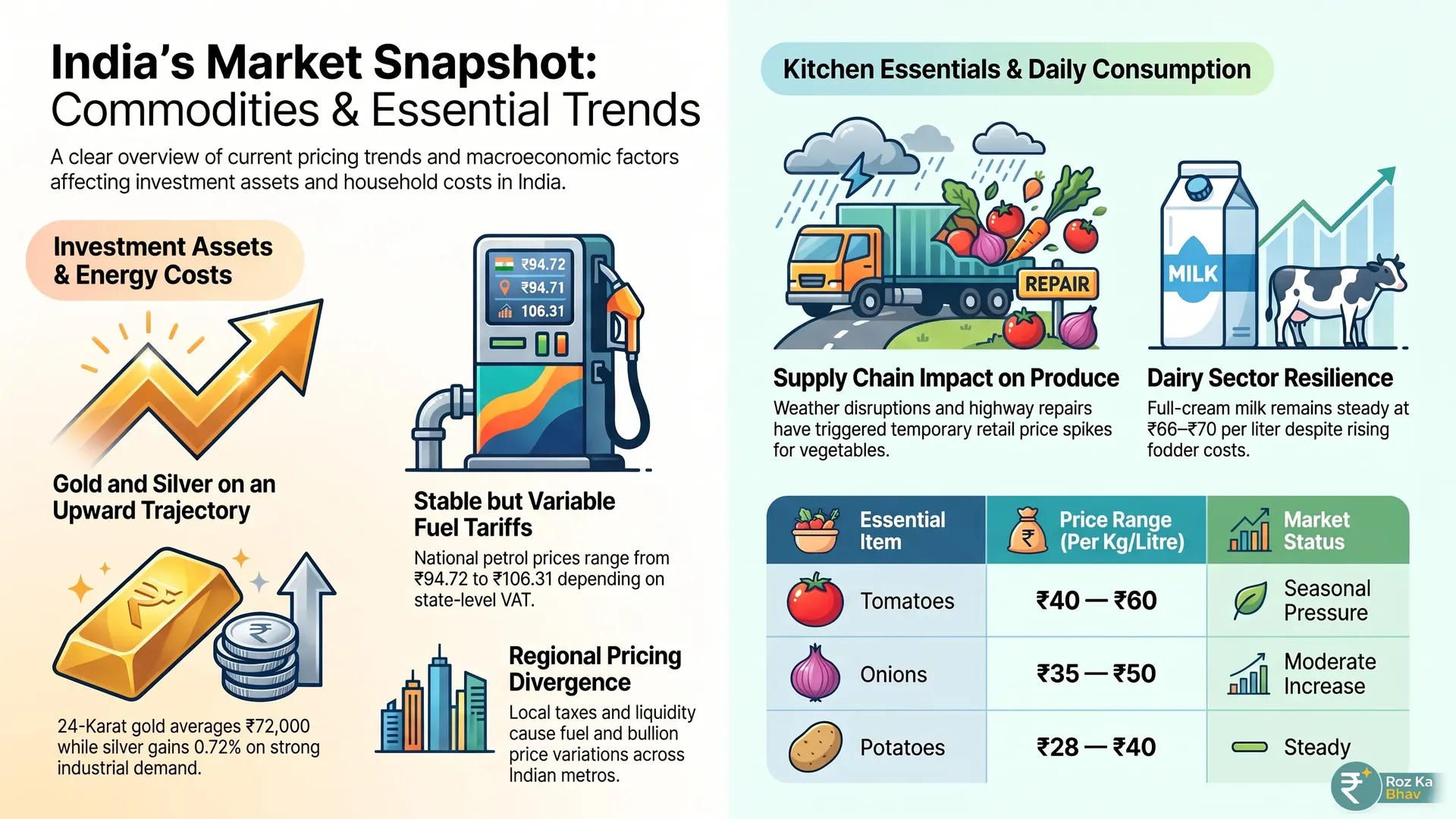
Energy Watch: Petrol, Diesel, and CNG Trends
The energy sector continues to be a cornerstone of retail inflation tracking across India. Retail fuel prices for petrol and diesel remain largely static across national capital regions and state capitals, reflecting a steady state pricing mechanism managed by public sector oil marketing companies. Global crude oil benchmarks; Brent and WTI; are hovering within comfortable bands, offering temporary relief to domestic logistics and transportation sectors.
At the same time, Compressed Natural Gas (CNG) adoption continues to surge among commercial fleet operators and private vehicle owners alike. Urban centers are prioritizing cleaner transit options, leading to state-level subsidies and infrastructure expansions that keep alternative fuel pricing stable despite fluctuating gas import costs.
Note: Data based on 2026-07-30.
Urban Fuel Price Divergence
While central tax components remain uniform, state-level Value Added Tax (VAT) creates noticeable divergences. For instance, Delhi maintains lower fuel tariffs due to tax rationalization, whereas cities like Mumbai and Hyderabad record higher retail rates due to elevated municipal and state levies. Commuters utilizing app-based cab services or personal vehicles must account for these regional variances when mapping out monthly transportation budgets.
Kitchen Essentials: Vegetable and Dairy Price Metrics
Everyday household budgeting is heavily dictated by the shifting tides of kitchen commodities. Vegetable pricing this season has experienced localized volatility due to unseasonal weather patterns in key agricultural belts across Maharashtra, Uttar Pradesh, and Madhya Pradesh. Staple vegetables like onions, potatoes, and tomatoes are seeing moderate upward price pressure at wholesale mandis, which directly translates to higher retail costs in neighborhood markets.
On the dairy front, major cooperatives and private suppliers maintain steady pricing structures, though input costs for cattle feed and fodder continue to challenge small-scale dairy farmers. Milk supplies remain robust, ensuring that essential dairy products like curd, paneer, and butter remain readily accessible across all retail tiers.
Note: Data based on 2026-07-30.
Regional Mandi Insights
In wholesale agricultural markets such as Azadpur Mandi in Delhi and Vashi Market in Navi Mumbai, supply arrivals are currently matching daily consumption demands. However, logistics disruptions caused by highway repairs and localized rainfall have introduced minor delays, causing temporary spot price spikes in select residential zones. Consumer advocates recommend purchasing seasonal produce directly from farmer-producer markets to optimize monthly grocery expenses.
Frequently Asked Questions
1. Why are gold and silver prices fluctuating in the Indian market?
Precious metal prices in India are heavily influenced by international spot rates, foreign exchange fluctuations between the US Dollar and the Indian Rupee, and domestic festive or wedding season demand. Global economic indicators and central bank interest rate decisions also play a vital role.
2. Are retail petrol and diesel prices expected to drop soon?
While international crude oil prices have remained relatively stable, domestic retail fuel rates depend heavily on government policy adjustments, excise duty revisions, and state-level VAT structures. Currently, oil marketing companies are maintaining status quo pricing.
3. What is causing the recent price hike in staple vegetables?
Vegetable Prices often experience seasonal volatility due to weather anomalies, crop yield variations in major agricultural states, and transit logistics challenges from wholesale mandis to retail outlets.
4. How can I track daily commodity price updates in India?
You can track verified daily commodity rates through official exchange portals like the Multi Commodity Exchange (MCX), government agricultural market committees (e-NAM), and financial updates provided by reputable market journalists.
Source & Price Verification – Financial Markets
- Gold & Silver Prices: Data referenced from IBJA, MCX India, and international benchmarks.
- Petrol & Diesel Rates: Daily retail prices sourced from Indian Oil, HPCL, and BPCL.
- Commodity Market Data: Verified using MCX, NCDEX, and government statistical releases.
- Verification Process: Prices are cross-checked with at least two independent official or exchange-based sources before publication.
- Disclaimer: Market prices are indicative and may vary by city, tax structure, or intraday volatility.
Note: Prices are updated daily and cross-checked before publishing. If you notice any discrepancy, please email us at support@rozkabhav.com.
