

Quick Summary: Indian commodity markets are experiencing mixed movements today driven by global macroeconomic shifts and domestic supply adjustments. While bullion prices fluctuate near critical resistance levels, energy commodities remain stable. Meanwhile, seasonal vegetable arrivals are offering temporary relief to retail inflation in major metropolitan hubs across the country.
As the Indian economy navigates through mid-year fiscal currents, commodity markets are reacting dynamically to a blend of international geopolitical tensions, shifting currency valuations, and changing domestic agricultural outputs. For the everyday consumer and seasoned investor alike, tracking these metrics is vital. What this means for your wallet is an ongoing balancing act between rising asset valuations and fluctuating daily living expenses. Market analysts at Dalal Street and leading commodities desks are closely monitoring these indicators to forecast consumer trends for the upcoming quarter with particular attention to institutional cash flows, agricultural mandi arrivals, and central bank reserve allocations.
Table of Contents
Bullion Market: Gold and Silver Analysis
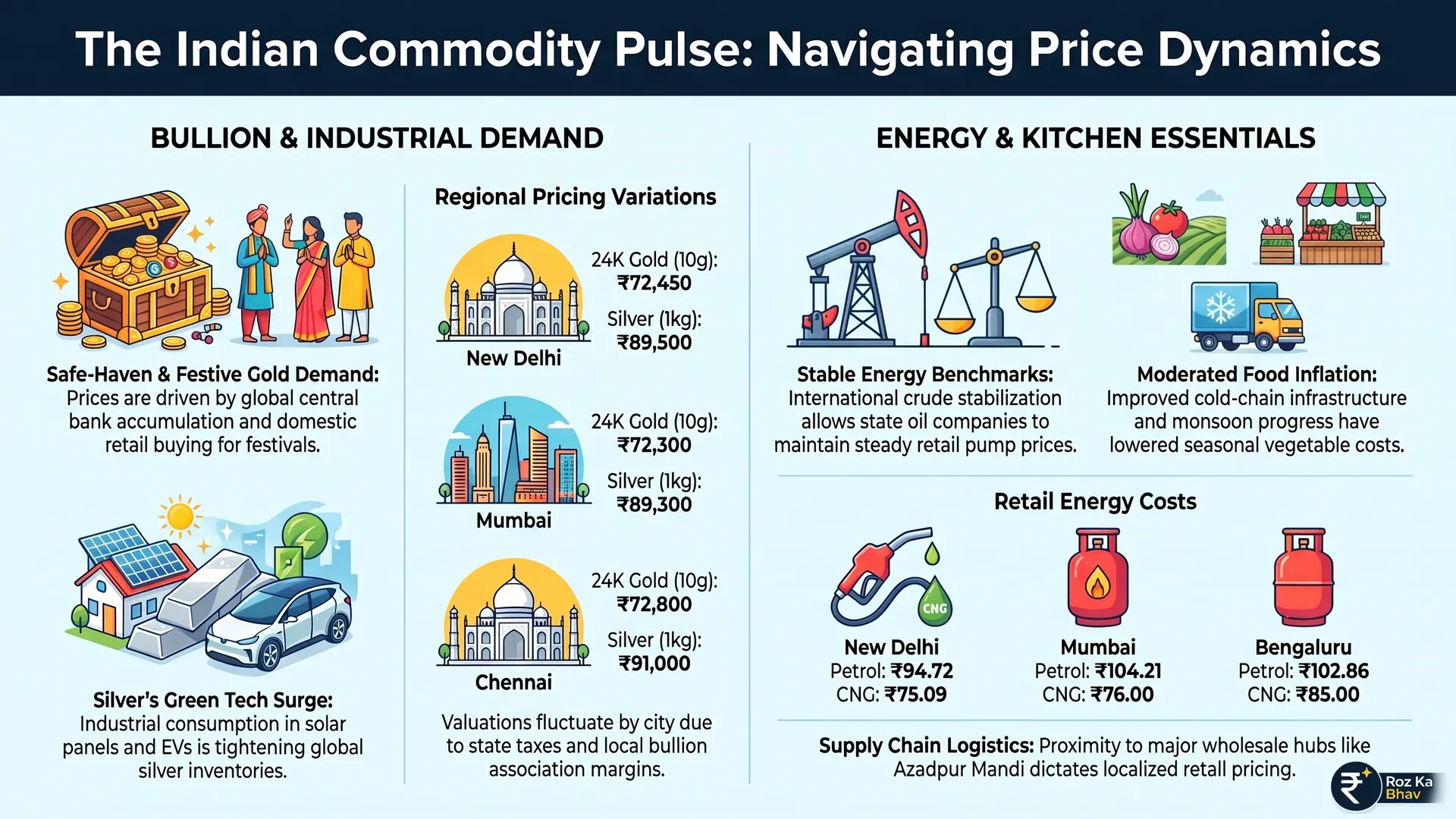
The domestic bullion market is currently navigating a period of high volatility, heavily influenced by global safe-haven buying and fluctuations in the US dollar index. Gold prices have seen steady traction, drawing support from persistent institutional demand and ongoing retail buying ahead of upcoming cultural and festive seasons alongside sustained purchases by central banks looking to diversify their currency reserves.
Silver, known for its dual identity as both a precious metal and an industrial commodity, is tracking broader industrial manufacturing metrics. Analysts suggest that increased consumption in green energy sectors particularly solar panel manufacturing and electric vehicle components is putting a strong structural floor under silver valuations while tightening physical market inventories nationwide.
City-Wise Precious Metals Snapshot
Retail gold and silver rates vary slightly across India due to local state taxes, transportation overheads, and bullion association margins. Below is a comparative overview of current baseline rates across major metropolitan centers:
Note: Data based on 2026-08-01.
| City | Gold (24K per 10g) | Gold (22K per 10g) | Silver (per 1kg) |
|---|---|---|---|
| New Delhi | ₹72,450 | ₹66,400 | ₹89,500 |
| Mumbai | ₹72,300 | ₹66,250 | ₹89,300 |
| Chennai | ₹72,800 | ₹66,700 | ₹91,000 |
| Kolkata | ₹72,300 | ₹66,250 | ₹89,300 |
Market analysts note that while short-term corrections are entirely possible given the rapid nature of recent global rallies, long-term investor sentiment remains fundamentally bullish. Investors are advised to utilize systematic investment strategies rather than attempting to time short-term market peaks, utilizing portfolio allocation frameworks tailored for inflationary hedging.
Energy Watch: Petrol, Diesel, and CNG Trends
Energy security and retail fuel pricing remain central pillars of the domestic macroeconomic landscape. Crude oil benchmarks have seen moderate stabilization in international markets, providing a comfortable cushion for state-run oil marketing companies (OMCs). Despite minor oscillations in Brent crude, retail pump prices for petrol and diesel across major cities have largely held steady providing much-needed relief to logistics and transport sectors while containing systemic freight inflation.
In parallel, the expansion of the City Gas Distribution (CGD) network continues to drive adoption rates for Compressed Natural Gas (CNG) and Piped Natural Gas (PNG). Urban commuters shifting toward cleaner alternative fuels are benefiting from stable pricing matrices regulated by domestic supply allocations which help mitigate urban commuter cost pressures in rapidly growing urban centers.
Metropolitan Fuel Price Breakdown
Pump rates for standard fossil fuels across key urban locations continue to reflect tax structures implemented by respective state governments:
Note: Data based on 2026-08-01.
| City | Petrol (per Litre) | Diesel (per Litre) | CNG (per Kg) |
|---|---|---|---|
| New Delhi | ₹94.72 | ₹87.62 | ₹75.09 |
| Mumbai | ₹104.21 | ₹92.15 | ₹76.00 |
| Bengaluru | ₹102.86 | ₹88.94 | ₹85.00 |
| Chennai | ₹100.75 | ₹92.34 | ₹82.50 |
Experts from the energy sector emphasize that maintaining domestic fuel price stability is crucial for keeping inflation figures within the Reserve Bank of India’s target band. Any unexpected spike in international crude values could test this equilibrium in the upcoming quarters; prompting potential fiscal policy adjustments by central authorities.
Kitchen Essentials: Vegetable and Dairy Price Dynamics
For households across India, the state of the local vegetable market and dairy sector dictates weekly budgeting reality. Recent data from key agricultural mandis indicates a seasonal moderation in Vegetable Prices. Improved supply chain logistics, better cold-chain storage facilities, and steady monsoon progression in key agricultural belts have helped smoothen out erratic price spikes seen in previous seasons ensuring broader retail stability across municipal markets.
However, select perishables like onions, tomatoes, and potatoes continue to display micro-volatility depending on regional harvest yields. Meanwhile, the dairy sector remains resilient, with cooperative federations and private players maintaining steady milk procurement prices while absorbing rising feed costs to protect consumer interests balancing dairy farmer yields against urban household expectations.
Regional Retail Trends for Household Staples
Monitoring regional retail pricing helps households and small businesses plan inventory and daily procurement efficiently. Below is an overview of estimated average retail rates for vital kitchen items:
- Tomatoes (per kg): Ranging between ₹30 to ₹50 depending on the proximity to major wholesale hubs like Azadpur Mandi in Delhi or Vashi in Mumbai.
- Onions (per kg): Stable between ₹35 to ₹55, supported by buffer stock releases from central warehousing agencies.
- Potatoes (per kg): Averaging a steady ₹25 to ₹40 across most northern and western markets.
- Fluid Milk (Full Cream, per Litre): Holding firm at ₹66 to ₹70 across major brands like Amul and Mother Dairy.
Agricultural economists stress that building long-term climate-resilient farming techniques and expanding localized warehousing infrastructure will be critical steps in completely subduing seasonal inflationary spikes in food products safeguarding consumer purchasing power against unexpected weather disruptions.
Frequently Asked Questions (FAQ)
1. Why do gold prices vary across different cities in India?
Gold prices differ from city to city due to local state taxes, transportation charges, logistics costs, and local bullion association trade margins.
2. Are petrol and diesel prices expected to change soon?
Retail fuel prices are managed by state-run oil marketing companies. While global crude oil prices remain stable, retail rates are expected to hold steady unless significant international market shifts occur.
3. What is driving the recent stabilization in vegetable prices?
Better supply chain management, improved transport logistics, timely monsoon distribution across key agricultural zones, and strategic government buffer stock releases have all contributed to stabilizing vegetable prices.
4. How can I track daily commodity price updates reliably?
You can track verified commodity data through official multi-commodity exchange (MCX India) portals, banking advisory reports, and financial market news updates.
Source & Price Verification – Financial Markets
- Gold & Silver Prices: Data referenced from IBJA, MCX India, and international benchmarks.
- Petrol & Diesel Rates: Daily retail prices sourced from Indian Oil, HPCL, and BPCL.
- Commodity Market Data: Verified using MCX, NCDEX, and government statistical releases.
- Verification Process: Prices are cross-checked with at least two independent official or exchange-based sources before publication.
- Disclaimer: Market prices are indicative and may vary by city, tax structure, or intraday volatility.
Note: Prices are updated daily and cross-checked before publishing. If you notice any discrepancy, please email us at support@rozkabhav.com.
