

As the sun rose over Mumbai’s Dalal Street this Thursday, a palpable sense of wait-and-watch filled the air. We are witnessing a fascinating if slightly concerning tug-of-war between domestic resilience and global volatility. The primary story today isn’t defined by a single number; rather, it’s how the average Indian household navigates a landscape where the Reserve Bank of India (RBI) plays defense against rising oil prices and geopolitical friction.
The reality is that US-Iran-Israel tensions have moved beyond the headlines they have physically manifested in gold shops and on commodity boards. Market tracking indicates that while broader indices like the Nifty and Sensex are holding their ground, the real movement is occurring in the invisible markets: diesel logistics, milk prices, and the premium on physical gold. Let’s break down exactly what is happening and, more importantly, why it matters to you.
Table of Contents
Bullion Market: Gold & Silver Analysis
Energy Watch: Petrol, Diesel & CNG Rates
Kitchen Essentials: Vegetable & Dairy Trends
Macro View: RBI Strategy and the Repo Rate
Frequently Asked Questions
The Bullion Market: Gold’s Unstoppable Ascent
For those planning a wedding this season, the news is challenging. Gold prices remain stubbornly high, refusing to relinquish the gains made earlier this month. Today, 24K gold is trading near ₹1,49,148 per 10 grams across most major metros. While we observed a minor dip of about 0.4% from the ₹1.55 lakh peak reached earlier in April, the correction buyers were hoping for has not materialized.
Silver often described as the poor man’s gold is also showing strength, holding steady at approximately ₹2.50 lakh per kilogram. Although silver has been the quieter of the two metals lately, industrial demand within India’s growing EV sector is providing a solid floor for its price. Here is a look at the rates across the country today:
Note: Data based on 2026-04-30.
| City | 24K Gold (10g) | 22K Gold (10g) | Silver (1kg) |
|---|---|---|---|
| New Delhi | ₹1,49,148 | ₹1,36,719 | ₹2,50,000 |
| Mumbai | ₹1,49,148 | ₹1,36,719 | ₹2,50,000 |
| Chennai | ₹1,50,218 | ₹1,37,600 | ₹2,55,000 |
| Kolkata | ₹1,49,148 | ₹1,36,719 | ₹2,50,000 |
The implications are straightforward: investors are likely seeing green in their portfolios, but consumers are feeling the pressure. Current exchange data suggests the rupee’s slight depreciation against the dollar is making imports even costlier. You can find detailed daily breakdowns at
GoodReturns or review the latest bullion trends via
The Sunday Guardian.
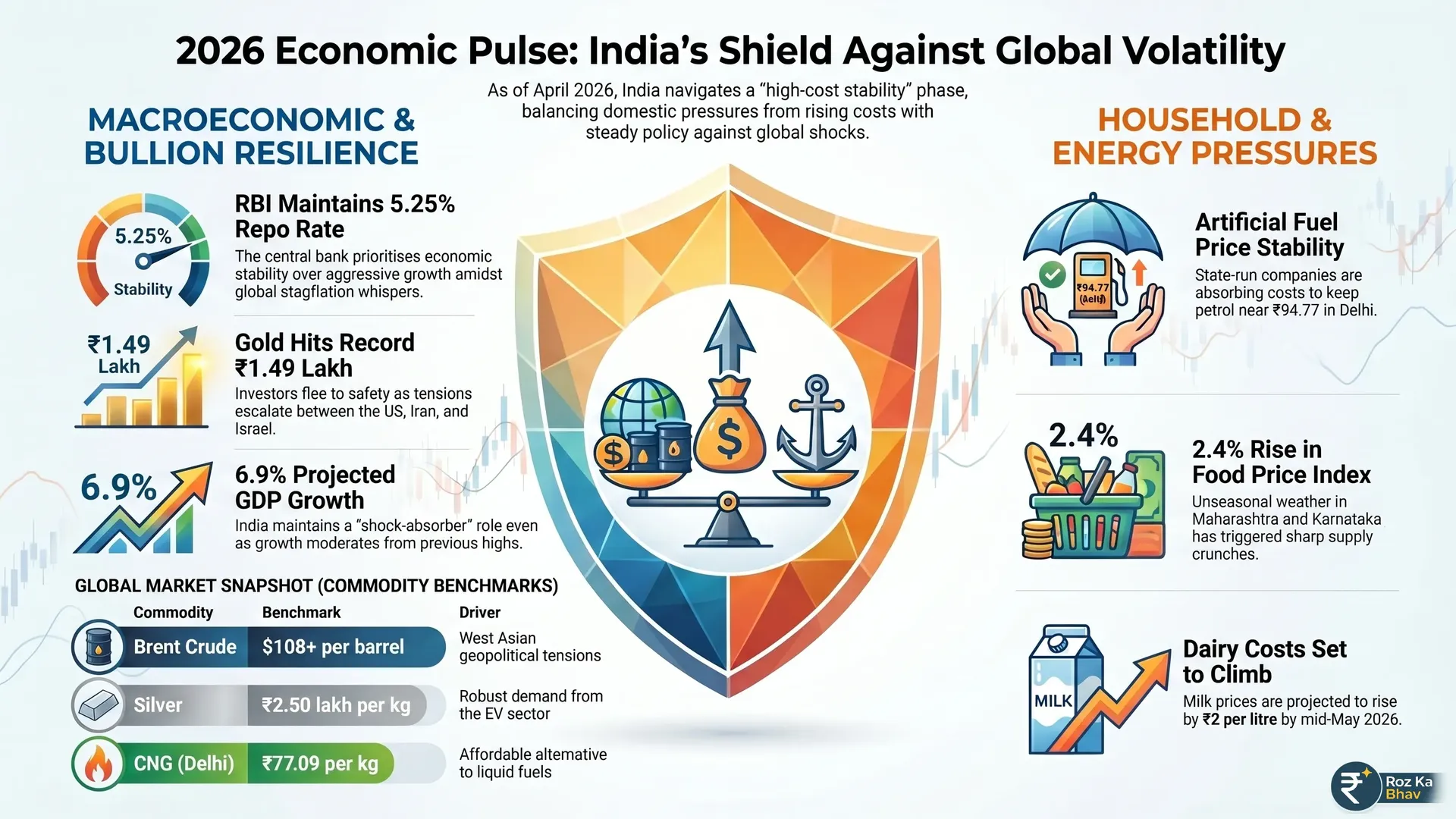
Energy Watch: The “Silent” Pump Prices
Despite massive turmoil in the Middle East pushing Brent Crude above $100, retail prices at the pump remain remarkably stable. As of April 30, petrol in Delhi is priced at ₹94.77 per liter. Diesel the lifeblood of the transport and logistics industry sits at ₹87.67 per liter.
This stability is largely due to state-run oil marketing companies absorbing costs to prevent a sudden inflation spike. However, if the regional conflict escalates or shipping blockades persist, these frozen prices may melt away. Already, cities like Bhubaneswar and Patna have seen marginal increases of 10 to 20 paise today; such small nudges often precede larger shifts.
City-Wise Fuel Rates
Note: Data based on 2026-04-30.
| City | Petrol (per L) | Diesel (per L) | CNG (per kg) |
|---|---|---|---|
| New Delhi | ₹94.77 | ₹87.67 | ₹77.09 |
| Mumbai | ₹103.54 | ₹90.03 | ₹81.00 |
| Chennai | ₹100.84 | ₹92.39 | ₹91.50 |
| Hyderabad | ₹107.46 | ₹96.26 | ₹94.69 |
For those driving CNG vehicles, the outlook is slightly better. Prices in Delhi remain the lowest in the country at ₹77.09, providing relief to taxi and auto-rickshaw drivers struggling with the rising cost of living. For live updates,
LiveMint’s daily tracker serves as a reliable source for real-time data.
Kitchen Essentials: The Real Inflation Story
Inflation feels most personal at the grocery store. While gold purchases are occasional, milk, tomatoes, and onions are daily necessities. The Food and Agriculture Organization (FAO) recently noted a 2.4% rise in the global food price index, which is now rippling through Indian mandis. Vegetable Prices have been volatile: unseasonal weather in early April damaged crops in parts of Maharashtra and Karnataka, leading to supply crunches in the north.
The dairy sector faces similar challenges. The cost of fodder and logistics has pushed major cooperatives to consider another marginal price hike. While full-cream milk remains around ₹66 – ₹68 per liter in most metros, there is talk of a ₹2 increase arriving by mid-May.
Current Mandi Prices (Averages)
- Onions: ₹35 – ₹45 per kg (varies by quality)
- Tomatoes: ₹40 – ₹60 per kg (sharp rise in Delhi-NCR)
- Potatoes: ₹25 – ₹30 per kg (stable)
- Milk (1L): ₹66 (Mother Dairy / Amul)
Macro View: RBI Plays the Long Game
Governor Sanjay Malhotra and the Monetary Policy Committee (MPC) have maintained a clear stance: the repo rate remains at 5.25%. While the committee aims to support growth projected to moderate to 6.9% this fiscal year they cannot ignore inflation risks posed by the West Asia conflict.
The RBI is currently in wait-and-watch mode. Cutting rates now to boost the economy could risk devaluing the rupee and making oil imports even more expensive; it is a classic catch-22. This represents one of the most cautious RBI positions seen in the last decade. For a deeper dive into policy highlights, visit the
Times of India’s live blog.
Frequently Asked Questions
1. Is this a good time to buy gold in India?
With prices near ₹1.5 lakh, it remains a gamble. If Middle East tensions cool, we could see a correction toward ₹1.4 lakh. However, if conflict escalates, ₹1.6 lakh is possible. Most experts suggest staggered buying rather than a lump sum investment right now.
2. Why are petrol prices not rising if global oil is over $100?
This is a combination of government-directed price stability and oil companies utilizing previous profit buffers. This cannot last indefinitely; if crude remains high, expect a slow, staggered increase in retail prices over the coming weeks.
3. Will my home loan EMIs go down anytime soon?
It is unlikely. Since the RBI kept the repo rate unchanged at 5.25%, most banks will maintain current lending rates. Significant rate cuts are not expected until later in 2026, contingent on inflation behavior.
4. Why is milk getting more expensive?
A mix of higher fodder costs, rising transportation fees, and a seasonal dip in procurement is driving prices up. Dairy cooperatives are under pressure to pay farmers more to compensate for their own rising operational costs.
In conclusion, the Indian economy is demonstrating its shock-absorber qualities. While much of the world feels the heat, domestic policy is keeping things steady for now. Whether you are reviewing your portfolio or your grocery bill, the theme for April 2026 is clearly stability at a high cost.
Source & Price Verification – Financial Markets
- Gold & Silver Prices: Data referenced from IBJA, MCX India, and international benchmarks.
- Petrol & Diesel Rates: Daily retail prices sourced from Indian Oil, HPCL, and BPCL.
- Commodity Market Data: Verified using MCX, NCDEX, and government statistical releases.
- Verification Process: Prices are cross-checked with at least two independent official or exchange-based sources before publication.
- Disclaimer: Market prices are indicative and may vary by city, tax structure, or intraday volatility.
Note: Prices are updated daily and cross-checked before publishing. If you notice any discrepancy, please email us at [email protected].